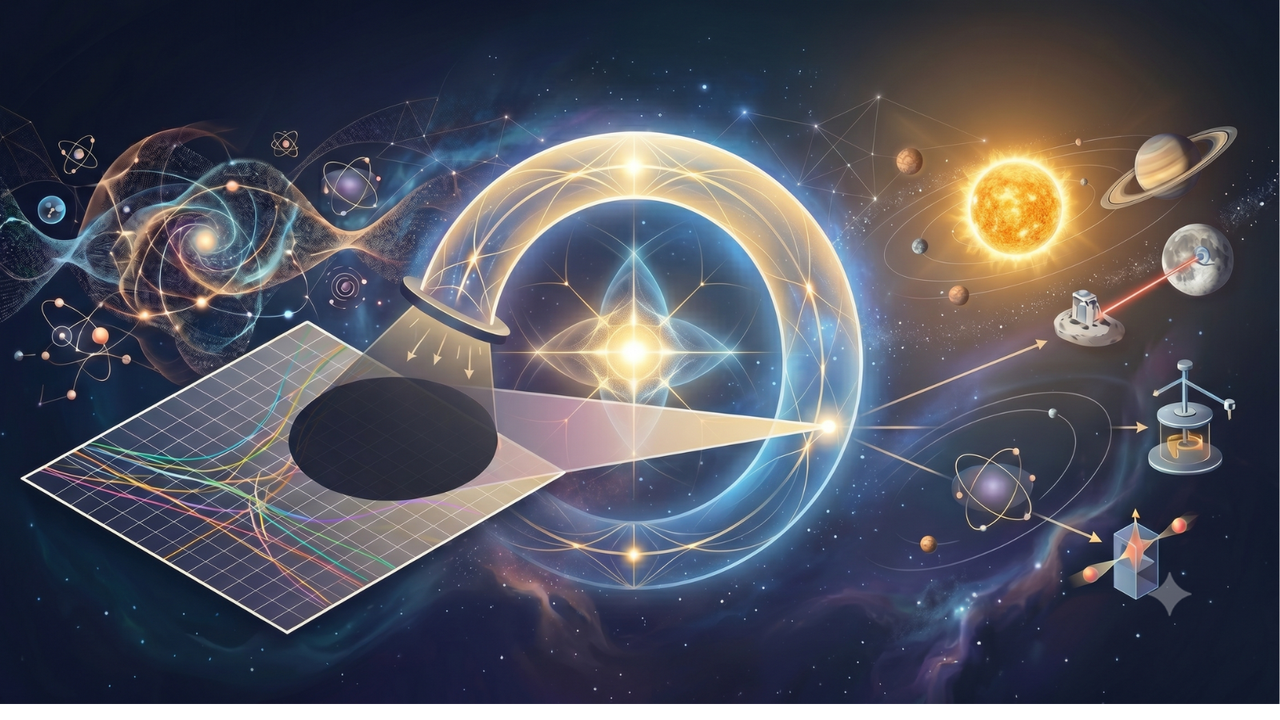
Physicists working on quantum gravity theory believe they may have found a path toward discovering a fifth fundamental force of nature. Currently, scientists recognize four fundamental forces: gravity, electromagnetism, and the strong and weak nuclear forces. A breakthrough in quantum gravity research suggests that unifying gravity with quantum mechanics could reveal entirely new physics beyond our current understanding.
The challenge lies in reconciling Einstein's general relativity, which describes gravity at large scales, with quantum mechanics, which governs the subatomic realm. These two pillars of modern physics remain fundamentally incompatible in their current forms. Quantum gravity frameworks attempt to bridge this gap by describing gravity as a quantized field, similar to how other fundamental forces operate.
Researchers propose that once physicists develop a consistent quantum gravity theory, it could naturally predict additional forces or particles not yet observed. This hidden fifth force might explain longstanding mysteries in physics, such as dark matter or dark energy, which comprise 95 percent of the universe but remain poorly understood. The new framework offers a mathematical structure that treats all fundamental interactions on equal footing, potentially revealing new symmetries and conservation laws.
Several approaches to quantum gravity exist, including string theory, loop quantum gravity, and asymptotic safety. Each proposes different mechanisms for quantizing spacetime itself. The researchers behind this work believe their framework provides a more systematic way to search for physics beyond the Standard Model.
However, significant obstacles remain. Quantum gravity effects typically occur at the Planck scale, an incredibly small distance where direct experimental observation proves nearly impossible with current technology. This means any fifth force would likely manifest only under extreme conditions or through indirect signatures in particle collider experiments or cosmological observations.
The work represents theoretical progress rather than experimental confirmation. Physicists must still develop testable predictions that could distinguish their quantum gravity framework from competing theories. Future experiments at facilities like CERN or space-based observatories might eventually provide