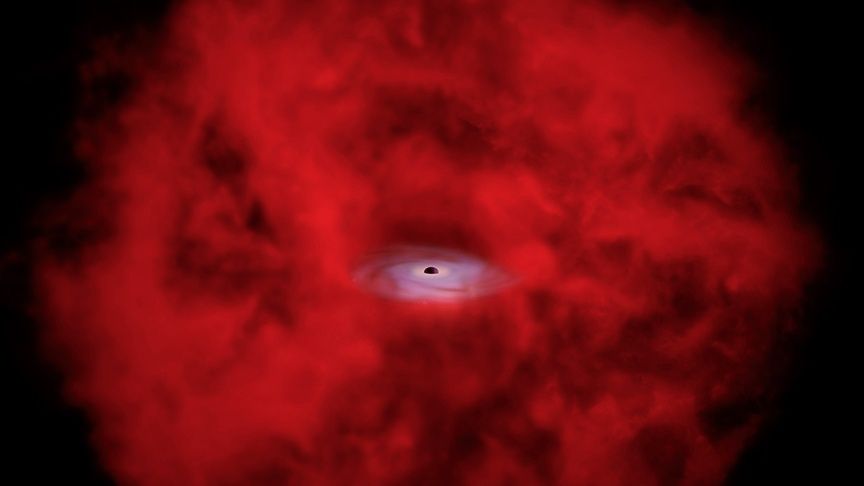
The James Webb Space Telescope detected mysterious red objects in deep space that astronomers struggled to classify. New X-ray observations provide a critical clue to their identity. Researchers found X-ray emissions from one of these objects, suggesting these "little red dots" may actually be black hole stars, a theoretical type of object that combines the properties of black holes with stellar material.
Black hole stars differ from conventional black holes. They form from hypothetical dark matter particles called WIMPs that accumulate in stellar cores, potentially creating objects that appear star-like but harbor black hole characteristics at their centers. This discovery matters because it could reshape our understanding of how the earliest galaxies assembled in the universe. These objects may have formed in the dense conditions of the early cosmos.
The X-ray detection represents concrete evidence beyond the initial infrared observations. Astronomers can now test whether these objects consistently emit X-rays as the black hole star model predicts. Follow-up observations with both X-ray and infrared telescopes will determine whether other red dots share this signature. Confirming black hole stars would open new pathways to understanding dark matter, one of physics' deepest unsolved mysteries.