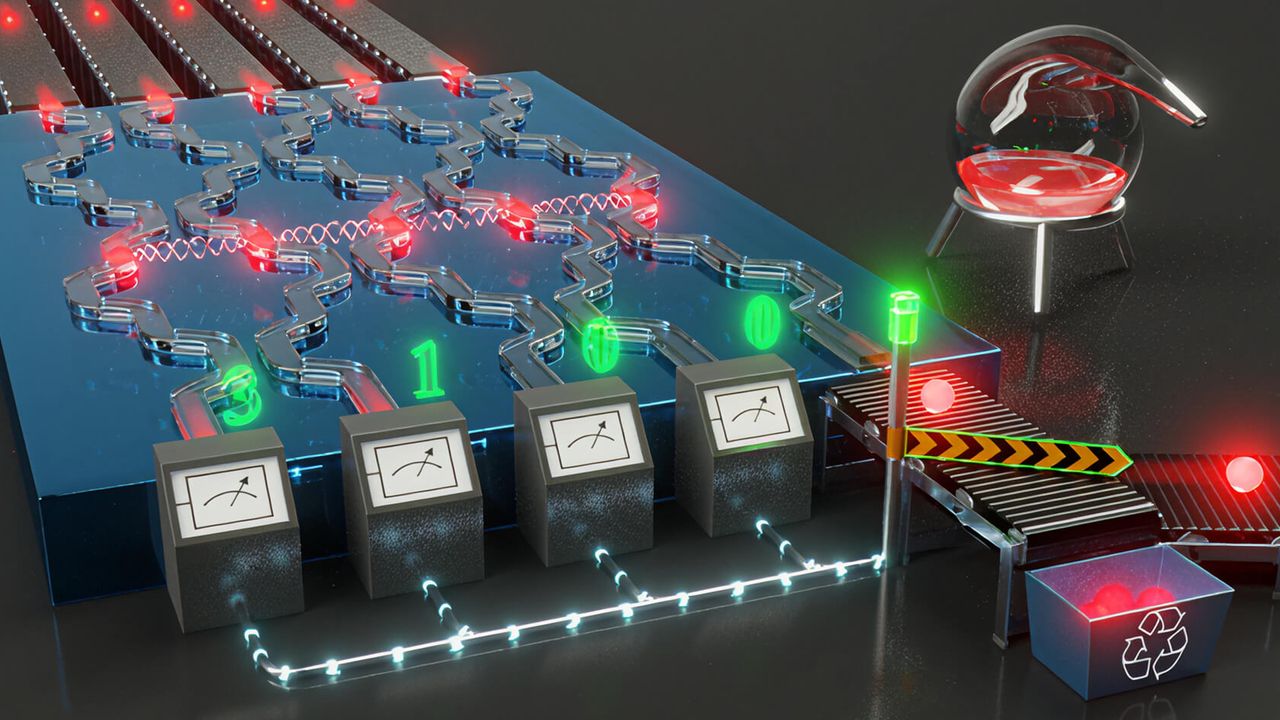
Researchers have solved a major obstacle blocking photonic quantum computers from practical use. The team developed a method to "distill" light, removing the noise that degrades quantum information and prevents these systems from scaling up.
Photonic quantum computers use particles of light, or photons, to process information. Unlike traditional computers that rely on electrical circuits, they harness quantum properties to perform calculations exponentially faster than conventional machines. The problem has always been noise. Imperfect photons introduce errors that compound as systems grow larger, making it nearly impossible to build machines with many qubits.
The distillation technique filters out these flawed photons, leaving behind higher-quality quantum light. This breakthrough removes a fundamental barrier to expansion. Researchers can now maintain quantum information integrity even with thousands of qubits operating together, a threshold previously considered unachievable.
The work opens a path toward practical photonic quantum computers that solve real-world problems in drug discovery, materials science, and optimization. The next phase involves testing the method at larger scales and integrating it into complete quantum computing systems. If successful, photonic platforms could offer significant advantages over competing quantum architectures, including easier operation at room temperature and better compatibility with existing optical infrastructure.