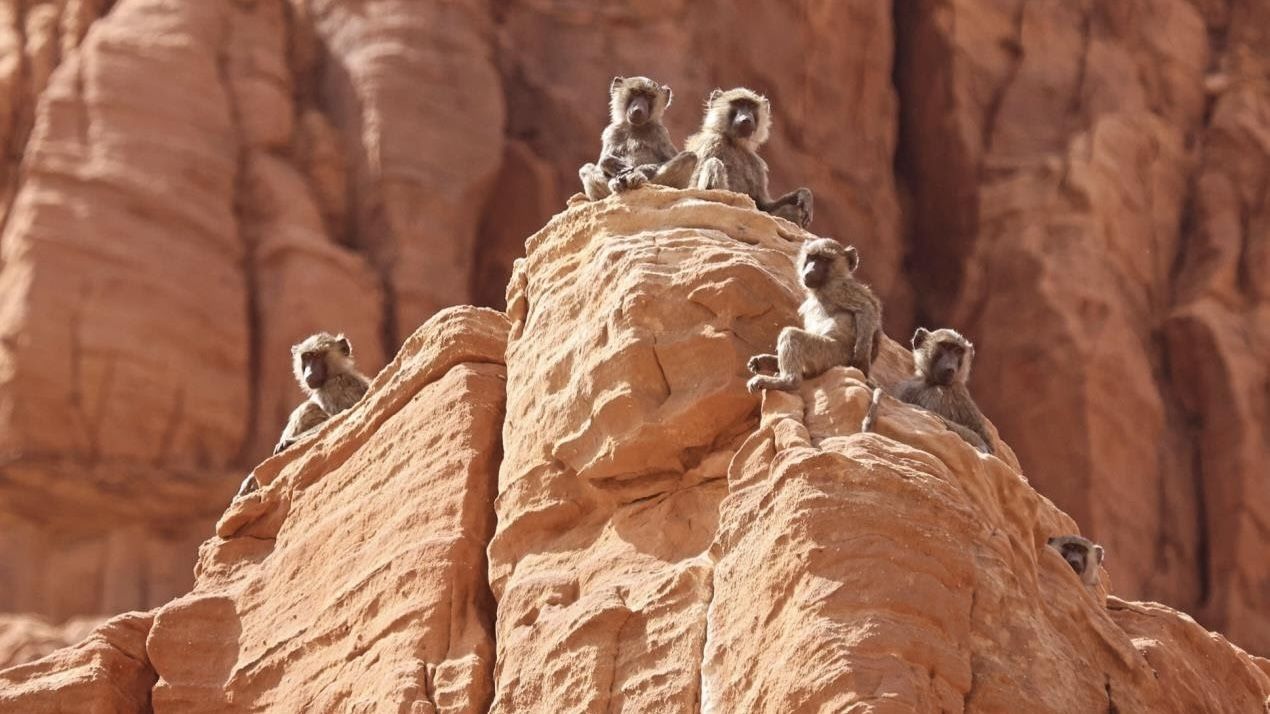
Verreaux's eagles in Chad's Sahara Desert have killed baboons weighing up to 58 pounds (26 kilograms), according to a study published November 18 in the American Journal of Biological Anthropology. This exceeds the previous assumption that eagles could not lift nonhuman primates over 29 pounds (13 kg).
Researchers found remains of at least nine adult baboons with deep talon marks on their bones, suggesting the eagles hunted and killed the primates. The baboons had an average estimated weight of 49 pounds (22.2 kilograms). Eight of the nine were male, a sex bias that suggests active hunting rather than scavenging, since scavenged remains would not favor one sex.
The findings raise questions about whether ancient hominins faced eagle predation. Some early human ancestors weighed within the size range of the baboons studied. Australopithecus afarensis, known as Lucy, weighed about 62 pounds (28 kilograms) around 3.2 million years ago. Catherine Hobaiter, a professor at the University of St. Andrews and study first author, noted that "several of the australopithecine species who lived around 1 [million to] 3 million years ago would be in the same weight range as the adult male baboons in our study" and would have been vulnerable to eagle attacks.
One confirmed case of an eagle killing a hominin exists: the Taung Child, an infant Australopithecus weighing around 22 pounds (10 kg), taken by an eagle around 2.8 million years ago.
Verreaux's eagles have talons with a grip diameter of 16 inches (40 centimeters) and hunt from cliff tops, sometimes in pairs. In the resource-limited Sahara, they may have adapted to hunt larger prey than typical for 9-pound eagles.
Robert Simmons from the FitzPatrick Institute of African Ornithology cautioned that this is "certainly a rare occurrence," occurring when baboons are found alone without cover in desert environments. W. Scott McGraw, an anthropology professor at The Ohio State University, suggested that early hominins may have evolved behavioral adaptations including living in groups, vocalizing warnings, and selecting protective habitats to reduce vulnerability to raptors.
Jesús Bautista-Rodríguez, coordinator of the Desert Golden Eagles Project, expressed caution about the conclusions. He stated that "it is quite possible that some, or even all, of these individuals were already dead, dying, severely weakened or otherwise unable to defend themselves when the eagles fed on them." The talon marks could indicate feeding activity on animals that were already deceased rather than evidence of active killing, he said.