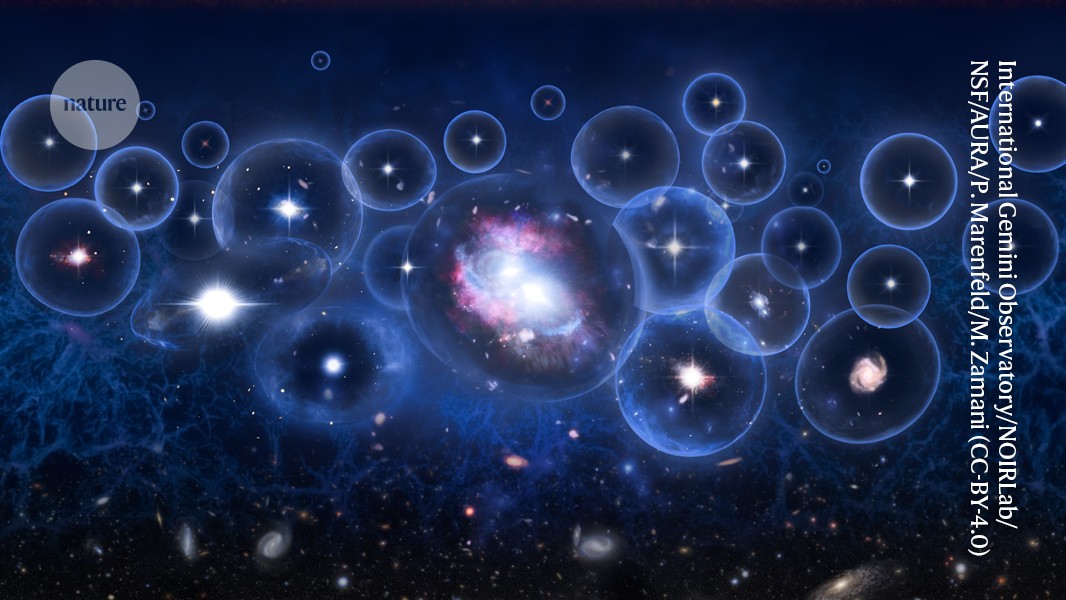
Astronomers have just discovered something that should fundamentally reshape our understanding of how the universe evolved: a pair of enormous black holes inside a single galaxy, each shining brighter than all the stars that surround them, existing less than one billion years after the Big Bang. This discovery, published in the Astrophysical Journal by Onorato, S. et al., doesn't merely add a data point to our astronomical catalog. It demands that we reconsider the timeline and mechanisms by which these 'celestial bodies of fathomless powerful darkness' grew to such extraordinary scales so impossibly early in cosmic history.
The existence of such luminous, massive black holes in the infant universe has long puzzled astronomers. Standard models of black hole formation and growth simply cannot easily explain how these objects accumulated sufficient mass in the available time. When black holes feed on surrounding material, they produce the brilliant light that makes them observable as quasars—and these two specimens are each outshining entire galaxies of stars. The fact that they coexist within a single galaxy makes the puzzle even more intriguing and suggests either that our models of black hole mergers are incomplete, or that the early universe provided conditions dramatically more favorable for rapid black hole growth than we previously understood.
This discovery arrives as we continue to probe the universe's earliest epochs with increasingly sophisticated instruments. These observations represent not an endpoint but a critical juncture: we now have concrete evidence that the conventional understanding of black hole formation timescales requires substantial revision. The implications ripple outward—if black holes grew faster and larger than theory predicts, what does this reveal about galaxy formation itself, about the distribution of matter in the early universe, and about the fundamental physics governing these extreme objects?
The path forward is clear. We need new theoretical frameworks that can accommodate these observations, models that explain how black holes of such magnitude could assemble in less than a billion years after the Big Bang. We need more observations like this one, searches for similar dual-black-hole systems at comparable cosmic distances, and investigations into whether this pairing represents a rare anomaly or a more common phenomenon we have simply overlooked until now.
These ancient quasars, shining with such ferocious brightness, are holding up a mirror to our incomplete understanding of cosmic history. Rather than accept that our models are sufficient, we should embrace the humility that these discoveries demand. The universe, it seems, is still teaching us lessons about its own origins.