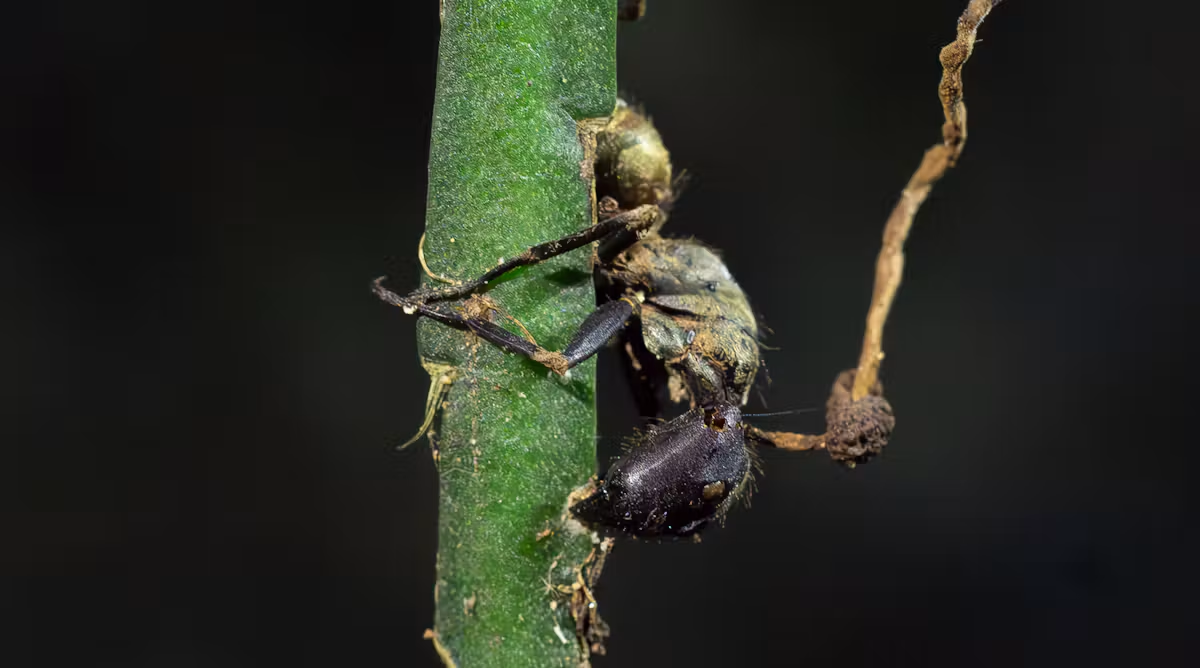
Parasites and fungi manipulate the behavior of living hosts in ways that resemble fictional zombies, though the biological mechanisms differ significantly from popular portrayals.
The zombie ant fungus, Ophiocordyceps, infects ants and causes them to leave their colony, climb vegetation, and bite onto plant surfaces before dying. Researchers examining infected ants found extensive fungal growth throughout the body and around muscle fibers, but not inside the brain. The fungus appears to form networks around the ant's muscles, suggesting it manipulates behavior through communication with multiple host tissues rather than direct brain control. Jaw muscles of infected ants show heavy fungal colonization and extreme contraction, possibly from molecules the fungus releases near these tissues. Scientists have not yet determined exactly what causes the complete sequence of wandering, climbing, and biting behaviors, though researchers identified fungal genes associated with proteins, toxins, and other compounds that could affect chemical signaling in the host.
Other parasites employ different strategies. The emerald jewel wasp injects venom into a cockroach's nervous system, reducing the insect's drive to move without paralyzing it. Hairworms infect insects like praying mantises and crickets, causing them to become attracted to light and enter water, where the worm escapes. Changes in proteins in the host's brain occur as the parasite manipulates it. Toxoplasma gondii infects rodents and reduces their aversion to cat odors, increasing the likelihood they will be eaten by cats, completing the parasite's life cycle.
Tara Deans, Associate Professor of Biomedical Engineering at Georgia Institute of Technology, noted that parasites need not control every action of their host. Instead, they may only change one key behavior.