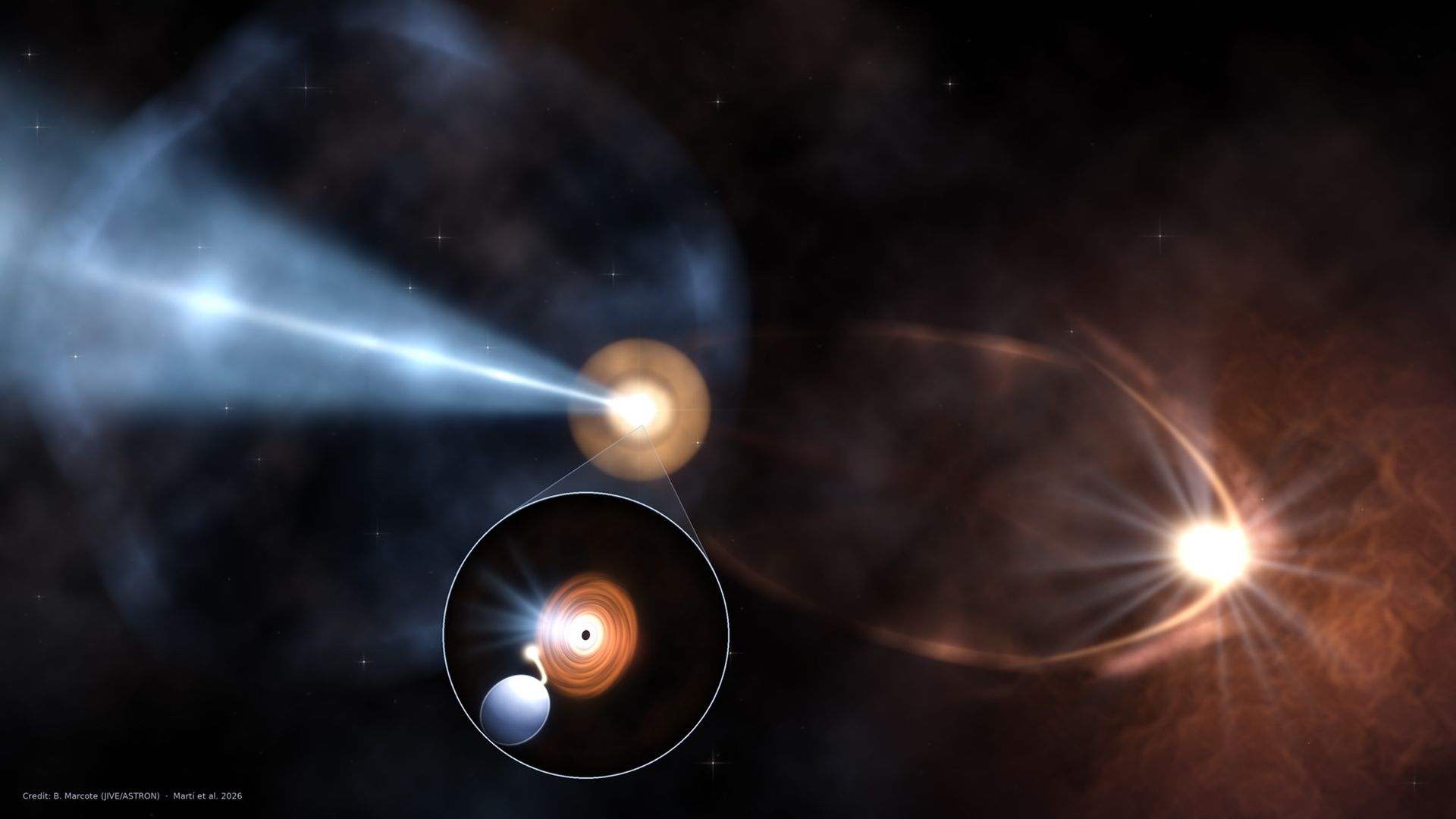
Astronomers report they may have discovered the first known microblazar, a long-theorized cosmic object that fires a powerful beam of particles directly toward Earth, according to Live Science.
Microblavars represent a class of cosmic phenomena predicted by theory but never before confirmed through observation. These objects function similarly to larger blazars, which are supermassive black holes at the centers of galaxies that emit jets of relativistic particles. The key difference is scale. Microblavars operate at much smaller scales, yet still produce intense beams of charged particles.
The potential discovery marks a turning point in extragalactic astronomy. Blazars have long been studied as among the most energetic objects in the universe, with their jets capable of traveling at nearly the speed of light. When these jets point directly at Earth, the radiation becomes particularly intense and observable from our planet. The microblazar candidate follows this same pattern, but at a previously unconfirmed scale of operation.
The significance of identifying a microblazar extends beyond merely adding another object type to astronomical catalogs. It validates decades of theoretical predictions about how cosmic acceleration mechanisms might operate across different size scales. If confirmed, this discovery suggests that the physical processes governing particle acceleration and jet formation in black hole systems apply not only to supermassive black holes but also to smaller, more common objects throughout the universe.
The fact that such an object happens to aim its beam toward Earth represents a fortunate alignment. Without that direct line of sight, the microblazar would likely escape detection, as its radiation would disperse in other directions and prove far fainter from our vantage point.
Astronomers continue observations to confirm the microblazar's nature and characteristics. Further study could reveal whether other such objects exist throughout the cosmos and how frequently they occur relative to their larger counterparts.