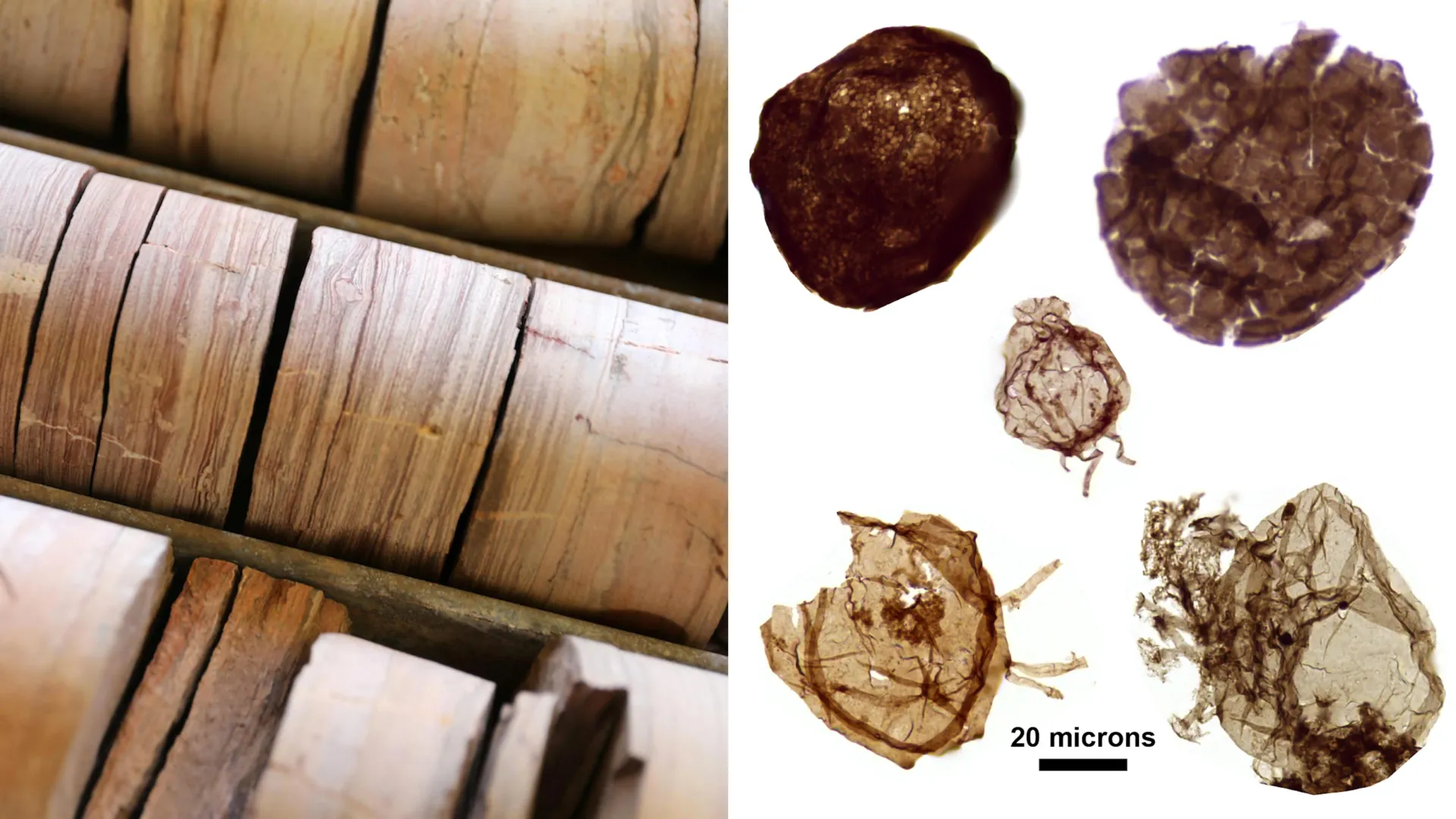
Researchers analyzing 1.7-billion-year-old rocks from Western Australia have discovered over 12,000 fossils that reshape our understanding of how complex life emerged on Earth. The fossils represent some of the oldest known eukaryotes, organisms with nucleated cells that form the basis for all plants, animals, and fungi alive today.
The international team, whose work appears in peer-reviewed journals, excavated these microscopic remains from ancient Australian formations. What struck them most was the distribution pattern. Eukaryotes thrived exclusively in oxygen-rich environments, from shallow coastal mudflats to deeper ocean waters. In contrast, oxygen-free zones nearby contained only simpler prokaryotic cells, which lack a nucleus.
This spatial pattern provides direct fossil evidence for a hypothesis geologists and biologists have debated for decades: that atmospheric oxygen availability acted as a gatekeeper for complex life's origin. The correlation is not coincidental. Building a nucleated cell requires substantially more energy than maintaining a prokaryotic cell. Aerobic respiration, which uses oxygen, generates roughly 15 times more ATP (cellular energy currency) per glucose molecule than anaerobic processes. Without oxygen, early organisms lacked sufficient energy to construct and maintain the elaborate internal structures that define eukaryotes.
The 1.7-billion-year-old timeframe matters enormously. Earth's atmosphere began accumulating oxygen around 2.4 billion years ago during the Great Oxidation Event. Yet complex multicellular life did not appear until roughly 600 million years ago. That 1.8-billion-year gap has puzzled scientists. Why did eukaryotes take so long to emerge if oxygen was available? These Australian fossils suggest eukaryotes actually arose much earlier, within a few hundred million years of atmospheric oxygenation. They simply remained microscopic and confined to oxygen-rich niches for over a billion years before eventually radiating into the diversity we observe today.
The fossil assemblage came from the Barney Creek Formation in the McArthur Basin. Researchers employed sophisticated microscopy and chemical analysis to identify distinct cell types and preserve delicate structures. The sheer abundance of specimens, exceeding 12,000, allowed for statistical confidence in the distribution patterns observed.
This work carries implications beyond paleontology. It demonstrates that life's complexity is not predetermined but contingent on environmental conditions. Oxygen levels regulate the complexity threshold life can achieve. On exoplanets lacking substantial atmospheric oxygen, complex multicellular organisms may never emerge, even if microbial life takes hold. Conversely, planets with higher oxygen concentrations might see faster transitions to complex life.
The findings also reframe debates about Earth's early biosphere. Rather than viewing the Proterozoic eon as a dull period of microbial monotony, scientists now recognize it as an era when simple eukaryotes quietly diversified in specific ecological niches, waiting for conditions that would eventually enable their explosive radiation into the forms we recognize today. Future work analyzing additional ancient rock formations from other regions will test whether this oxygen-complexity link holds universally across geological time and geography.