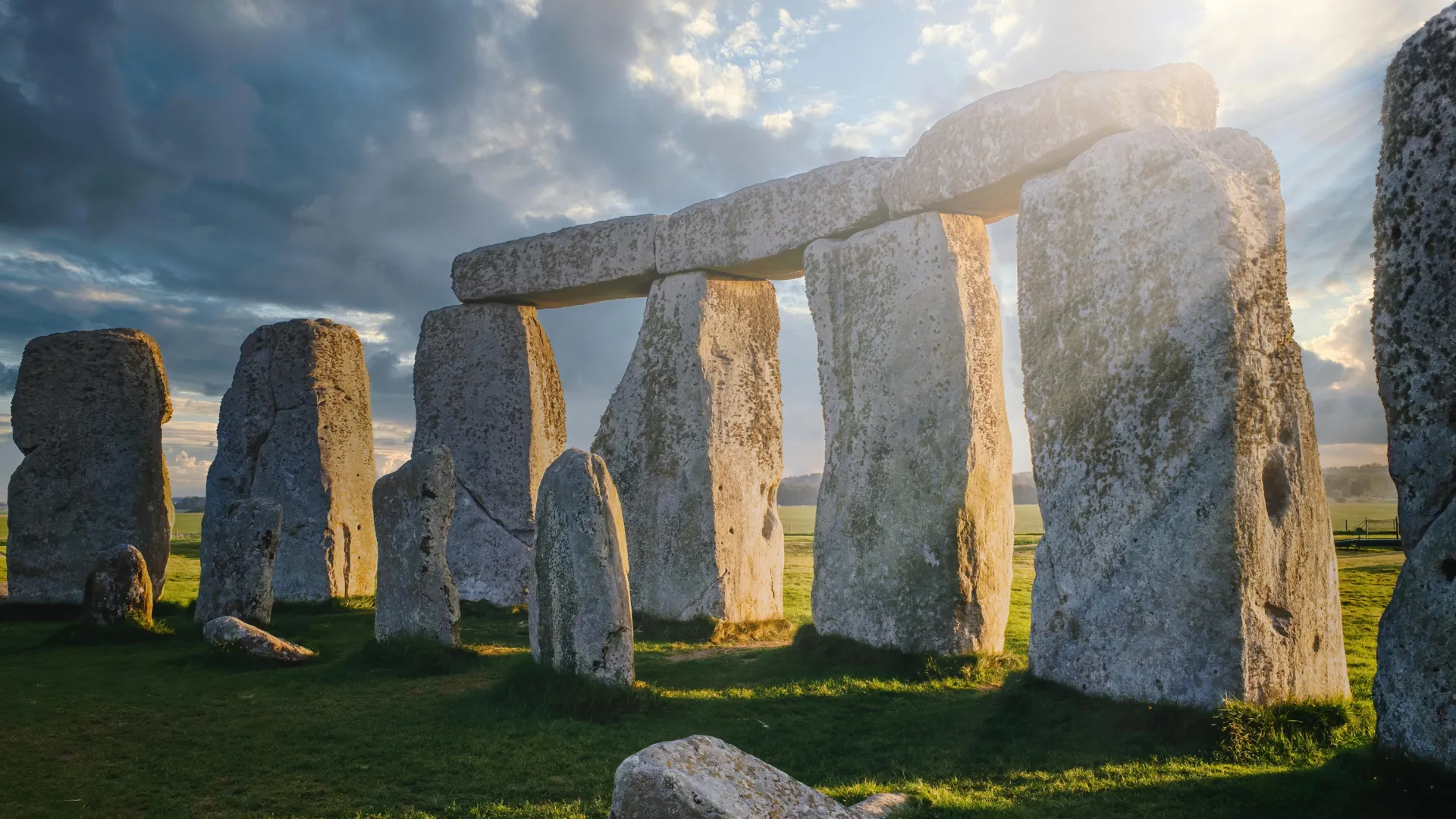
# Stonehenge's Altar Stone: A Journey Across Glaciers and Continents
Researchers have proposed a radical origin story for one of Stonehenge's most enigmatic blocks. The six-ton Altar Stone, a bluish-gray sandstone that sits at the heart of the monument, may have begun its journey to Salisbury Plain not in human hands but in the grip of glaciers advancing from Scotland.
A new analysis suggests the stone traveled from its source in the Scottish Highlands to Dogger Bank, a submerged landmass in the North Sea, during the last Ice Age. Glaciers transported the massive block across hundreds of kilometers of frozen terrain. Only after the ice receded did prehistoric people encounter the stone and recognize its value as something worth hauling another 750 kilometers south to Stonehenge on Salisbury Plain.
This multistage transport hypothesis rests on geological detective work. Researchers matched the mineral composition and chemical signature of the Altar Stone to specific outcrops in Scotland. The stone's reddish-brown coloration and crystalline structure point definitively to a source in the Scottish Borders or nearby regions. Previous studies established that people transported bluestones and other Stonehenge components from Wales, but the Altar Stone's journey appears fundamentally different in both distance and mechanism.
The glacier hypothesis changes how archaeologists view Stonehenge's construction. It implies that prehistoric builders did not simply quarry stone from nearby sources. Instead, they recognized and valued a block that had been delivered by nature's own engineering. The stone's unusual journey may have enhanced its spiritual or ceremonial significance, marking it as something special before it ever arrived at the monument.
Transport logistics in prehistoric times represented a staggering organizational feat. Moving a six-ton stone across 750 kilometers required coordinated labor, engineering knowledge, and sustained commitment across generations. Researchers estimate the journey took place over many centuries, possibly involving multiple communities that passed the stone hand to hand across the landscape. The effort suggests the Altar Stone held extraordinary cultural value, not merely practical utility.
Dating the glacial transport remains challenging. The last major glaciation in Britain ended roughly 10,000 years ago, while Stonehenge rose around 5,000 years ago. This 5,000-year gap creates a window of opportunity. The stone could have rested on Dogger Bank or nearby coastal areas for millennia before being discovered and transported inland. Alternatively, earlier glacial cycles may have moved the stone, placing it even further back in time.
The discovery adds texture to the long prehistory surrounding Stonehenge. Rather than viewing the monument in isolation, researchers now see it as the endpoint of much longer geological and cultural narratives. The Altar Stone connects Stonehenge to Scotland, to glacial cycles, and to ancient peoples' ability to recognize and value natural objects over vast distances.
Future work will focus on pinpointing the stone's precise Scottish source and refining estimates of when glaciers deposited it at Dogger Bank. Researchers also hope to understand what prompted Stonehenge's builders to travel so far for this particular stone when closer materials were available. The answer may reveal how prehistoric communities valued certain objects or what beliefs motivated their monumental efforts.