# Atlantic Ocean Current Collapse Shows Accelerating Weakening, Threatening Global Weather Systems
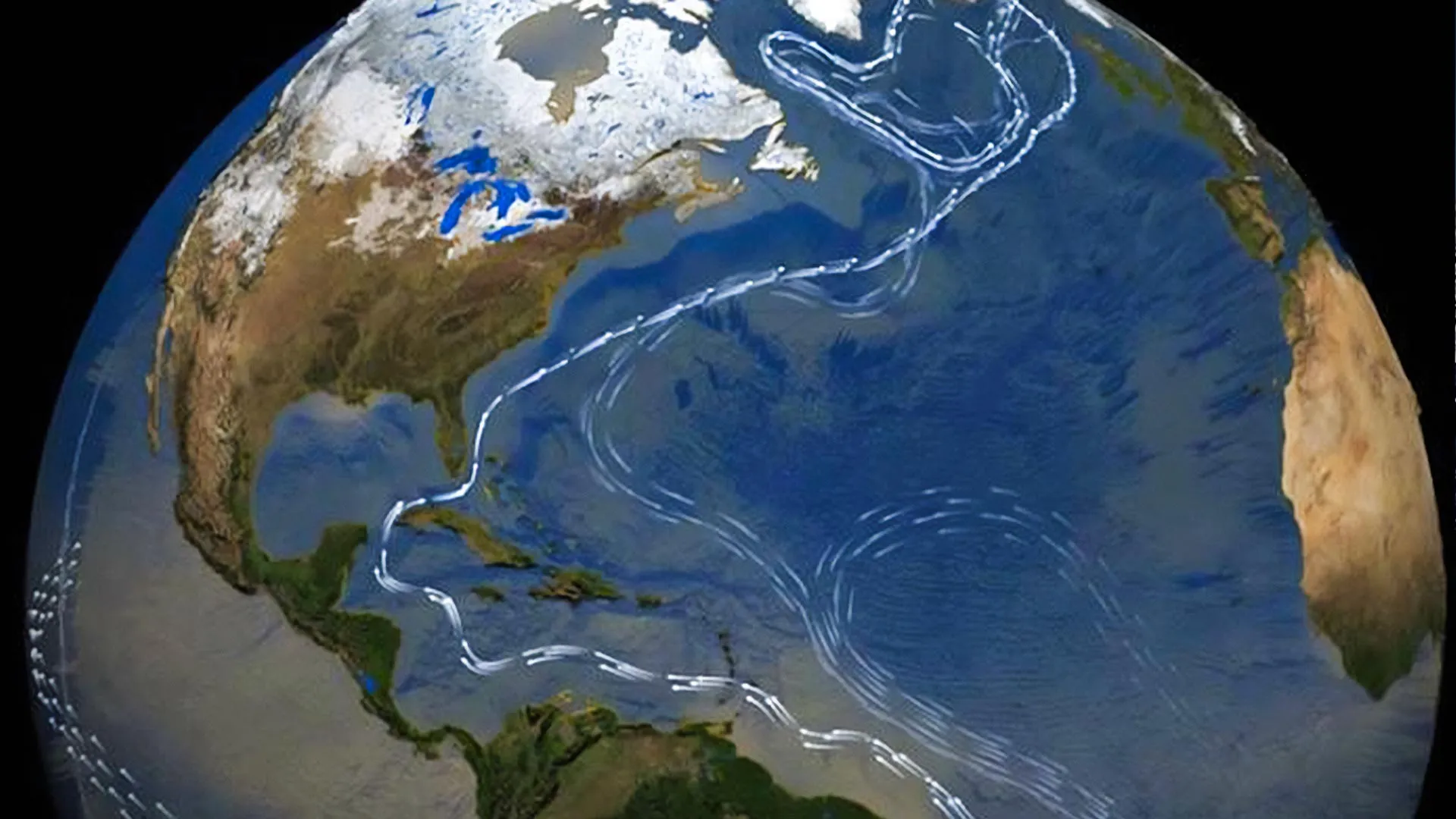
A critical ocean circulation system that regulates Atlantic weather patterns has been losing strength for nearly two decades, according to new observational evidence gathered by oceanographers. The Atlantic Meridional Overturning Circulation (AMOC), which includes the famous Gulf Stream, is slowing at a rate that experts describe as alarming.
The AMOC functions as a vast conveyor belt moving warm water northward and cold water southward across the Atlantic Ocean. This circulation pattern drives weather systems, distributes heat, and stabilizes climate across Europe, North America, and Africa. When it weakens, the consequences ripple globally.
Researchers analyzed direct ocean measurements collected over an extended period, documenting a consistent decline across multiple locations along the Atlantic basin. The data reveals the slowdown extends across a wide geographic area rather than occurring in isolated pockets. This geographic breadth strengthens evidence that the weakening represents a genuine system-wide decline rather than natural variability.
The projected impacts are severe. A continued AMOC slowdown could trigger colder winters in Europe and northeastern North America, increase Atlantic hurricane intensity, disrupt rainfall patterns across Africa and the tropics, and raise sea levels along the U.S. East Coast. Coastal communities from Florida to Massachusetts face particular vulnerability from accelerated water accumulation as the AMOC loses its ability to push water away from shore.
Scientists attribute the primary driver to freshwater input from melting Greenland ice sheets. As Arctic ice melts, it releases freshwater into the North Atlantic. This freshwater is less dense than salt water, disrupting the density gradients that power the AMOC. Cold, salty water normally sinks in the North Atlantic, pulling warm water northward in a continuous cycle. Freshwater input weakens this sinking mechanism.
Climate models have long predicted AMOC weakening under warming scenarios, but observational confirmation provides concrete evidence that theoretical predictions match reality. The nearly two-decade timescale shows the process unfolds faster than some earlier models suggested.
The research carries limitations. Ocean measurements remain sparse compared to the atmosphere, and establishing causation between specific drivers and circulation changes requires careful analysis. Some natural variability still occurs within the system. However, the consistency and duration of observed weakening across independent measurement networks reduces uncertainty about fundamental trends.
The implications extend beyond weather forecasting. Insurance companies, coastal planners, and agricultural operations across multiple continents depend on relatively stable Atlantic patterns. A destabilized AMOC forces recalibration of these systems. Port cities must plan for changing sea levels. Farmers must adapt to shifting precipitation patterns. Energy infrastructure faces new challenges from changing storm patterns.
Monitoring will intensify. Oceanographic institutions have expanded buoy arrays and satellite measurements specifically to track AMOC changes in real time. These efforts aim to detect acceleration or stabilization of the current and provide earlier warning of threshold-crossing events.
The Atlantic Ocean current system demonstrates how climate change operates through complex physical mechanisms rather than simple temperature increases. Understanding and monitoring these circulation patterns represents essential work for predicting regional and global climate futures.