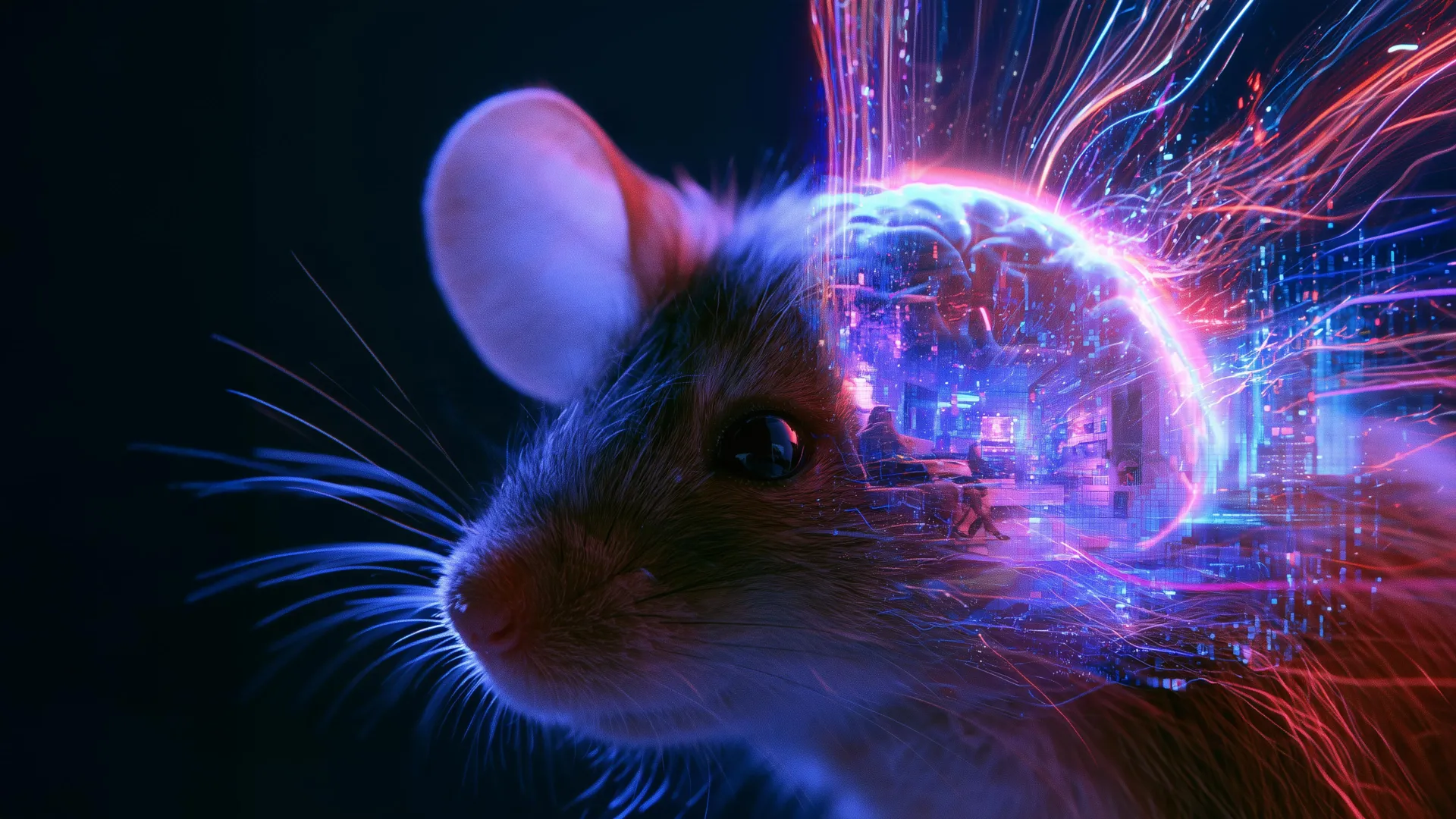
# Scientists Reconstruct Mouse Visual Experience Directly from Brain Signals
Researchers have achieved a remarkable feat: they reconstructed visual videos from the brain activity of mice, creating 10-second clips based entirely on neural signals from the visual cortex. This breakthrough offers a window into how the brain transforms raw sensory input into the perceptions we experience.
The work demonstrates that visual information can be decoded from patterns of neural firing in ways previously thought impossible. By analyzing electrical activity across neurons in the visual cortex, scientists built computational models that could predict what a mouse was seeing in real time. The reconstructed videos, though pixelated and abstract compared to actual footage, contained recognizable elements and spatial relationships that matched the original stimuli.
The research holds implications far beyond understanding mouse vision. It reveals the neural code underlying perception itself. The visual cortex does not simply record what the eye sends. Instead, the brain actively reorganizes and reshapes sensory signals through layers of processing. This experiment captures that transformation by showing what emerges from the neural computation rather than what entered the eye.
Previous studies had decoded simpler aspects of vision, such as the direction of motion or the orientation of edges in an image. This work goes further by reconstructing complex, dynamic visual scenes. Researchers trained machine learning models on the relationship between neural activity patterns and natural video footage. Once trained, these models could generate videos matching the neural signatures alone, without reference to the original stimulus.
The team likely used electrophysiology or calcium imaging to record from dozens or hundreds of neurons simultaneously. These techniques reveal when individual neurons fire and at what rate. The reconstructions suggest that the information needed to recreate visual experience lives in the collective activity of these neural populations, encoded in patterns of timing and intensity across many cells.
Understanding this neural code has practical applications. It could improve brain-computer interfaces that help paralyzed patients control robotic limbs or communicate. If researchers can decode what someone is seeing or imagining from their brain activity, they could potentially reconstruct thoughts or intentions. This raises both therapeutic and ethical questions about brain privacy and the nature of conscious experience.
The work also contributes to neuroscience's grand challenge: understanding how physical processes in the brain generate subjective experience. While reconstructing mouse vision does not explain consciousness itself, it shows how the brain's internal models relate to external reality. The gap between the detailed videos mice actually see and the reconstructed versions provides clues about what the brain prioritizes and what it discards.
Limitations remain. Reconstructions work best with specific types of visual input similar to training data. The technique requires invasive electrode placement and extensive neural recordings. Scaling this from mice to humans poses technical and practical obstacles. Human brains are vastly more complex, with billions of neurons and intricate layering in visual processing regions.
The research invites deeper questions about the relationship between neural firing patterns and perception. Does the brain's reshaping of sensory input always improve survival and reproduction, or does it sometimes mislead us? How much of what we see reflects objective reality versus internal neural computation? These experiments provide tools to answer such questions systematically.