# Why Arctic Sea Ice Behaves Like a Hyperactive Crowd
Arctic sea ice has puzzled researchers for decades. The frozen surface moves faster and spreads more widely than physics equations predict. A new study identifies the culprit: collisions between individual ice floes act as an energy transfer mechanism that fundamentally changes how the ice mass behaves.
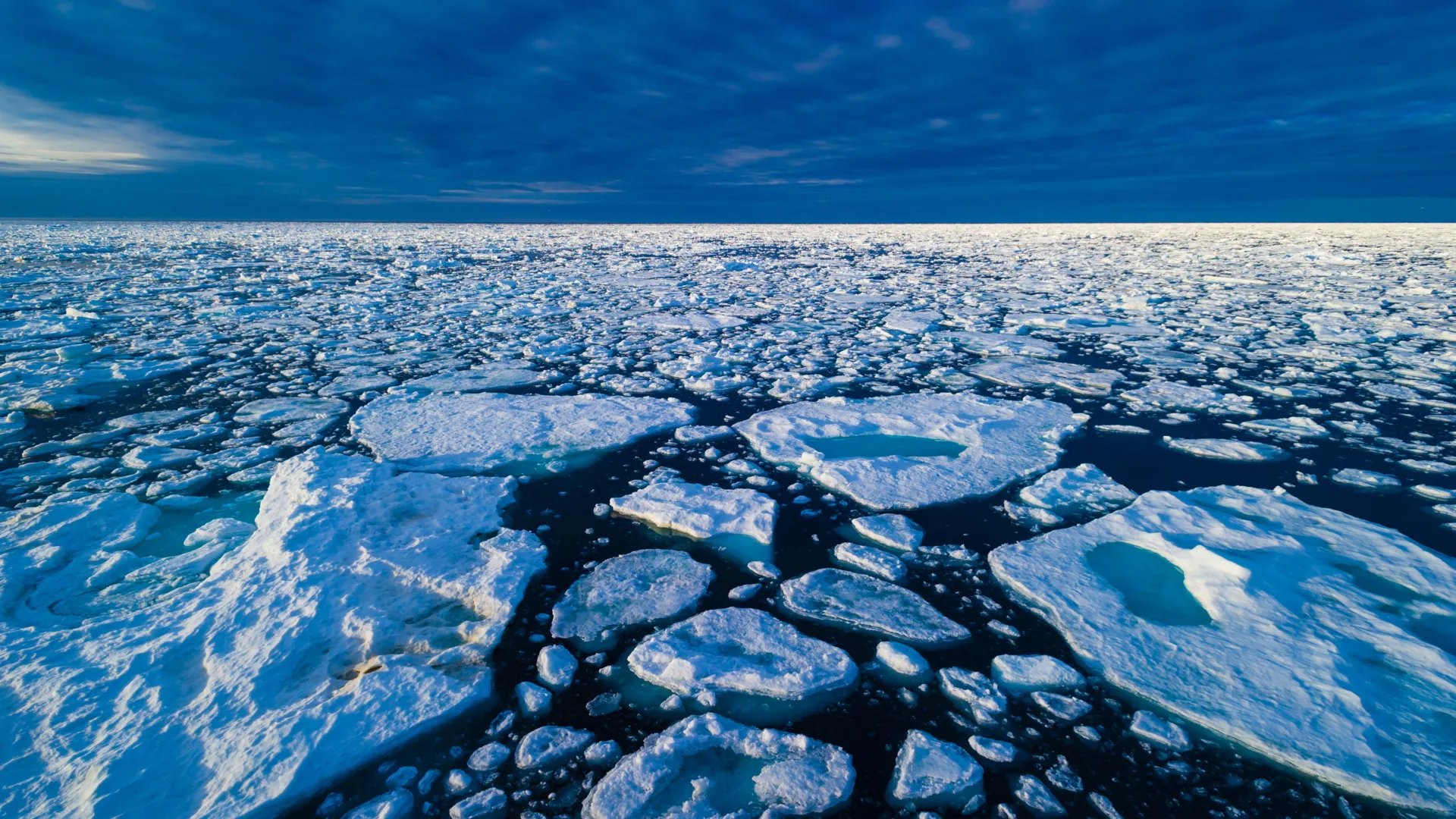
The research challenges a longstanding assumption in climate modeling. Scientists previously treated Arctic sea ice as a continuous, solid sheet that responds predictably to wind and ocean currents. In reality, the ice consists of millions of separate floes, each drifting independently until they crash into neighbors. These collisions dissipate energy in unexpected ways.
The team analyzed how ice floes interact during movement. When floes collide, they don't simply bounce off each other. Instead, the impacts transfer kinetic energy throughout the ice pack in a manner that cannot be captured by traditional fluid dynamics equations. Think of a crowded subway platform at rush hour. Individual people (floes) moving in slightly different directions create complex, unpredictable crowd movement that no single-person motion equation can describe.
This discovery resolves several observational mysteries. Arctic sea ice spreads across larger areas than models predict. The ice also accelerates and decelerates in patterns that seemed random. Satellite data and field measurements showed the ice moving up to 40 percent faster in certain conditions than theoretical models suggested. The floe collision hypothesis explains these discrepancies without requiring new physics.
The implications extend beyond academic curiosity. Arctic sea ice extent and motion patterns directly affect global climate. The ice reflects sunlight back to space, regulating planetary temperature. As climate change reduces ice coverage, the albedo effect weakens, accelerating warming in a positive feedback loop. Accurate models of ice motion matter for predicting regional and global climate impacts.
The researchers used computational models incorporating realistic floe sizes, shapes, and collision mechanics. When collision energy transfer was included, the models reproduced observed ice velocity and spread patterns with greater accuracy. The work validates that treating sea ice as a granular material, rather than a continuous fluid, produces more reliable predictions.
Prior work recognized that sea ice was not monolithic, but few studies quantified how collision dynamics reshape the system's behavior. This research fills that gap by demonstrating that local interactions between adjacent floes scale up to influence entire Arctic ice regions.
Climate models now require revision to incorporate these findings. Ocean and ice modeling centers worldwide will need to update their simulation codes to account for granular flow dynamics. This process takes time. Models feed into climate projections that inform policy decisions about carbon emissions targets and climate adaptation strategies.
The discovery also opens questions about other ice sheets. Antarctic sea ice faces different thermal and mechanical conditions, but collision dynamics likely play a role there too. Greenland's outlet glaciers, which calve into the ocean as icebergs, might experience similar granular behavior at scales that affect sea level rise projections.
Future research should track how climate warming affects collision frequencies and energy transfer as the ice pack becomes increasingly fragmented. Thinner ice and rising water temperatures reduce ice extent, potentially changing how floes interact. Understanding these cascading effects requires continued field observations paired with improved computational models.