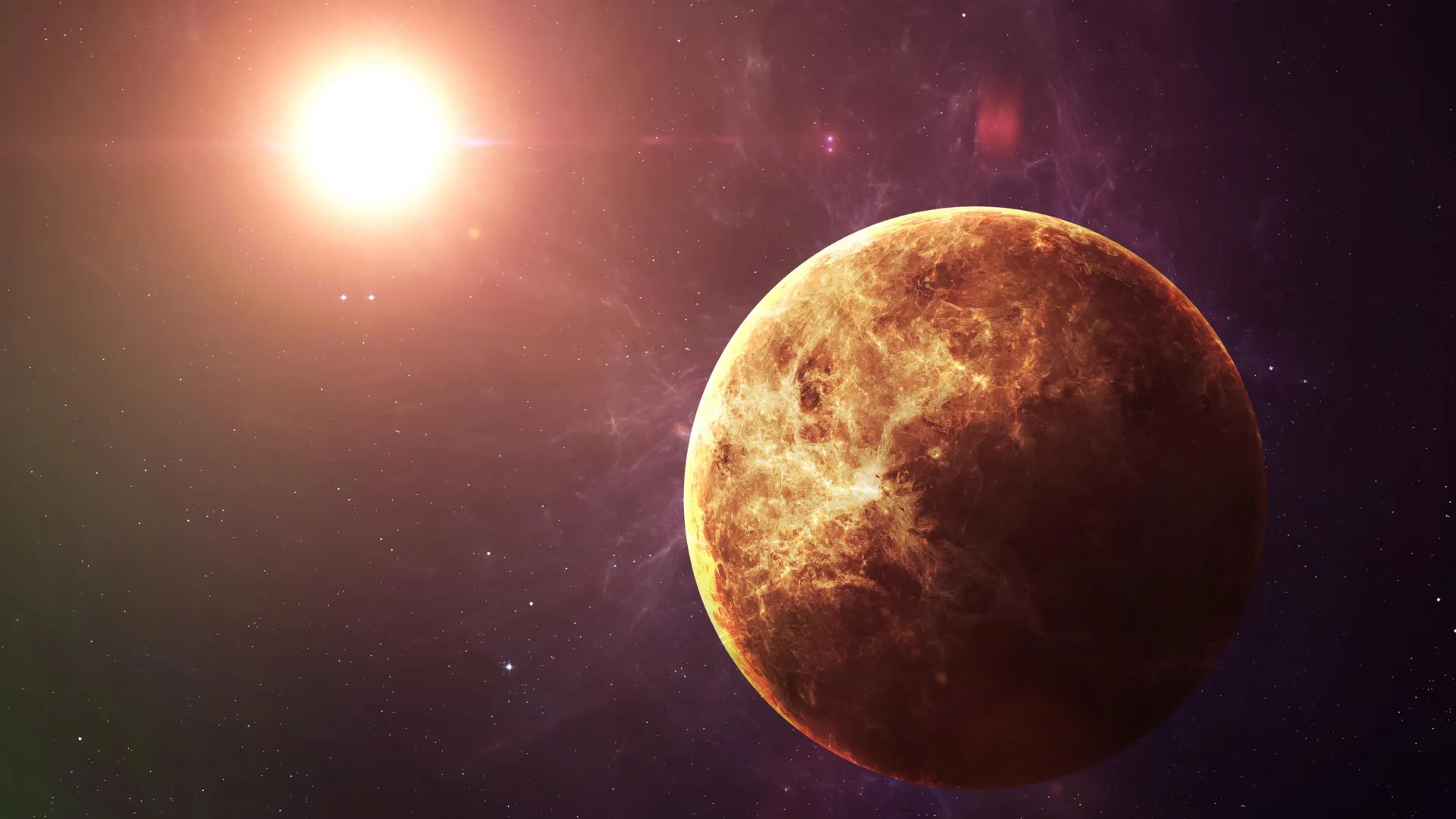
# Venus May Have Consumed Its Own Moon, Computer Models Suggest
Venus rotates so slowly that any moon orbiting the planet would have spiraled inward and crashed into it, according to new simulations. This finding upends the standard assumption that moons gradually drift away from their parent planets over time.
Researchers ran computer models examining orbital dynamics around Venus, which rotates once every 243 Earth days. The slowness of this rotation fundamentally changes how celestial mechanics work near the planet. While Earth's moon recedes from Earth at about 3.8 centimeters per year due to tidal forces, a Venusian moon would experience the opposite effect.
The simulations revealed that orbital decay would accelerate dramatically. Larger moons would plunge into Venus even faster than smaller ones. This stands in stark contrast to our solar system's common pattern, where moons typically move away from their host planets over billions of years. Venus's unusual rotation rate creates gravitational conditions that reverse this trajectory entirely.
The research bears on questions about Venus's formation and early history. Astronomers have long wondered whether Venus, similar in size to Earth, might once have possessed a moon. The planet's current state offers few clues. Today, Venus rotates backward relative to most planets, rotates extremely slowly, and lacks any natural satellites. These features suggest a violent past, possibly involving giant impacts during the early solar system.
Understanding why Venus lost a potential moon matters for planetary science. The mechanisms that govern moon stability reveal how planetary systems evolve. A moon falling into Venus would leave no trace in the modern era, making detection impossible through current observations. However, this scenario could explain aspects of Venus's rotation and structure that remain puzzling.
The simulations provide a physics-based explanation for an absence rather than a presence. Venus might never have had a stable moon, or it might have had one that met this orbital doom billions of years ago. Either scenario fits with what we observe today.
This work highlights how a planet's rotation rate profoundly shapes its orbital neighborhood. Venus's extreme slowness transforms it into a gravity well that pulls inward rather than holds outward. The research demonstrates how computer modeling allows scientists to explore planetary histories that leave no observable evidence behind.
Future observations of exoplanetary systems may reveal whether other slow-rotating planets show similar evidence of having consumed their moons. The study opens new avenues for understanding planetary system stability and the conditions that make moons sustainable across cosmic time.