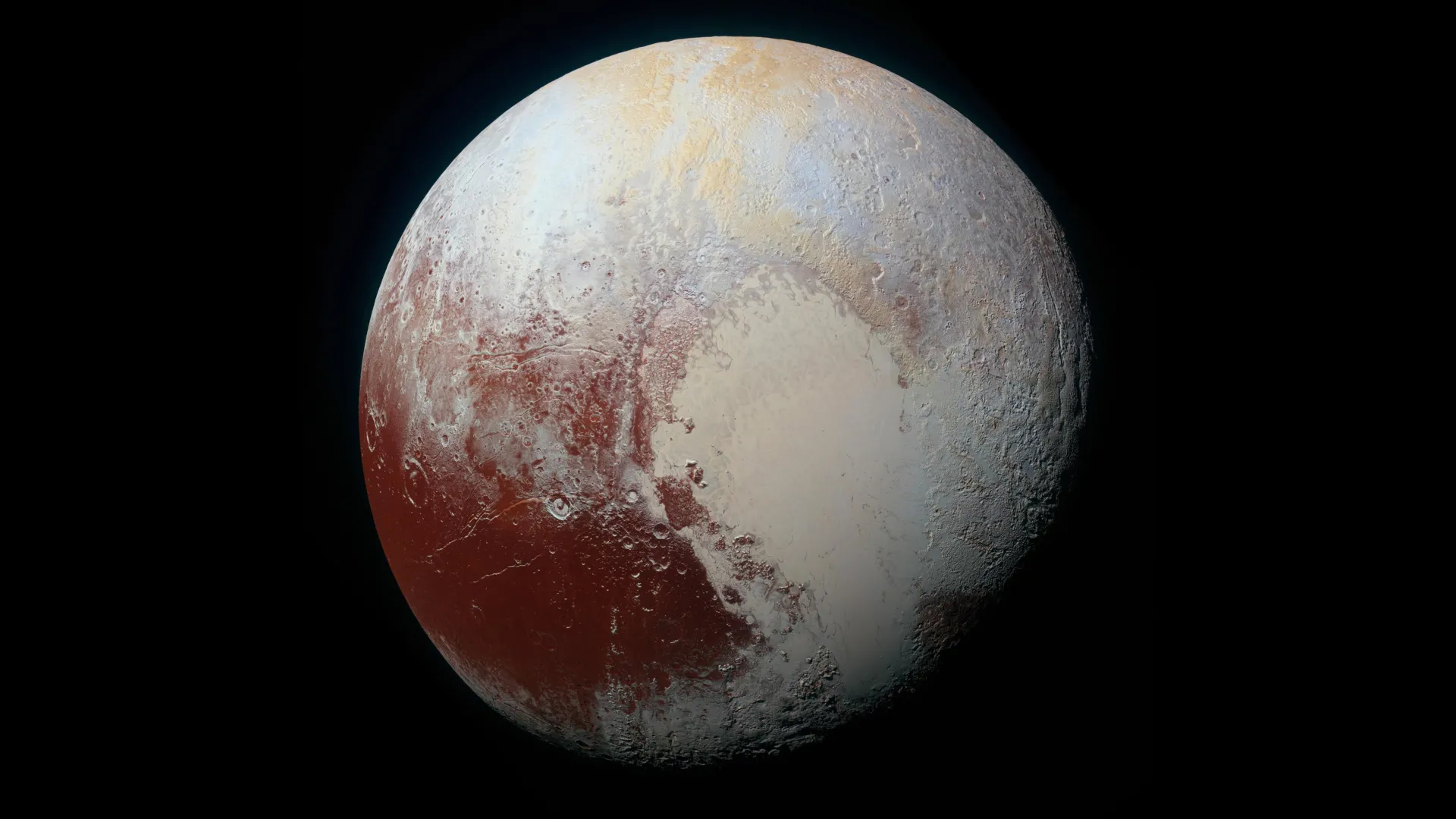
NASA's New Horizons spacecraft has detected evidence of liquid nitrogen flowing across Pluto's surface in recent geological time, suggesting the dwarf planet remains far more dynamic than its icy exterior implies.
Researchers analyzing images from New Horizons discovered dark features on Sputnik Planitia, Pluto's vast nitrogen ice glacier, that show patterns consistent with liquid nitrogen rising through fractures from beneath the ice shell. Computer modeling conducted by the team demonstrates that nitrogen can melt at the base of the glacier where internal heat exists, then migrate upward through narrow conduits in the ice.
The finding challenges the conventional view of Pluto as a static, frozen world locked in perpetual dormancy. Instead, it reveals a body with ongoing geochemical processes driven by internal energy sources. These subsurface reservoirs of liquid nitrogen, maintained by heat from radioactive decay and residual warmth from Pluto's formation, can reach the surface under specific conditions. When nitrogen reaches warmer zones near the glacier's base or along thermal gradients, it transitions from solid to liquid state and travels through the porous ice structure.
The dark streaks observed by New Horizons cameras provide the key observational clue. Unlike the bright nitrogen ice that dominates Sputnik Planitia, these darker features contain impurities. When liquid nitrogen flows upward and evaporates at or near the surface, it leaves behind concentrated deposits of darker materials. These residues accumulate in patterns that match what the computer models predict for cryogenic fluid transport systems.
New Horizons conducted its historic flyby of Pluto in July 2015, capturing the highest-resolution images of the dwarf planet's surface with a minimum distance of 7,750 kilometers. The mission revealed Pluto as a world of stunning geological diversity, with mountains of water ice, vast nitrogen plains, and evidence of ancient volcanism. Sputnik Planitia itself covers an area roughly equivalent to Texas and consists primarily of nitrogen ice mixed with methane and carbon monoxide ices.
This discovery extends the concept of planetary geology beyond traditional boundaries. Earth scientists have long documented liquid water movement through rock and soil, but Pluto demonstrates that analogous processes operate with entirely different cryogenic fluids at temperatures near minus 380 degrees Fahrenheit. The mechanisms of subsurface fluid transport, pressure dynamics, and phase transitions remain fundamentally similar even when working with exotic ices rather than water.
The implications reach beyond Pluto itself. Similar processes likely operate on other icy bodies in the outer solar system, including Neptune's moon Triton and Saturn's moon Enceladus, both of which harbor subsurface oceans or reservoirs of volatile compounds. Understanding cryogenic fluid dynamics on these worlds informs broader models of planetary evolution and habitability in extreme environments.
The New Horizons team continues analyzing data from the 2015 encounter. The spacecraft currently travels through the Kuiper Belt, having passed beyond Pluto to study other icy objects. Future observations from ground-based telescopes and potential orbital missions may provide additional constraints on Pluto's internal heat sources and the frequency of nitrogen cryovolcanism.