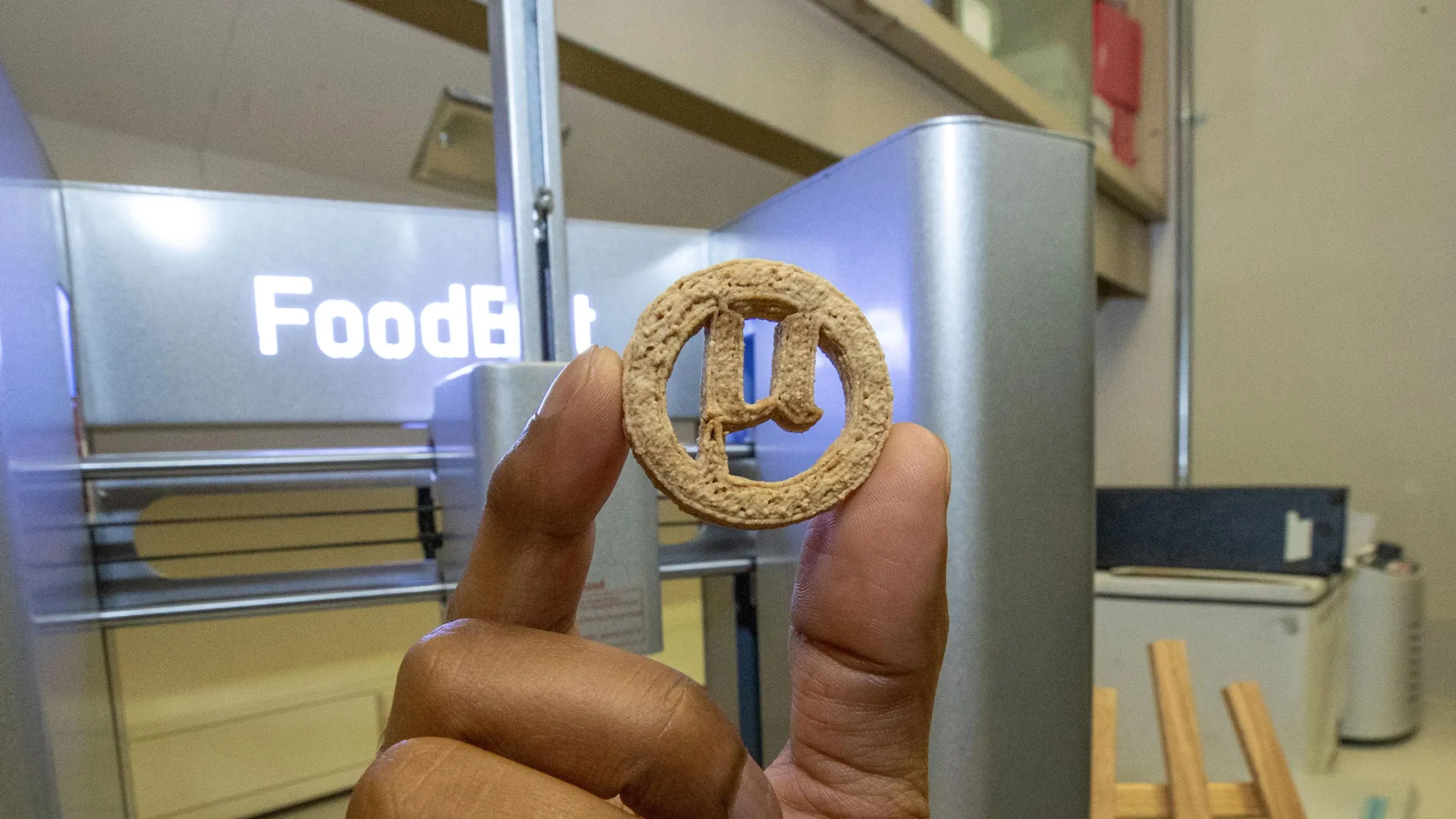
Scientists funded by NASA have engineered yeast to convert plastic waste and agricultural byproducts into edible cookies, a development that addresses two global problems simultaneously: plastic pollution and food scarcity.
The engineered yeast transforms polyethylene terephthalate (PET) plastic and agricultural waste into complete nutritional ingredients, including proteins, fats, vitamins, and vanilla flavoring. Researchers then use these fermentation-derived components to 3D-print small cookies called µBites. The technology emerged from work on NASA's Deep Space Food Challenge, which seeks innovative solutions for feeding astronauts on long-duration missions.
The system operates through synthetic biology. Scientists modified yeast strains to metabolize plastic polymers and agricultural residues, converting them into building blocks for food production. This fermentation-based approach bypasses traditional agriculture entirely, producing nutrient-dense ingredients in controlled bioreactors. The cookies represent a proof-of-concept for converting waste streams into shelf-stable food products.
The potential applications extend beyond space exploration. Food insecurity affects nearly 700 million people globally, and plastic waste continues accumulating in landfills and oceans at alarming rates. A technology that processes both simultaneously offers dual environmental and humanitarian benefits. The 3D-printing component allows customization of cookies for specific nutritional profiles or taste preferences, opening possibilities for targeted nutrition in crisis situations or isolated environments.
However, the technology faces scalability challenges. Lab-scale fermentation differs substantially from industrial production. Moving from prototype µBites to meaningful quantities of food requires developing infrastructure for large-scale bioreactor systems, establishing supply chains for plastic collection and sorting, and ensuring the food safety regulations across multiple jurisdictions. The taste profile of fermentation-derived vanilla and other flavorings may also require refinement for consumer acceptance.
Cost remains another hurdle. Current production likely exceeds costs for conventional food manufacturing, though researchers did not disclose specific figures. As with many biotechnology innovations, scaling up should reduce per-unit expenses, but the timeline remains uncertain.
The technology also faces feedstock limitations. Not all plastic types work equally well with the engineered yeast. PET plastic, found in beverage bottles and packaging, responds well to fermentation. Other polymers require different enzymatic approaches or remain poorly degradable. Agricultural waste selection matters too. Some residues contain compounds toxic to yeast, requiring preprocessing that adds complexity.
Despite these constraints, the achievement represents significant progress in fermentation biotechnology. Converting waste into food addresses the linear economy model of take-make-dispose that dominates current systems. For long-duration space missions, in-situ resource utilization becomes critical. Astronauts cannot rely on resupply missions from Earth indefinitely. Generating food from waste materials aligns with NASA's goal of creating closed-loop life support systems for lunar bases and Mars settlements.
The research team did not disclose specifics about when commercial deployment might begin or which institutions led the work, though the project emerged from the Deep Space Food Challenge competition framework.
Immediate next steps likely involve conducting taste and safety trials, scaling fermentation volumes, and testing various plastic waste compositions. If successful, pilot programs could launch within three to five years, initially targeting space agencies or humanitarian organizations serving food-insecure regions.