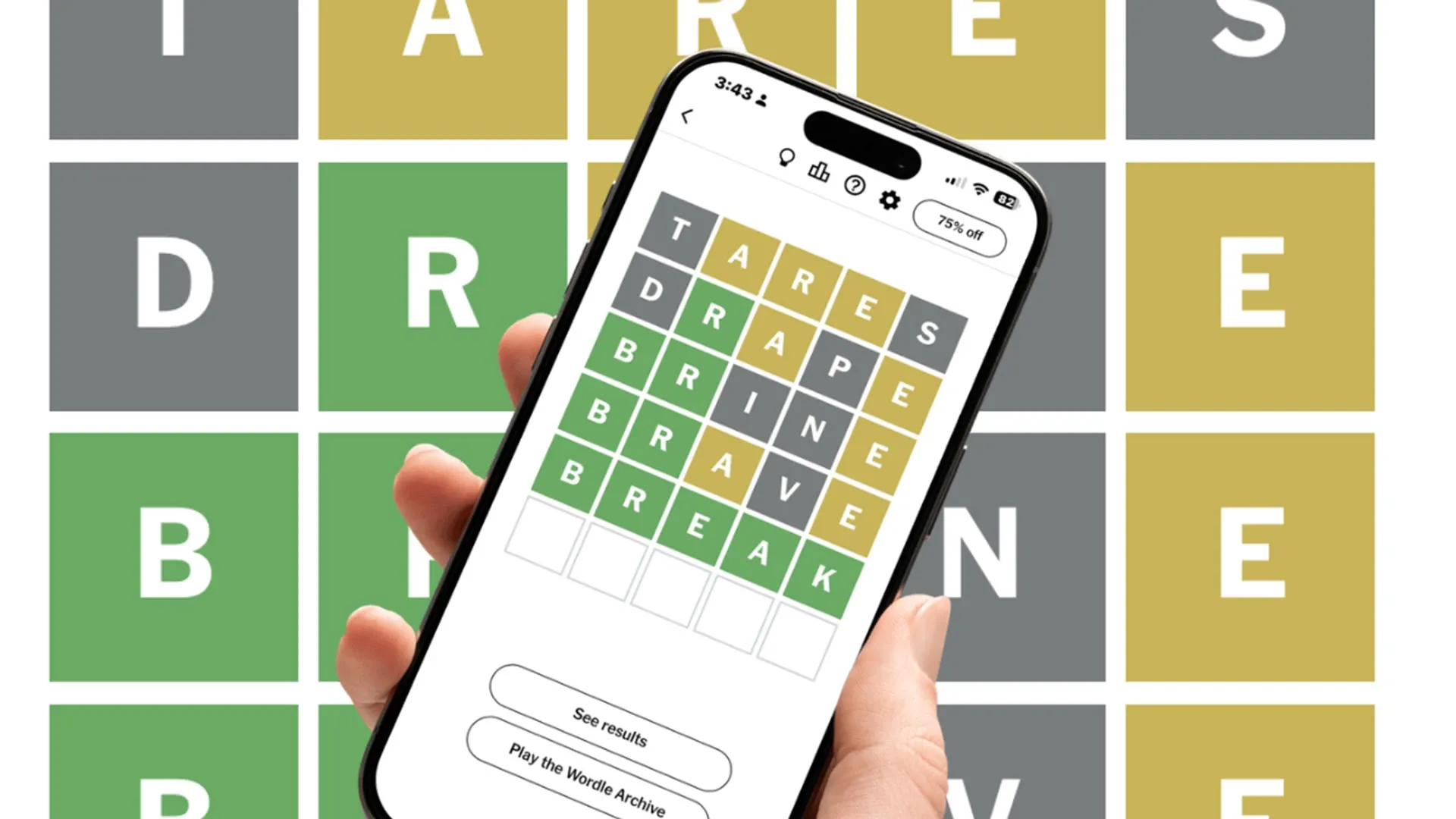
Researchers at Binghamton University have cracked Wordle's code using information theory, developing a strategy that solves the puzzle in 99% of attempts. The approach abandons the common-sense strategy of guessing words filled with frequent letters in favor of a mathematically rigorous method based on Shannon entropy.
Shannon entropy measures the amount of uncertainty or information content in a system. Applied to Wordle, the concept works like this: each guess eliminates possibilities from the remaining answer pool. The optimal strategy doesn't prioritize guessing the most likely answer. Instead, it selects words that maximize information gain, meaning each guess cuts down the remaining possibilities as dramatically as possible, regardless of whether that guess word appears in the actual solution set.
The researchers' method treats Wordle as an information-theoretic problem rather than a word puzzle. The game starts with 2,309 possible solution words from the New York Times word list. The first guess matters enormously. Rather than intuiting a word packed with common letters like E, A, R, O, and T, the algorithm calculates which guess yields maximum entropy reduction. This sometimes means selecting an unusual word that seems like a poor candidate for the answer but splits the remaining possibilities into the most evenly distributed groups.
This strategy diverges sharply from how most human players approach Wordle. Players typically lean on frequency analysis, guessing words with the most common letters to narrow down options. That works reasonably well, but it leaves room for inefficiency. The mathematical approach systematizes the process, converting what feels like guesswork into algorithmic optimization.
The 99% success rate represents a dramatic improvement over human average performance. Most casual players solve Wordle in four to six attempts. The algorithm consistently solves it in three to four attempts. The method shows particular strength when dealing with less obvious letter combinations or when early guesses yield minimal information.
Binghamton University's work builds on decades of information theory research pioneered by Claude Shannon at Bell Labs in the 1940s. Shannon entropy has applications far beyond word games, influencing data compression, cryptography, and machine learning. This Wordle application demonstrates how abstract mathematical principles translate into practical problem-solving.
The research has practical limits. The 99% success rate applies to words within the official Wordle solution list. If the New York Times ever expands or modifies its word set, the strategy would require recalibration. Additionally, the method assumes knowledge of which words the game actually uses as solutions, information the average player lacks. A truly blind approach using only the broader acceptable-word list would yield different results.
The study also highlights why Wordle captivates millions. The puzzle sits at an intersection of randomness and constraint, where mathematical elegance meets human intuition. While an algorithm can optimize the process, the human satisfaction of solving Wordle comes partly from the uncertainty and creative guessing that makes the mathematical approach feel less rewarding to play.