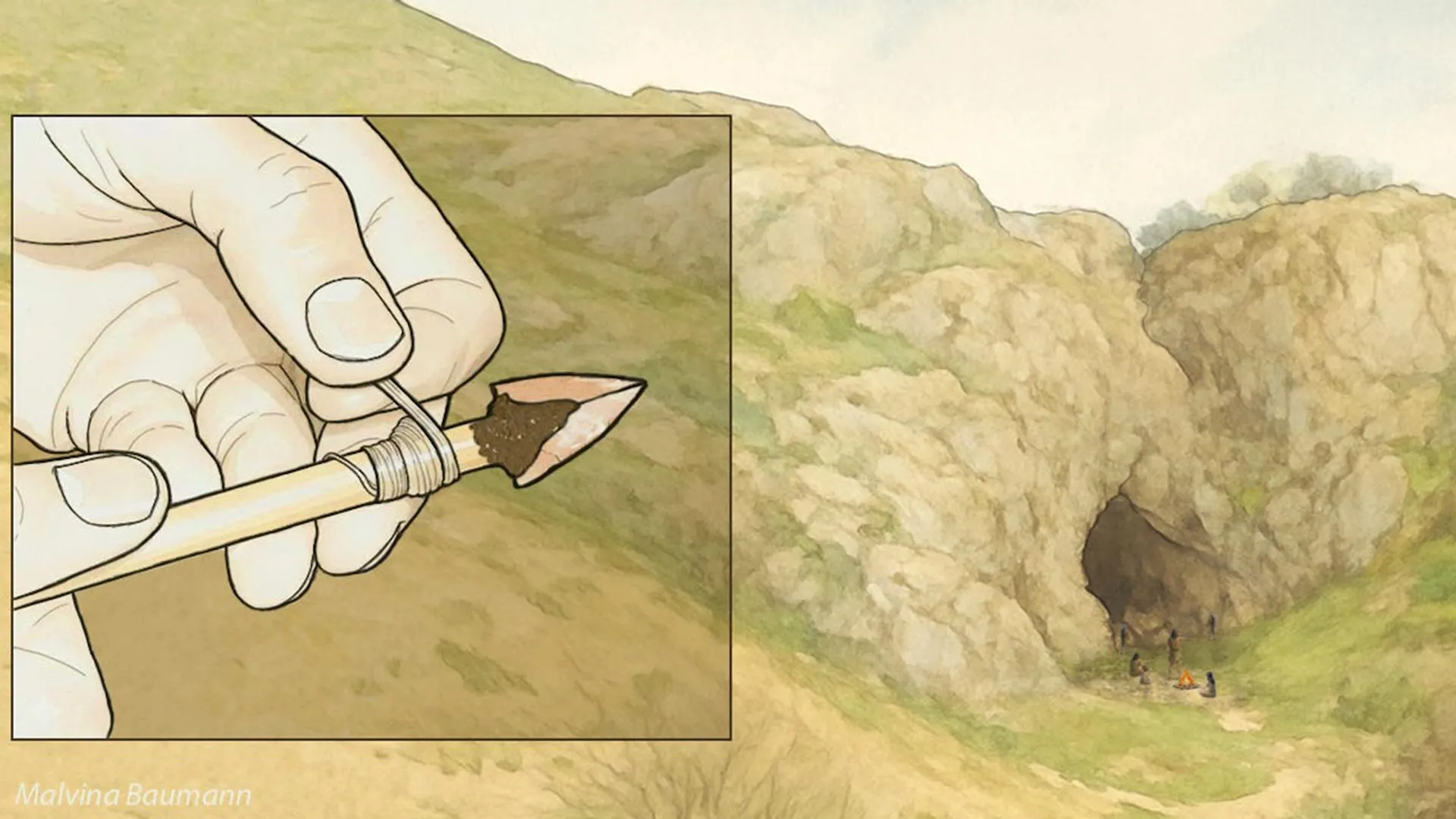
Archaeologists working in Uzbekistan have uncovered evidence that sophisticated projectile weapon technology emerged tens of thousands of years earlier than previously thought, challenging conventional timelines of human technological development and migration patterns across Eurasia.
The discovery centers on tiny projectile points dated to 80,000 years ago, found at archaeological sites in Central Asia. These miniature weapons display distinctive features, including a size and design consistent with stone arrowheads, along with impact damage patterns that match later projectile weapons discovered at Homo sapiens sites in France. The similarity between these ancient Central Asian tools and much younger European artifacts suggests a shared technological innovation rather than independent invention.
The research team examined the physical characteristics and damage signatures of the Uzbekistani points with precision. The wear patterns on the stone weapons revealed fractures consistent with high-velocity impact, the kind of damage produced when a projectile strikes bone or hide. This forensic approach to stone tools provides compelling evidence that these objects functioned as effective hunting weapons rather than serving alternative purposes.
The timing of this discovery carries profound implications for human prehistory. At 80,000 years ago, anatomically modern humans had not yet firmly established themselves across Europe. Yet populations in Central Asia possessed the cognitive and technical sophistication to design, manufacture, and deploy effective projectile weapons. This technological capacity required abstract thinking, planning, and the ability to understand projectile physics, all markers of advanced behavioral sophistication.
The findings suggest that technological innovation did not radiate outward from Europe or follow a simple linear progression from Africa to the rest of the world. Instead, different human populations developed comparable technological solutions independently or through cultural exchange networks spanning vast distances. Central Asia may have served as a crucial innovation hub, with technologies potentially spreading westward toward Europe and eastward toward Asia.
The discovery also raises questions about how long projectile technology persisted in Central Asia and whether later European examples represent independent reinvention or continuity of ancient traditions. Archaeologists will need to excavate additional sites and establish more precise chronologies to address these questions. Dating techniques, artifact analysis, and comparative studies across regions will refine understanding of how this technology spread and evolved.
The work demonstrates how new excavations can overturn established narratives about human capability and migration. For decades, archaeologists emphasized Europe as the center of technological advancement during the late Pleistocene. This Uzbekistani evidence repositions Central Asia as equally capable of supporting innovation, suggesting that human ingenuity emerged across multiple populations simultaneously rather than concentrating in specific geographic regions.
Researchers must now determine whether additional sites in Central Asia yield similar projectile points, whether older or younger examples exist, and how this technology relates to broader patterns of tool use and hunting strategies. Each new discovery adds texture to the emerging picture of human prehistory, one in which innovation was distributed, adaptive, and sometimes remarkably similar across populations separated by vast distances.