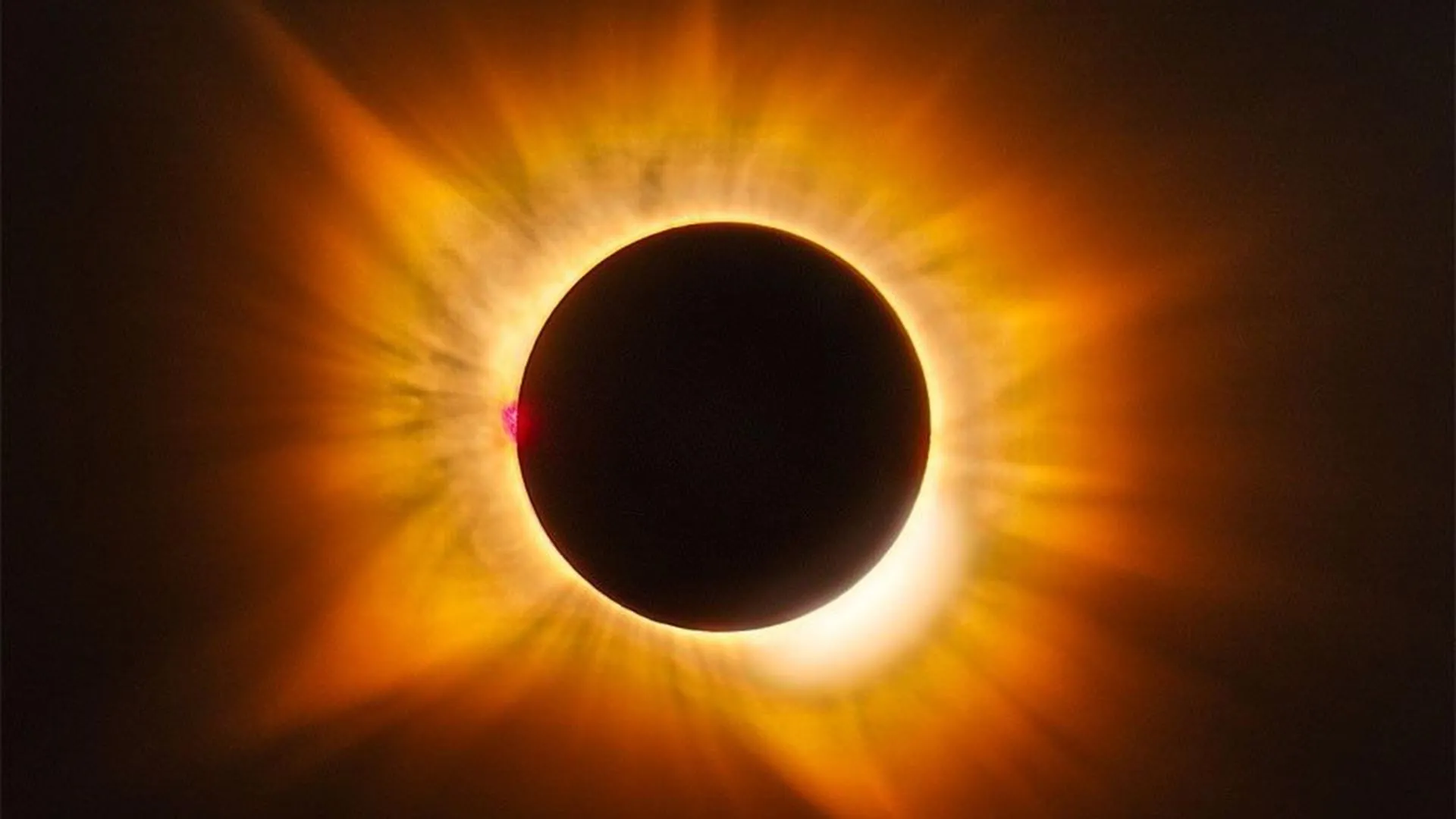
During Spain's recent total solar eclipse, observers witnessed an unusual golden corona instead of the typical pearly white glow that surrounds the Sun during totality. This striking color shift resulted from two atmospheric factors combining at once.
The Sun's position near the horizon as it set meant its light traveled through a much thicker layer of Earth's atmosphere before reaching observers. This extended path through air naturally filters shorter blue wavelengths, leaving longer red and yellow wavelengths to dominate. Simultaneously, smoke from nearby wildfires added another filtering layer, further removing blue light from the spectrum.
The combination created a dramatic golden halo around the Moon's silhouette. Adding to the spectacle, a bright pink solar prominence remained visible during totality, the prominence appearing more vivid against the golden corona rather than the typical white backdrop.
The corona normally appears white because the Sun's outer atmosphere emits light across the full visible spectrum. During a total solar eclipse, when the Moon blocks the Sun's bright disk, the fainter corona becomes visible to the naked eye. However, atmospheric conditions profoundly affect how observers perceive this light.
This eclipse demonstrates how Earth's atmosphere acts as a filter, selectively transmitting certain wavelengths. Similar effects occur during sunset, when the Sun appears orange or red for the same reason. Wildfire smoke compounds this filtering effect by introducing additional particles that scatter and absorb light.
The Spain eclipse represents a rare convergence of astronomical and meteorological conditions. Most total solar eclipses occur with the Sun higher in the sky, where less atmosphere lies between the Sun and observers. Clear skies also typically accompany eclipse viewing sites, minimizing smoke interference. The combination of a low Sun position and active wildfires created a unique optical event that observers won't experience during every eclipse.