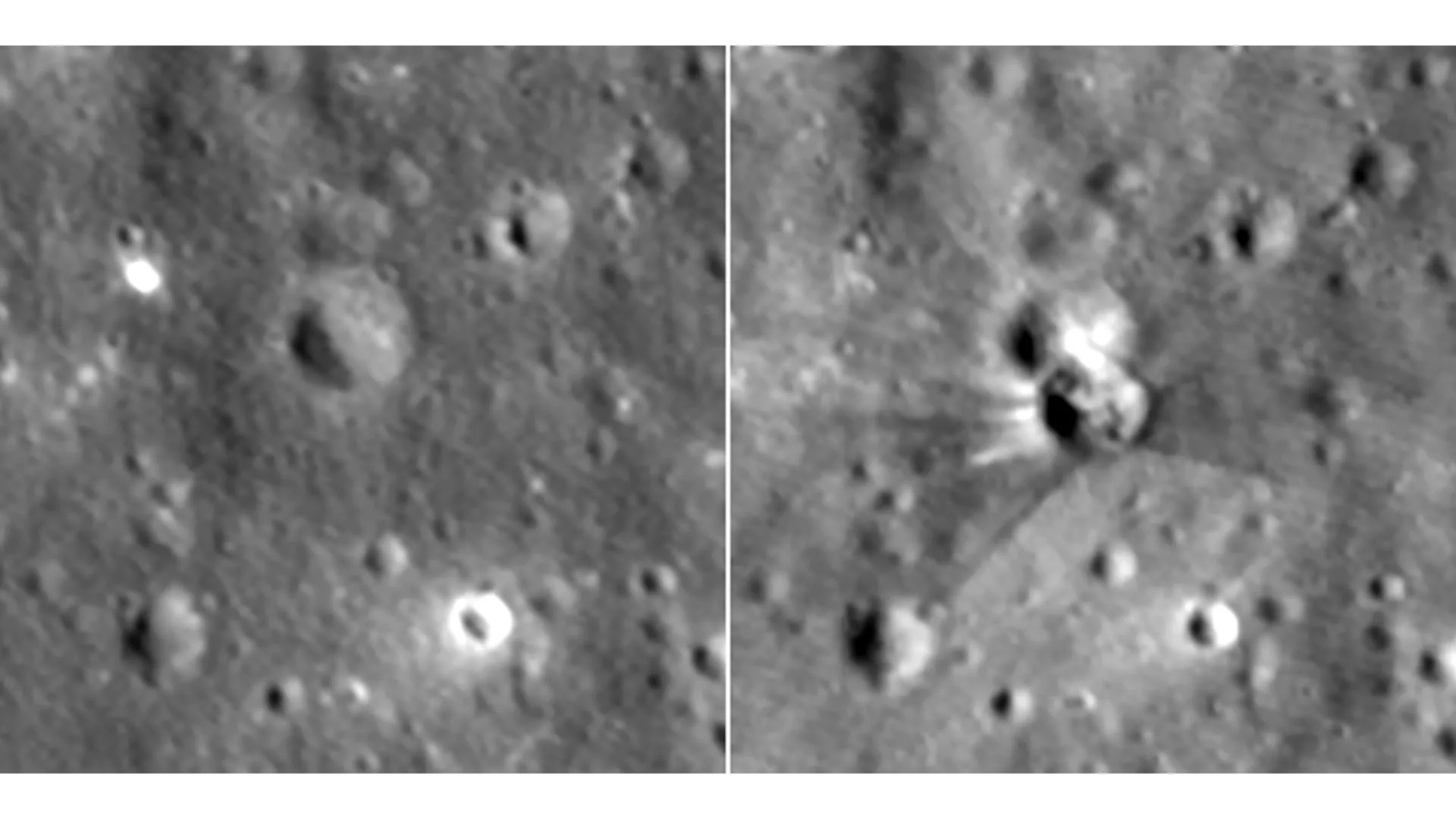
A spent SpaceX Falcon 9 rocket stage struck the Moon on August 5, creating a crater roughly 60 feet across. NASA's Lunar Reconnaissance Orbiter photographed the impact site, revealing bright and dark debris trails radiating across the lunar surface.
The collision exposed fresh subsurface material, offering scientists an unintended window into the Moon's geology. The streaking patterns visible in the orbiter's images result from the violent ejection of regolith and rock during impact. Bright material typically indicates younger, less weathered lunar dust, while darker streaks suggest older or compositionally different debris.
This represents one of the few confirmed instances of human-made debris striking the Moon with sufficient force to create an observable crater. The Falcon 9 upper stage reached the lunar surface after years drifting through space following a 2015 lunar gravity assist maneuver. Orbital mechanics eventually destabilized the rocket's trajectory, sending it on a collision course with the Moon.
The impact poses no safety risk to human missions or existing lunar infrastructure. However, it underscores the growing volume of debris accumulating in cislunar space as spaceflight activity intensifies. SpaceX and other launch providers generate spent stages routinely, and tracking their long-term trajectories remains challenging.
NASA's Lunar Reconnaissance Orbiter, operational since 2009, frequently documents impact craters and surface changes across the Moon. The instrument's high-resolution imaging capability enables researchers to measure crater dimensions, analyze ejecta patterns, and extract compositional data from freshly exposed material. Such observations contribute to broader maps of lunar geology and weathering processes.
As lunar exploration accelerates with planned crewed missions and commercial activity, managing space debris becomes increasingly relevant. The impact serves as a reminder that objects in cislunar orbit require constant monitoring to predict collision scenarios and mitigate risks for