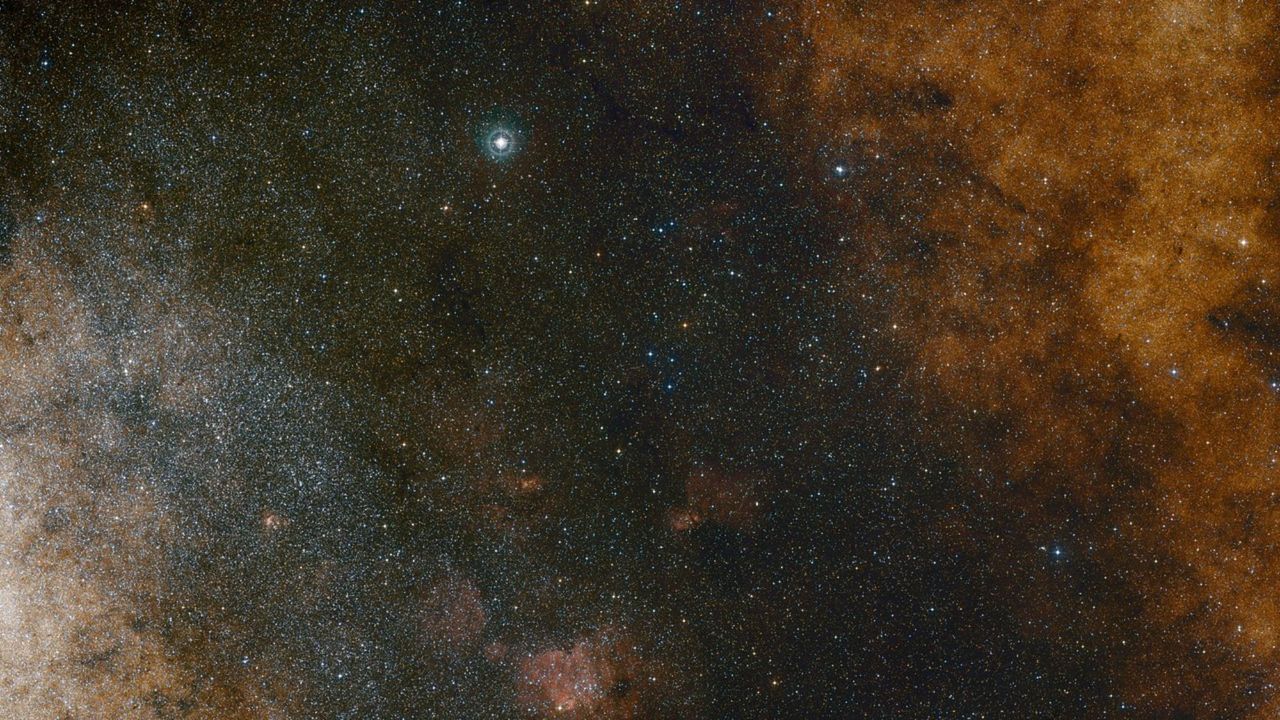
Astronomers discovered the fastest star ever observed in the Milky Way, traveling at 15,500 miles per second as it orbits Sagittarius A*, the supermassive black hole anchoring our galaxy's center.
The star's extreme velocity stems from its proximity to Sagittarius A*, where gravitational forces reach extraordinary intensities. Objects closer to a black hole experience stronger gravitational pulls, accelerating them to relativistic speeds that would be impossible anywhere else in the galaxy.
This discovery builds on decades of research tracking stellar orbits near the galactic core. Since the 1990s, astronomers have monitored stars in this region using infrared telescopes that penetrate the dust obscuring the galactic center from visible light. Each observation refined measurements of how fast these objects move around Sagittarius A*.
The star's faintness presents observational challenges. Detecting it required sensitive instruments and careful analysis to distinguish its signal from background noise and nearby stellar objects. Yet its rapid motion makes it scientifically valuable, offering a natural probe of spacetime itself in one of the universe's most extreme environments.
The findings help astronomers understand the mass and properties of Sagittarius A*, which contains about 4.1 million times the sun's mass. By measuring how stars orbit the black hole, researchers calculate its gravitational influence with precision impossible through other methods.
The discovery also tests general relativity in the strong gravitational regime where Einstein's theory makes predictions fundamentally different from older physics. If the black hole's properties deviated from theoretical expectations, stars nearby would follow different orbital paths than predicted. So far, observations confirm general relativity's predictions, even as black hole science explores increasingly extreme conditions.
This star joins a small catalog of ultra-fast objects near Sagittarius A*. As telescope technology improves and astronomers compile longer observational records, they continue finding