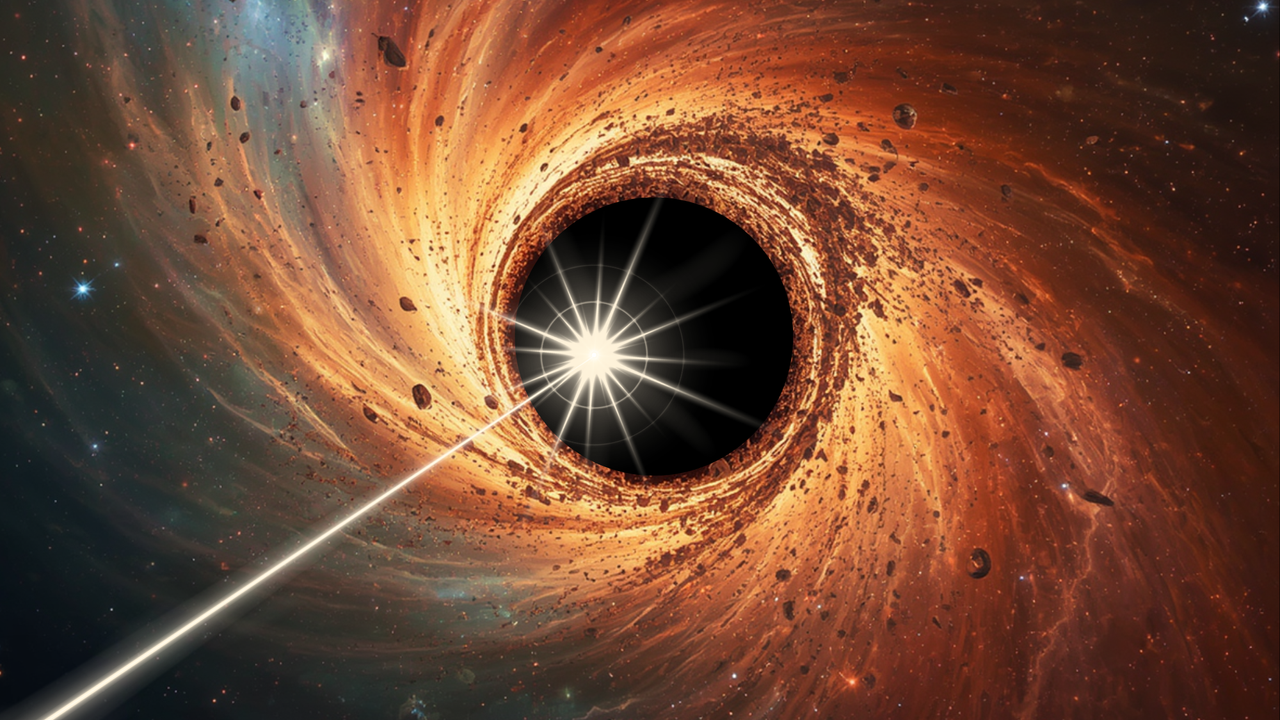
Astronomers have detected evidence that dark matter is gravitationally lensing the jets emitted from a distant blazar, offering a new window into understanding both supermassive black holes and the invisible matter that dominates the universe.
A blazar is an active galactic nucleus with jets pointed directly at Earth. The jets travel at nearly the speed of light and emit intense radiation across multiple wavelengths. In this case, researchers identified that an unseen clump of dark matter positioned between the blazar and Earth is bending and magnifying the jet's light through gravitational lensing, the same phenomenon Einstein predicted over a century ago.
This discovery carries twin scientific benefits. First, it reveals information about the behavior of supermassive black holes as they actively accrete material and launch powerful jets into space. The magnification effect allows astronomers to observe details of the jet structure that would otherwise remain invisible to current telescopes.
Second, and perhaps more intriguingly, the dark matter clump itself becomes a subject of study. By analyzing how the lensing distorts the blazar's light, researchers can infer properties of the dark matter distribution, including its mass and spatial extent. This approach offers a novel method for mapping dark matter that doesn't require it to emit or absorb light directly.
The discovery also connects to neutrino astronomy. Blazars rank among the leading candidates for producing the high-energy cosmic neutrinos detected by observatories like IceCube. Dark matter lensing could amplify not only the electromagnetic radiation from blazars but potentially their neutrino output as well, making these distant sources more detectable for neutrino telescopes searching for the origins of these elusive particles.
The research demonstrates how gravitational lensing can serve as a tool for multimessenger astronomy, where information arrives in different forms: light, neutrinos, and gravitational waves