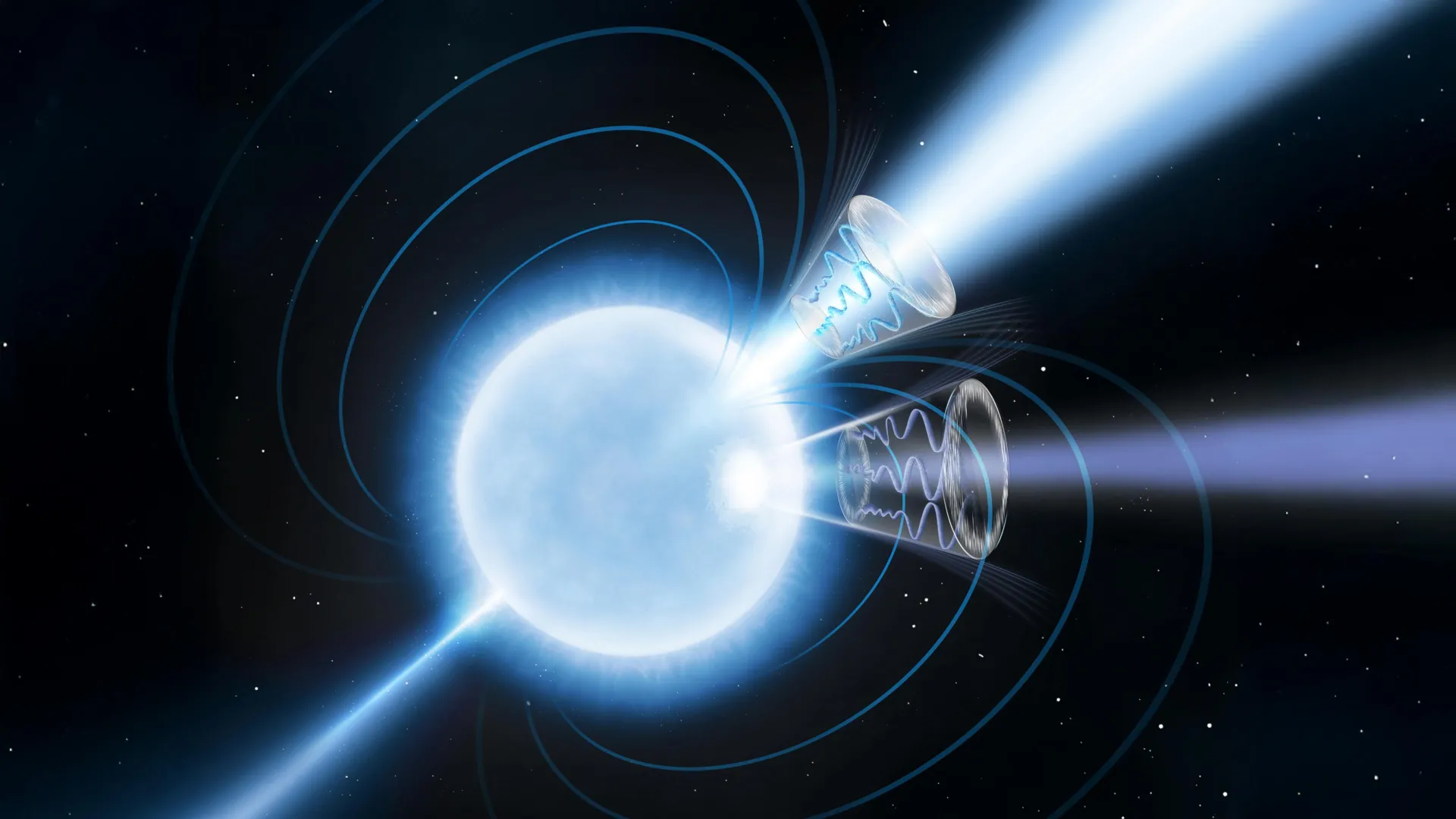
Researchers analyzing radiation from an extremely magnetic neutron star may have detected a quantum effect that challenges our understanding of empty space. The phenomenon, called vacuum birefringence, was predicted by physicist Werner Heisenberg in 1936 but has never been directly observed until now.
The team studied light from a magnetar, a neutron star with a magnetic field billions of times stronger than Earth's. According to quantum field theory, such intense magnetic fields should warp the behavior of light traveling through seemingly empty space. Specifically, the light's polarization—the orientation of its electromagnetic waves—should shift in predictable ways.
The researchers found exactly this polarization shift in data from the magnetar. This alignment with Heisenberg's prediction provides the first direct evidence that vacuum birefringence actually occurs in nature. The effect emerges because the quantum vacuum is not truly empty. Instead, it seethes with virtual particle-antiparticle pairs that briefly pop in and out of existence. An intense magnetic field influences these ghostly particles, which in turn affects how photons travel through space.
Confirming this discovery requires additional observations and peer review. The magnetar's extreme conditions create an ideal laboratory for testing quantum field theory predictions that remain inaccessible in terrestrial experiments. Future observations of similar objects could strengthen the evidence and reveal new properties of the quantum vacuum.
The implications extend beyond fundamental physics. Understanding vacuum birefringence could inform research into quantum electrodynamics and the behavior of light in extreme environments. It also demonstrates how astronomical objects serve as natural laboratories for testing physics that cannot be replicated on Earth.
This finding bridges the gap between abstract quantum theory and observable cosmic phenomena, offering astronomers a new tool for exploring the quantum realm's deepest mysteries.