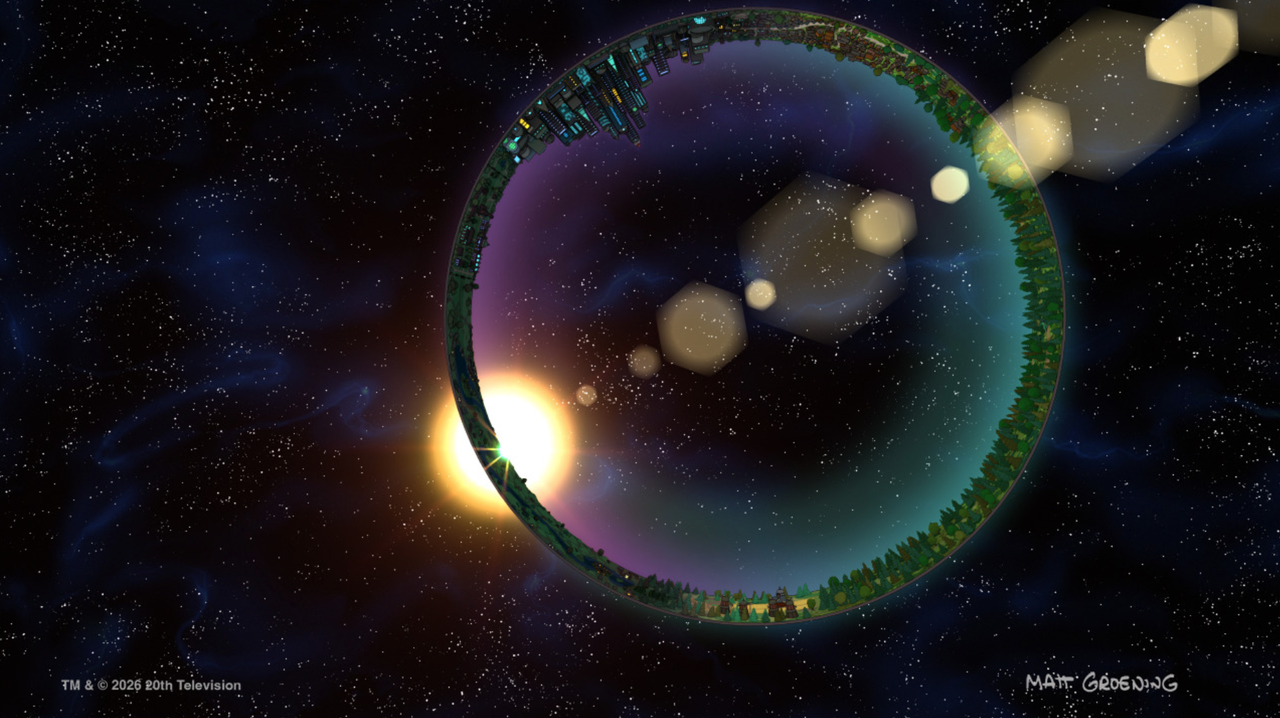
# Futurama Returns to Ring World Concept in Latest Episode
The animated series "Futurama" tackles a classic science fiction trope in its newest episode, featuring a ring-shaped megastructure inhabited by superintelligent rats. The episode plays on the long-standing fascination in speculative fiction with Niven rings, megastructures that could theoretically encircle a star to harness its energy output.
The show's writers named the fictional world "Wheel World," a tongue-in-cheek reference to its ring geometry. Ring worlds have appeared throughout science fiction, most famously in Larry Niven's 1970 novel "Ringworld," which explored the engineering and civilization possibilities of such a structure. The concept remains popular because ring worlds solve the Dyson sphere problem of structural stability while providing enormous surface area for habitation.
The choice to populate this ring with superintelligent rats adds a comedic twist to hard science fiction concepts. The episode uses the ring world not merely as backdrop but as part of its narrative about intelligence, civilization, and the absurdist humor that defines "Futurama." The show, which has cycled through cancellations and revivals since its 1999 debut, continues drawing on legitimate astrophysical and astronomical concepts while applying its trademark irreverent comedy.
"Futurama" has a long history of anchoring episodes in real science. The series employs actual physicists as consultants and has built jokes around legitimate scientific principles, from time dilation to robotics ethics. By framing the rat civilization on a ring world, the episode engages viewers familiar with hard science fiction while remaining accessible to casual viewers.
The ring world concept remains theoretically plausible, though building one would require matter and energy far exceeding anything humanity currently possesses. Scientists continue publishing papers exploring the engineering requirements, habit