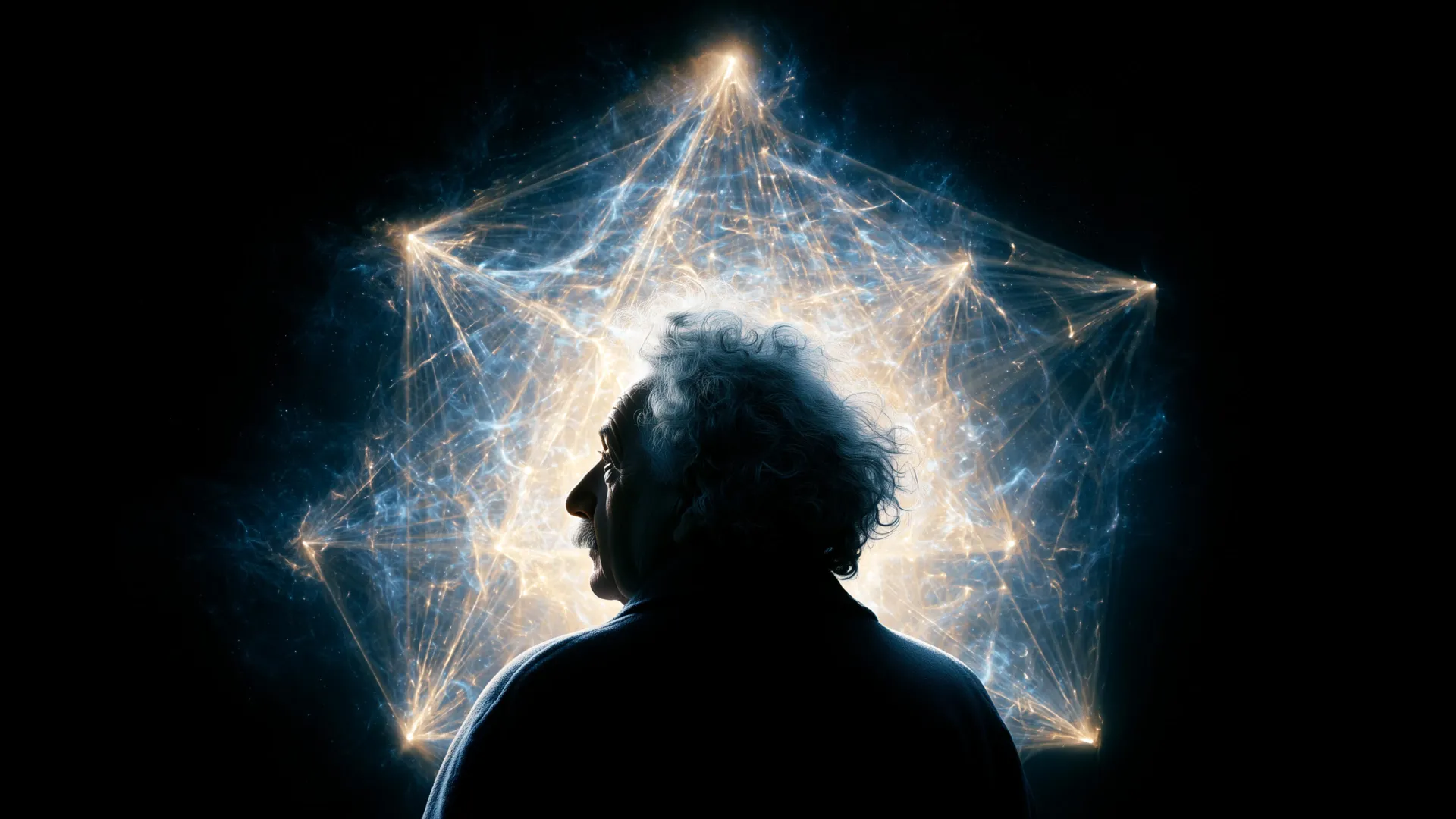
Albert Einstein famously dismissed his cosmological constant as his "biggest blunder." He introduced the term in 1917 to keep the universe static, then abandoned it after Edwin Hubble's 1929 discovery that the universe was expanding. Decades later, the constant returned with dramatic vindication.
In 1998, astronomers studying distant supernovae made a stunning observation. Saul Perlmutter, Adam Riess, and Brian Schmidt led teams that found the universe's expansion was accelerating, not slowing down as gravity should cause. This discovery upended decades of cosmological thinking and earned the three scientists the 2011 Nobel Prize in Physics.
The cosmological constant provided the perfect explanation. Einstein's abandoned mathematical term, now reinterpreted as dark energy, accounts for roughly 68 percent of the universe's mass-energy content. It acts as a repulsive force, counteracting gravity and driving accelerated expansion.
Today, the Lambda-Cold Dark Matter model, which incorporates the cosmological constant, stands as cosmology's reigning framework. It successfully predicts the cosmic microwave background's temperature fluctuations, galaxy cluster distributions, and large-scale structure across billions of light-years. The model's predictive power appears remarkable.
Yet tensions lurk beneath this success. The Hubble constant, measuring expansion rate, shows different values depending on measurement method. Local measurements from nearby galaxies yield higher values than observations of the early universe suggest. This discrepancy, persistent across multiple independent surveys, hints that something fundamental may be incomplete in our current model.
Additionally, physicists struggle to explain dark energy's origin theoretically. The quantum vacuum energy predictions exceed observations by 120 orders of magnitude, a gap physicists call the "worst prediction in science." Some theorists propose modified gravity theories or time-varying dark energy as alternatives.
Einstein's cosmological