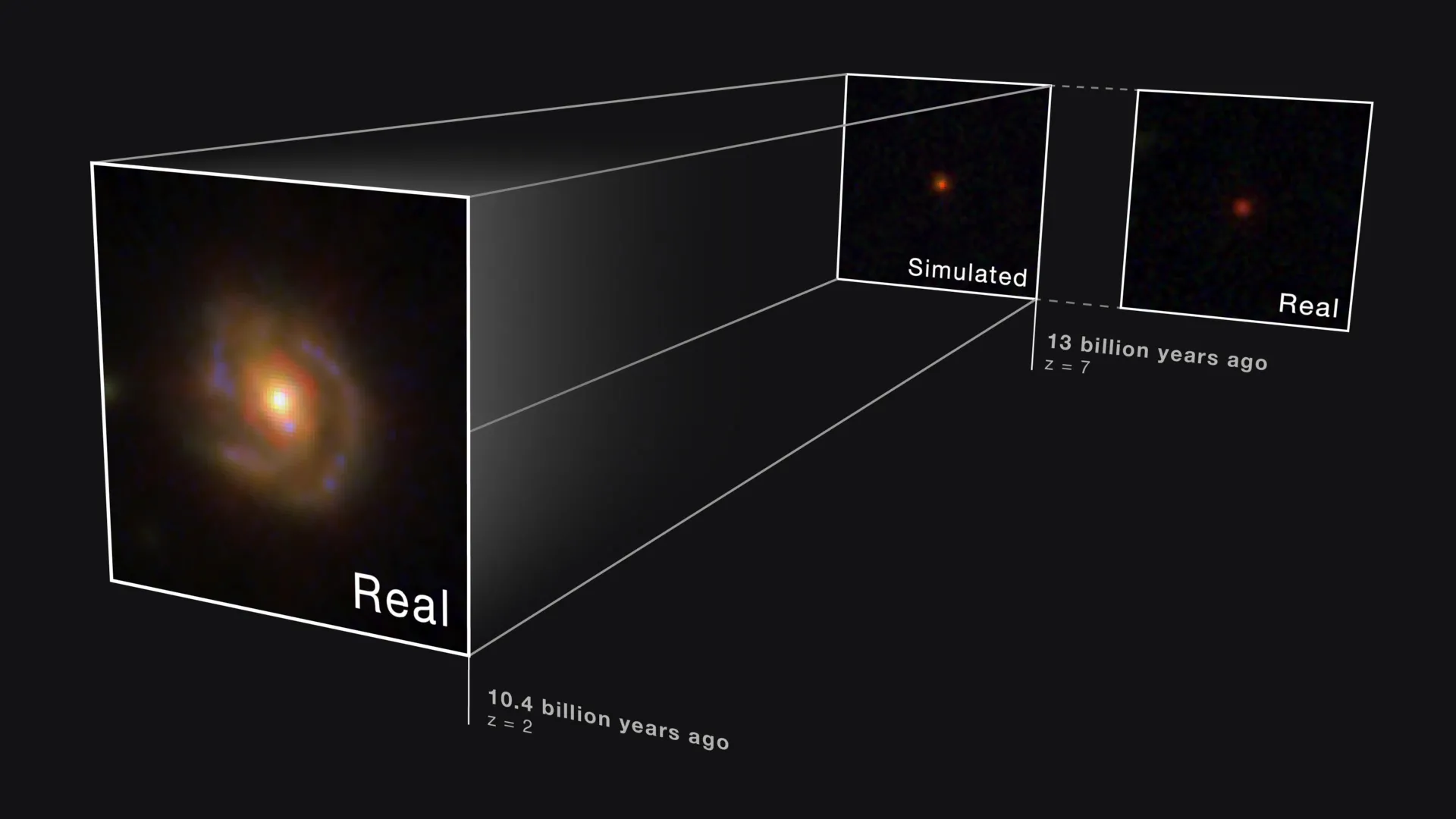
Astronomers using the James Webb Space Telescope have identified a potential explanation for the "little red dots" that puzzle researchers studying the early universe. These mysterious objects appear far more frequently in the cosmos than existing galaxy formation models predict.
Researchers studying a nearby spiral galaxy called the "Saguaro" discovered a compact, intensely bright red center that closely matches the properties of these distant enigmatic objects. The critical finding emerged when scientists simulated how the Saguaro would appear from much greater distances. The galaxy's spiral structure became invisible at those scales, revealing only the brilliant red core.
This discovery suggests the little red dots may not be exotic objects at all, but rather the brilliant central regions of ordinary galaxies whose outer structures remain too faint for current telescopes to detect. The red color results from dust obscuring ultraviolet and visible light, allowing only infrared radiation to escape toward Earth.
The Webb telescope, which observes primarily in infrared wavelengths, may be inherently biased toward detecting these red cores while missing the fainter surrounding galaxies. This would explain why astronomers find so many more little red dots than predicted by simulations of galaxy formation and evolution.
The implication carries weight for cosmology. If these objects represent standard galaxies rather than previously unknown phenomena, it reconciles observations with theoretical predictions about how galaxies developed in the early universe. However, the research also highlights a fundamental limitation of Webb's current capabilities. The telescope cannot easily observe the full extent of dusty galaxies, potentially skewing astronomers' understanding of the universe's composition and structure.
Further observations using complementary telescopes operating at different wavelengths could help confirm whether the little red dots are indeed hiding entire galaxies. This would require detecting the faint outer regions that simulations suggest should surround the bright centers. The Saguaro galaxy provides a local laboratory for testing these hypotheses before applying conclusions to