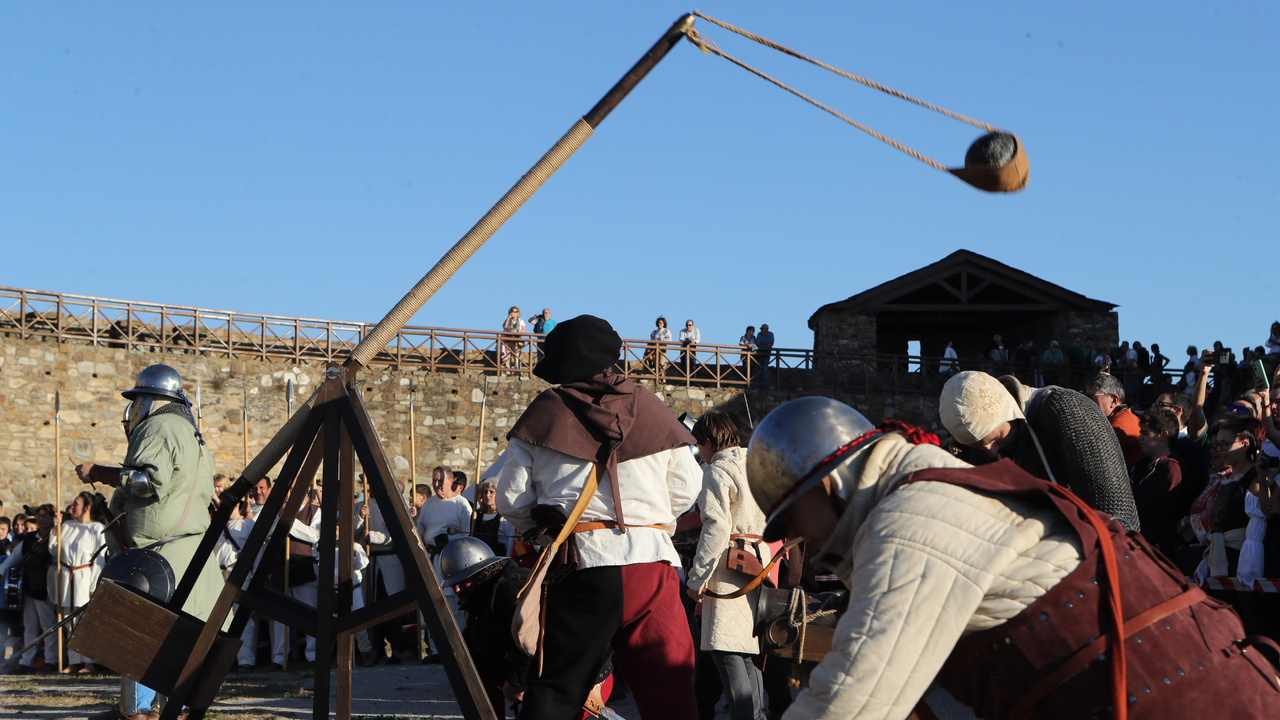
A medieval skeleton discovered near a Scottish castle bears evidence of catastrophic injury consistent with impact from a trebuchet, the medieval siege weapon. The remains show 167 fractures distributed across the skeleton in patterns that researchers believe match direct contact from a projectile launched by a trebuchet known as the "War Wolf."
The skeleton was found buried at Stirling Castle in Scotland. Historical records indicate that Edward I of England deployed the War Wolf during his 1304 siege of the castle. The weapon was one of the largest and most powerful trebuchets ever constructed. If the identified remains do belong to a War Wolf victim, this skeleton would represent rare physical evidence of a specific historical military event.
The fracture pattern on the bones provides the primary evidence for this hypothesis. The researchers analyzed the distribution and nature of the breaks, finding them consistent with blunt force trauma from a single, high-velocity impact rather than from conventional weapons like swords or arrows, or from falling debris. The concentration and severity of fractures across multiple skeletal regions suggests a direct hit from a heavy projectile.
However, significant limitations exist. The skeleton has not been definitively dated to 1304, and the exact cause of death cannot be proven beyond uncertainty. Medieval combat and construction accidents could produce similar fracture patterns. Additionally, the War Wolf was used only briefly during that specific siege, limiting the window for attribution.
The discovery provides a tangible connection to medieval military technology and Edward I's military campaigns in Scotland. Trebuchets like the War Wolf represent the pinnacle of siege engineering in the medieval period. Direct evidence of their effects on human remains remains extremely rare in the archaeological record.
Researchers involved in the analysis have not yet published formal peer-reviewed findings in a major archaeological or historical journal, though the discovery has generated significant media attention. Further analysis and potential radiocarbon dating could strengthen or challenge the current interpretation.