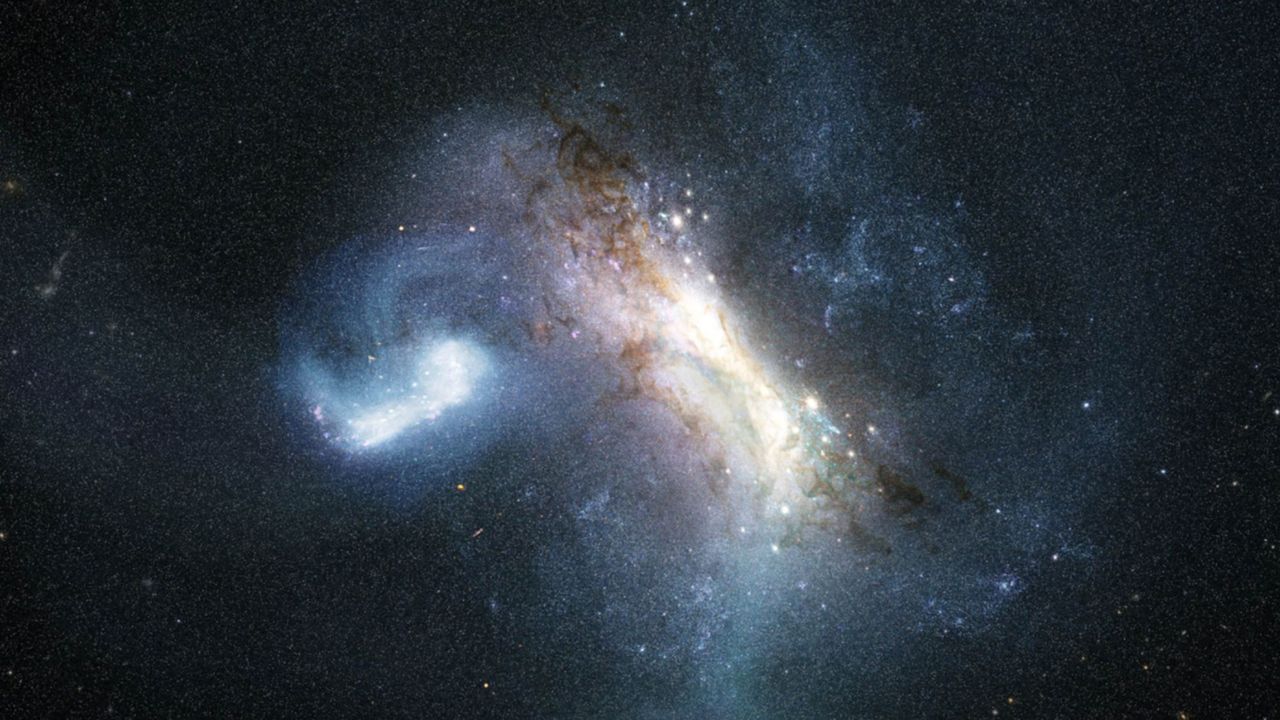
Astronomers have discovered evidence that the Milky Way collided with another galaxy in its distant past, fundamentally reshaping our galaxy's structure and composition. This ancient merger left an imprint that researchers are only now detecting through advanced observational techniques.
The collision occurred billions of years ago when a dwarf galaxy crashed into the Milky Way. The impact redistributed stars, gas, and dark matter throughout our galaxy, altering its spiral structure and stellar populations. Evidence for this merger appears in the distribution of older stars and chemical abundance patterns that reveal a distinct population from an intruding system.
Astronomers identified this merger by analyzing stellar kinematics and chemical signatures using data from space telescopes and ground-based observatories. Stars belonging to the disrupted galaxy retain different orbital patterns and chemical compositions compared to native Milky Way stars. These signatures act as archaeological markers, allowing researchers to reconstruct the collision's timeline and characteristics.
This discovery fits into a broader understanding of galactic evolution. Astronomers now recognize that most large galaxies, including the Milky Way, assembled themselves through multiple mergers with smaller systems over cosmic history. Each collision triggered bursts of star formation and rearranged galactic architecture.
The Milky Way faces another merger in its future. The Andromeda Galaxy, our nearest large galactic neighbor, will collide with the Milky Way in approximately 4.5 billion years. Understanding how ancient mergers shaped our galaxy provides context for predicting how Andromeda's impact will transform us further.
Current research relies on precise measurements of stellar motions and compositions from missions like Gaia, which catalogs positions and velocities of nearly two billion stars. These datasets enable astronomers to trace back the origins of stellar populations and identify interlopers from merged galaxies.
The discovery underscores how dynamic galaxies truly are across cosmic timesc