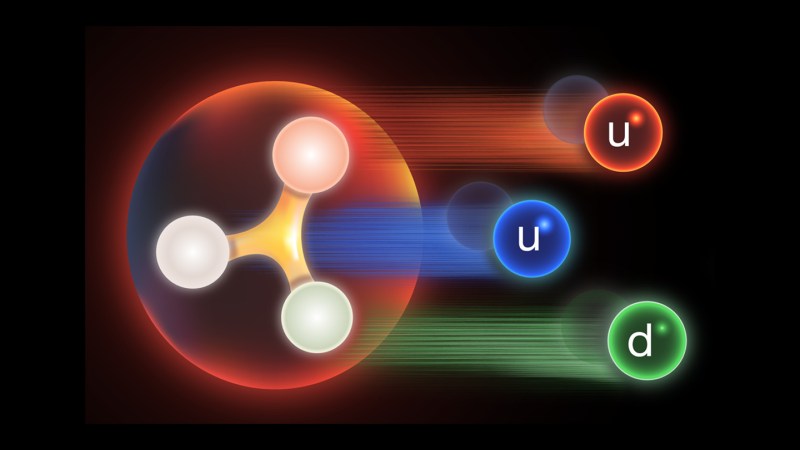
Physicists have discovered that gluons, the particles that bind quarks together inside protons, play a deeper role than previously understood. Beyond their mechanical function of holding protons intact, gluons appear to help establish the proton's fundamental identity through baryon number, a quantum property central to particle physics.
Baryon number is a conserved quantity that distinguishes baryons, the heavy particles that include protons and neutrons, from other particle types. Researchers have long assumed this property originated solely from the quarks within the proton. However, new theoretical and experimental work suggests gluons actively contribute to defining baryon number as well.
This finding reshapes understanding of how quantum properties distribute across the subatomic world. The work indicates that gluons carry baryon number, not as isolated objects but through collective quantum effects that emerge from their field interactions. When gluons mediate the strong force binding quarks together, they simultaneously participate in establishing what makes a proton a baryon rather than some other particle type.
The research builds on decades of investigations into proton structure. Previous studies focused on how quarks and gluons share the proton's momentum and angular momentum. This latest work extends that framework by revealing gluons' contribution to baryon number conservation, one of nature's fundamental symmetries.
Understanding this mechanism has implications for deeper questions in particle physics. Baryon number conservation underpins why protons don't spontaneously decay into lighter particles, a stability that allows matter itself to exist. If gluons truly participate in generating this property, it suggests the strong force plays a more foundational role in defining particle identity than the Standard Model currently emphasizes.
Scientists emphasize the work remains theoretical and requires confirmation through precision experiments at facilities like the Large Hadron Collider or through advanced computational models. The discovery nevertheless points toward a more unified picture of how the fundamental forces