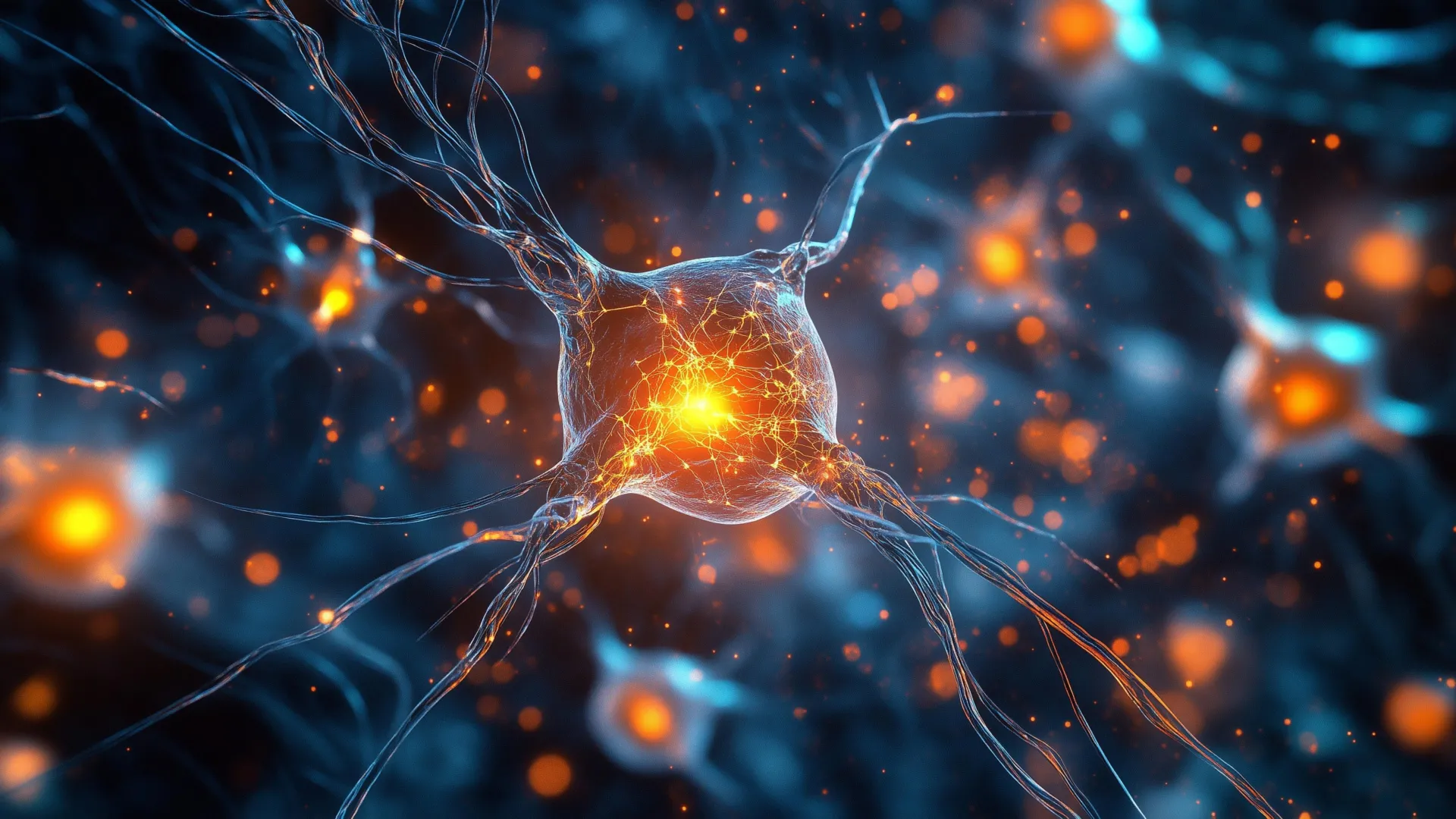
Cortical neurons in the human brain perform far more complex computations than scientists previously understood, according to new research. The findings suggest individual brain cells function more like sophisticated biological computers than simple binary switches, potentially explaining how the brain generates abstract thinking, language, and mathematical reasoning.
Researchers discovered that single neurons can execute intricate mathematical operations. This capability reshapes the long-held model treating neurons as simple relay stations that either fire or remain inactive. The complexity lies in how these cells process incoming signals from thousands of synaptic connections, then integrate that information in nonlinear ways.
The implications for neuroscience are substantial. If individual neurons possess greater computational power than previously thought, the brain's overall processing capacity may be far higher than current models suggest. This could explain how roughly 86 billion neurons generate the richness of human cognition, from abstract reasoning to creative problem-solving.
The research underscores why the brain remains remarkably efficient despite its energy constraints. Rather than requiring vast neural networks for every mental operation, individual neurons can handle more sophisticated calculations independently. This efficiency may also clarify why the brain maintains such remarkable adaptability and learning capacity across the lifespan.
However, understanding how these individual computational abilities translate into emergent brain-wide phenomena remains an open question. Scientists still need to determine how millions of these powerful neurons coordinate to produce conscious thought, memory storage, and the seamless integration of sensory information. The findings also raise questions about how damage to even small neural populations might disrupt complex cognitive functions.
This work builds on decades of neuroscience research gradually revealing neuronal sophistication. Previous studies showed neurons possess unexpected plasticity and can form new connections throughout life. This latest discovery extends that picture, positioning individual neurons as participants in cognition rather than merely passive components of larger circuits. Future research will likely focus on mapping how neural computation scales from single cells to systems-level brain function.