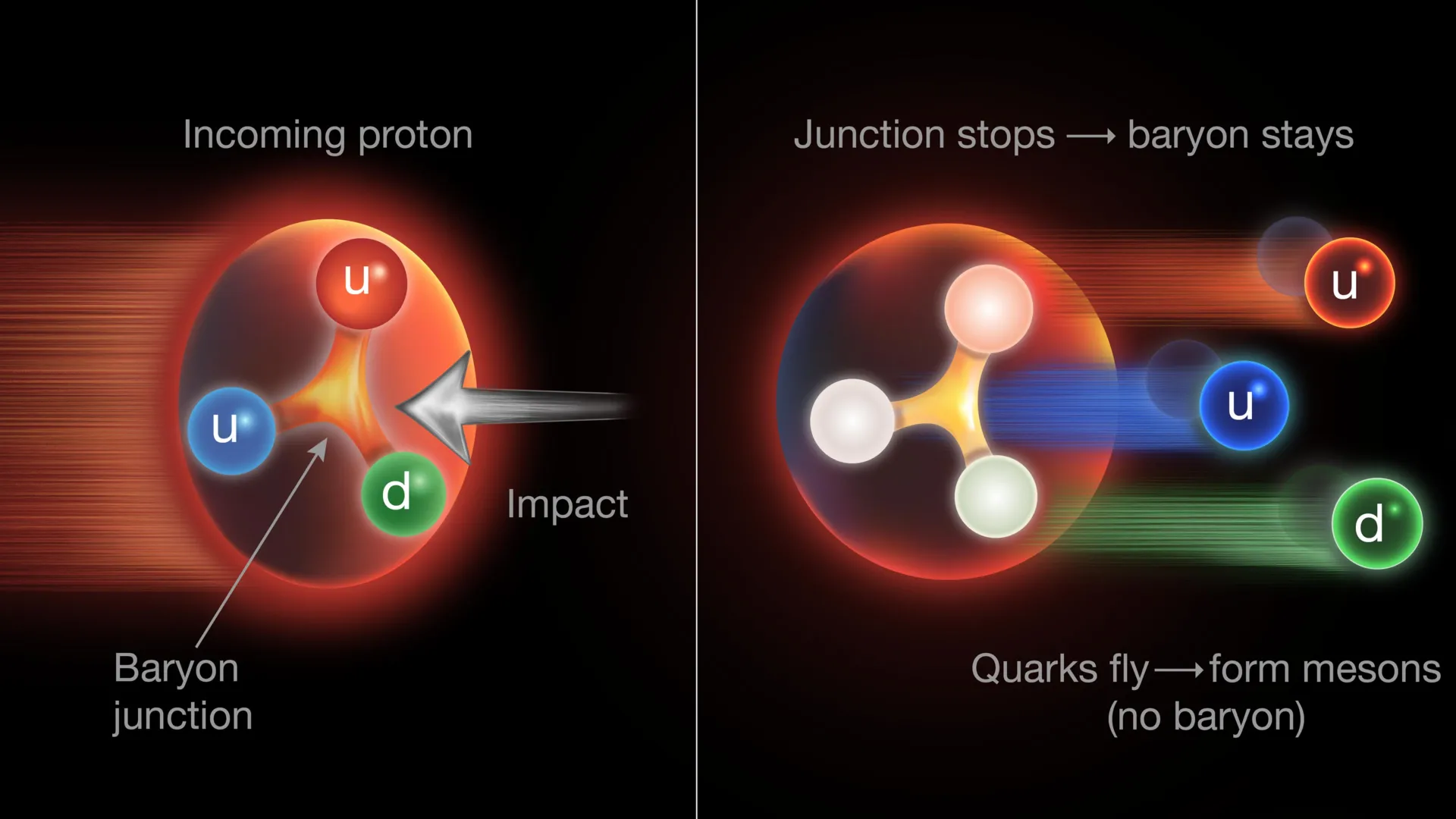
Physicists analyzing collision data from the Relativistic Heavy Ion Collider (RHIC) have discovered an unexpected internal structure in protons that upends decades of textbook understanding about how these particles maintain stability. Rather than baryon number—a quantum property essential to matter's conservation—residing simply in three quarks, the research reveals it concentrates at a Y-shaped junction formed by gluons that bind those quarks together.
The finding emerged from detailed analysis of high-energy proton collisions captured at RHIC, a particle accelerator operated by Brookhaven National Laboratory. Scientists identified signatures suggesting gluons arrange themselves into a distinctive junction geometry at the proton's core. This structure appears to play an active role in preserving baryon number, a conservation law that prevents protons from decaying and thus keeps ordinary matter stable.
The discovery challenges the conventional quark model taught in physics courses for over fifty years. That model treats baryon number as a simple property carried by three valence quarks. The new evidence indicates the story involves a more intricate interplay between quarks and gluons, with gluon topology itself contributing fundamentally to how matter maintains its identity.
Baryon number conservation underpins nuclear and particle physics. Without it, protons would gradually decay into lighter particles, dissolving the atoms that form all visible matter. Understanding the mechanism preserving this quantity at the subatomic level addresses a deep question about why the universe contains stable matter rather than energetic radiation.
The research opens several directions for future investigation. Scientists must now determine how universal this Y-shaped gluon junction proves across different proton interactions and at various energy scales. Theorists will need to incorporate these findings into quantum chromodynamics, the theory governing strong nuclear forces and gluon behavior.
While the RHIC data provide compelling evidence, physicists recognize limitations inherent in collision experiments