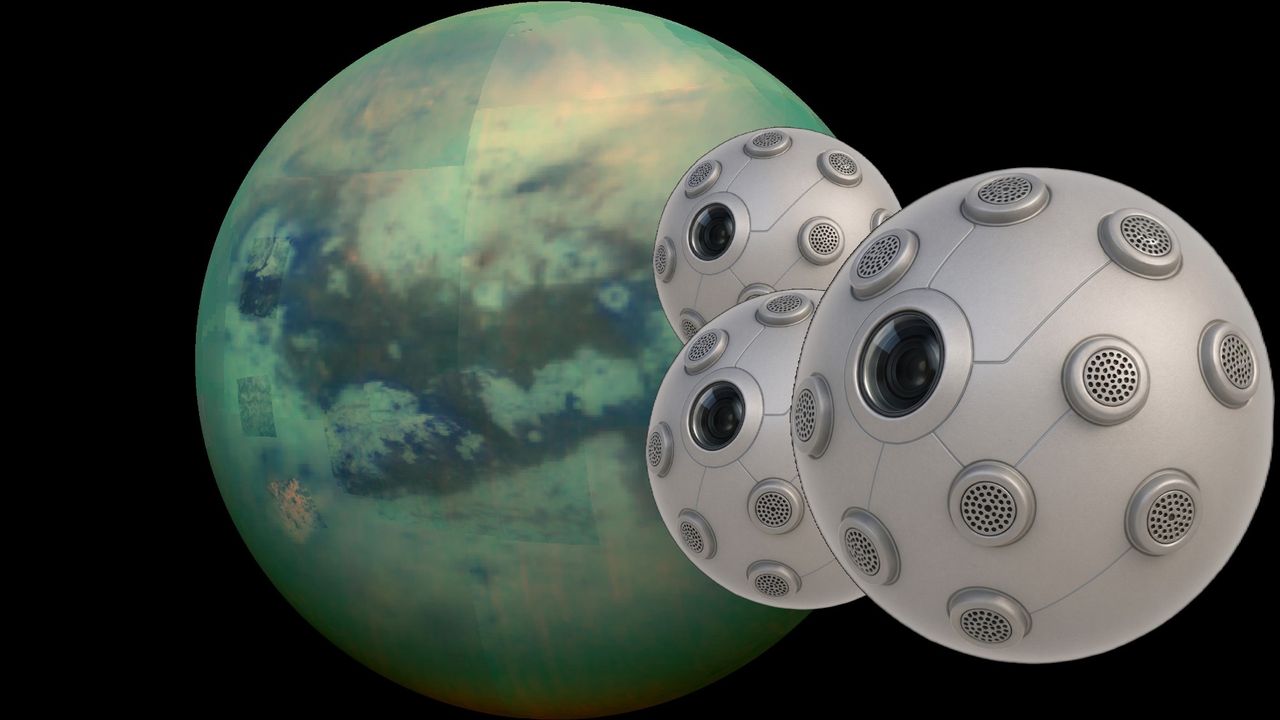
NASA has awarded early-stage funding to develop spherical autonomous robots, called Aerobots, designed to explore the subsurface caves of Titan, Saturn's largest moon. The project builds on the success of the Ingenuity helicopter, which demonstrated aerial mobility on Mars.
Titan presents one of the most intriguing exploration targets in the solar system. The moon possesses a thick nitrogen atmosphere, liquid hydrocarbon lakes and seas, and extensive cave systems carved into water ice. Its dense atmosphere creates conditions favorable for flight, unlike Mars. Aerobots would exploit this environment to navigate terrain inaccessible to wheeled rovers.
The spherical design offers distinct advantages. A compact, resilient shape can withstand impacts and rolls across uneven cave floors. Multiple thrusters embedded throughout the sphere enable omnidirectional movement and precise hovering in Titan's atmosphere. The configuration reduces mechanical complexity compared to traditional helicopter designs.
The funding represents NASA's continued investment in novel mobility platforms for planetary exploration. After Ingenuity's historic flights on Mars demonstrated that aerial reconnaissance dramatically enhances rover operations, space agencies recognize flight as essential for future missions. Titan's atmosphere, roughly 1.5 times denser than Earth's, provides natural advantages for aircraft operating with minimal power requirements.
Key challenges remain before deployment. Engineers must develop systems capable of functioning in Titan's extreme cold, approximately minus 290 degrees Fahrenheit (minus 179 Celsius). Autonomous navigation systems must operate with significant communication delays between Earth and Saturn, currently ranging from 40 minutes to over two hours depending on orbital positions. Power systems must sustain operations for extended periods using limited onboard energy sources or radioisotope generators.
The project currently remains in early development stages, meaning physical prototypes and testing lie years ahead. A demonstration mission to Titan would likely not launch before the 2040s, given