# JWST Reveals Mysterious "Black Hole Star" Shining with Impossible Brightness
The James Webb Space Telescope has discovered an object from the early universe that defies conventional classification. Astronomers detected this red object just a few hundred million years after the Big Bang, and it exhibits characteristics that blur the line between star and black hole.
The object, nicknamed a "black hole star," shines approximately 100 billion times brighter than our Sun. This extreme luminosity creates a puzzle. Stars of comparable brightness typically contain black holes at their centers, yet the internal structure of this object appears fundamentally different.
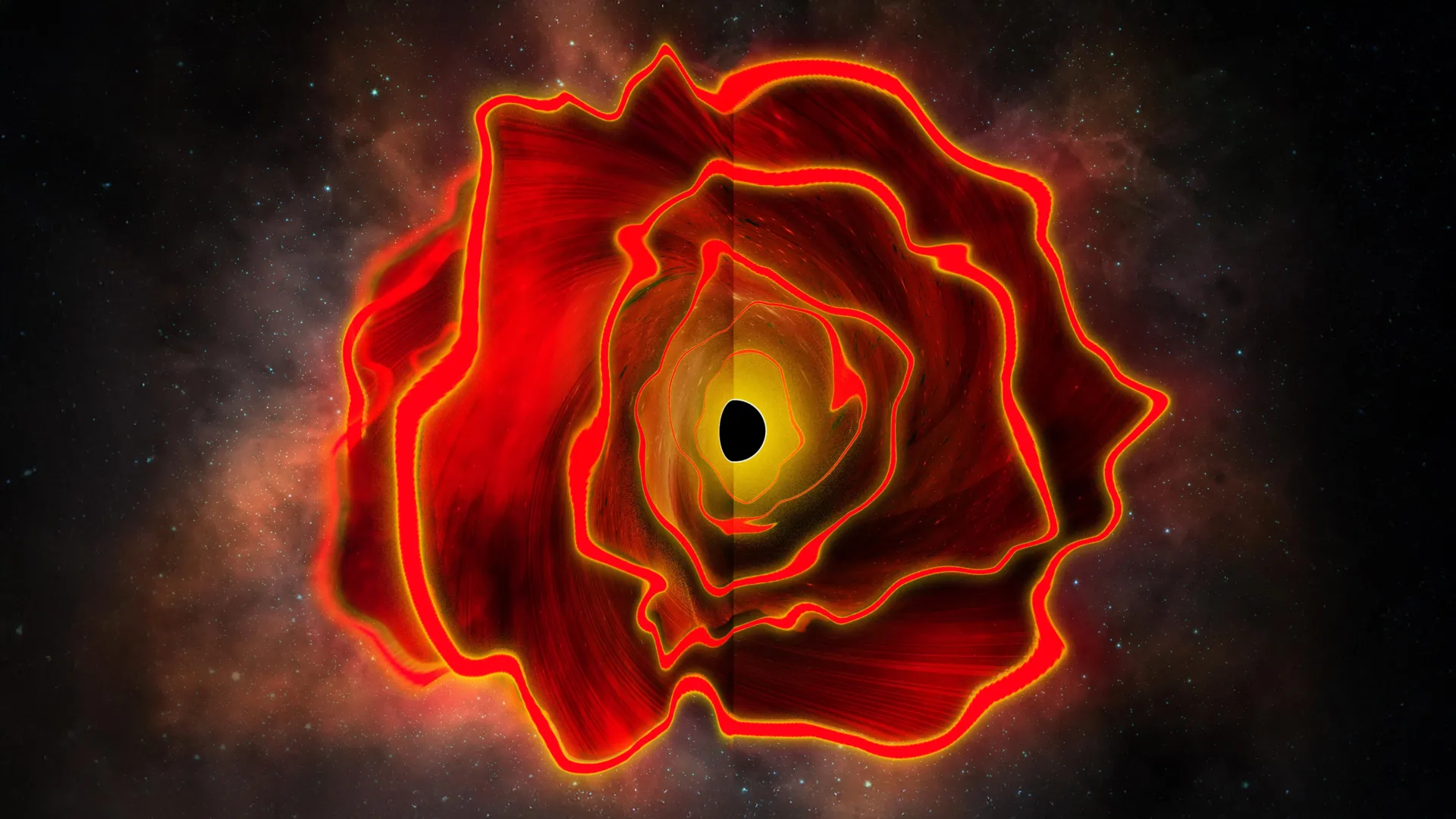
Researchers propose that the mystery object contains a black hole with a mass roughly 100,000 times that of the Sun. This black hole sits cloaked within an extraordinarily dense envelope of hydrogen gas. The envelope itself stretches to dimensions comparable to our solar system, giving the entire structure the appearance of a giant star despite harboring a black hole at its core.
This discovery raises immediate questions about early universe formation. In the first few hundred million years after the Big Bang, the universe contained different conditions than today. Stars formed more rapidly, and the interplay between stellar objects and black holes operated under different parameters.
The object's existence challenges current astrophysical models. Conventional black hole formation typically requires stellar death. A massive star exhausts its fuel, collapses, and forms a black hole in the process. Yet this object appears to exist in an earlier phase, suggesting that black holes in the early universe may have formed through alternate pathways or assembled matter in unexpected configurations.
The distinctive red coloring observed by JWST provides additional clues. The redness suggests heavy redshift, confirming the object's extreme distance and ancient age. The specific wavelengths detected also indicate the presence of hydrogen-rich material surrounding the black hole.
Webb's infrared detection capabilities proved essential for this discovery. Early universe objects emit most of their light in infrared wavelengths due to cosmic expansion stretching visible light into the infrared spectrum. JWST's sensitive infrared instruments can detect these distant, faint objects where previous telescopes could not.
The "black hole star" classification reflects genuine uncertainty about the object's nature. It does not fit neatly into established categories. It resembles a star in appearance and overall structure, yet its energy output and compact central engine identify it as something else entirely. The thick hydrogen envelope surrounding the black hole may prevent standard black hole accretion mechanisms, instead allowing radiation to escape through the surrounding material.
Future observations will test competing theories about this object's composition and formation. Spectroscopic analysis could reveal the temperature, density, and motion of the surrounding hydrogen envelope. Additional discoveries of similar objects would establish whether this represents a common phenomenon in the early universe or a rare anomaly.
This finding underscores how JWST continues to reveal that the early universe operated differently than the cosmos we observe today. Objects once thought impossible now appear in the infrared data. Each discovery pushes astronomers to reconsider fundamental assumptions about stellar evolution, black hole formation, and the conditions that prevailed mere hundreds of millions of years after cosmic creation.