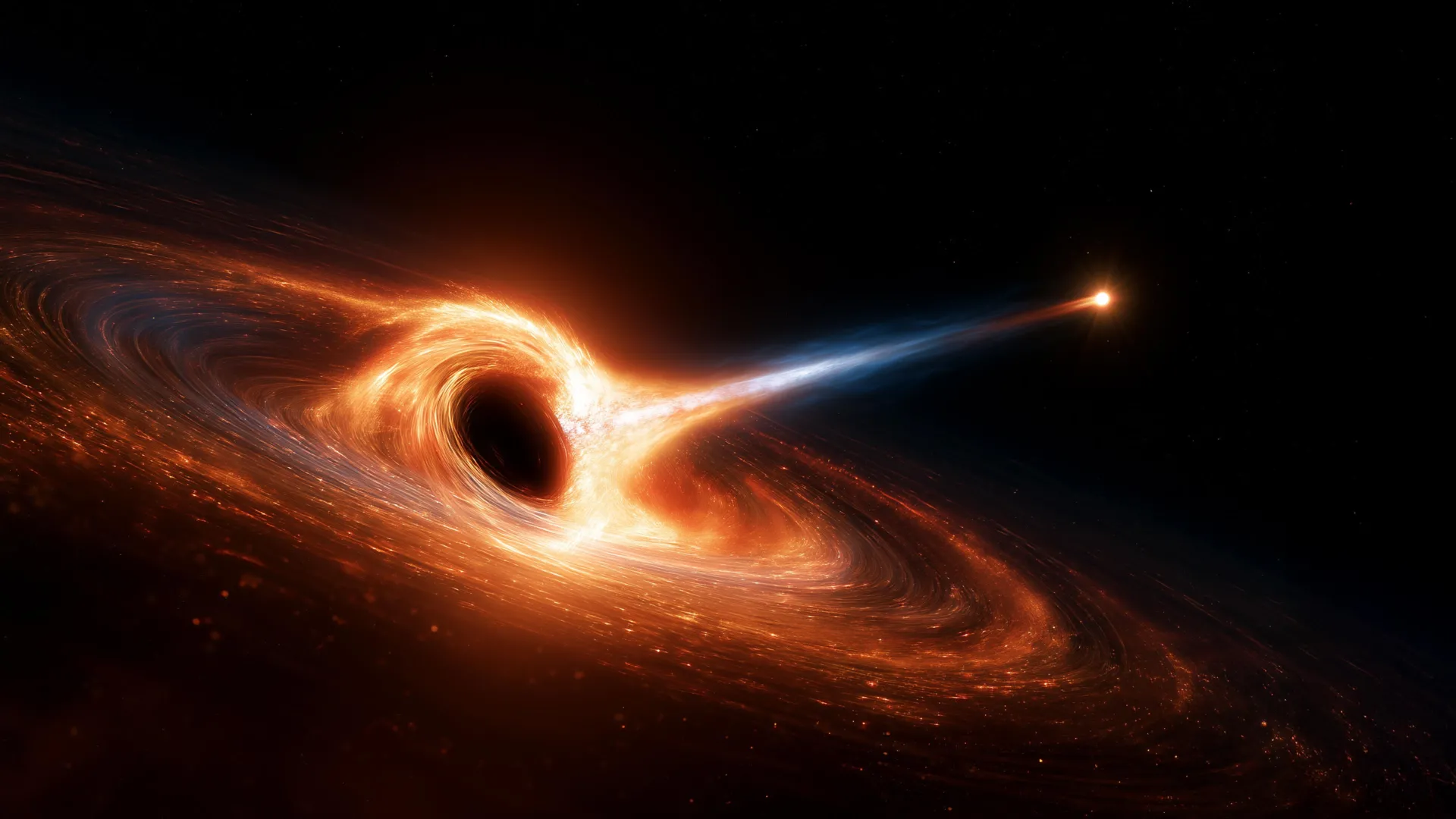
Astronomers observed a black hole tearing apart a massive star in what researchers are calling "the Whippet," one of the most violent stellar encounters ever recorded. The explosion released roughly 400 billion times the Sun's total energy output in a brief burst, generating a shock wave that expanded outward at approximately 20 percent light speed.
The discovery carries an unusual twist. Months after the initial explosion, scientists detected helium moving at unexpectedly high velocities through the debris field. This rapid motion suggests that some physical structure may have endured the black hole's destructive forces, rather than being completely obliterated as standard theory predicts.
In a tidal disruption event like this, a star ventures too close to a black hole's gravitational grip. The intense tidal forces stretch and compress the star until it fragments. Most models assume the star is torn completely apart into an accretion disk that spirals into the black hole, releasing tremendous energy in the process.
The Whippet event challenges this picture. The fast-moving helium indicates that a coherent object, possibly a dense stellar core or other compact remnant, may have survived the shredding and is now plowing through the surrounding debris. Such survival would require the star to possess an unusually dense center or for the black hole's gravity to have missed the most tightly bound inner regions.
This discovery opens questions about the composition and internal structure of stars being torn apart by supermassive black holes. Understanding what survives these cataclysmic encounters could reveal new information about stellar composition and the mechanics of extreme gravitational phenomena.
The research team studied the event using multiple telescopes across different wavelengths. The detection of the anomalous helium motion marks an important observation window into the detailed physics of tidal disruption, an area where observations remain limited. Future monitoring of similar events may clarify whether surviving structures