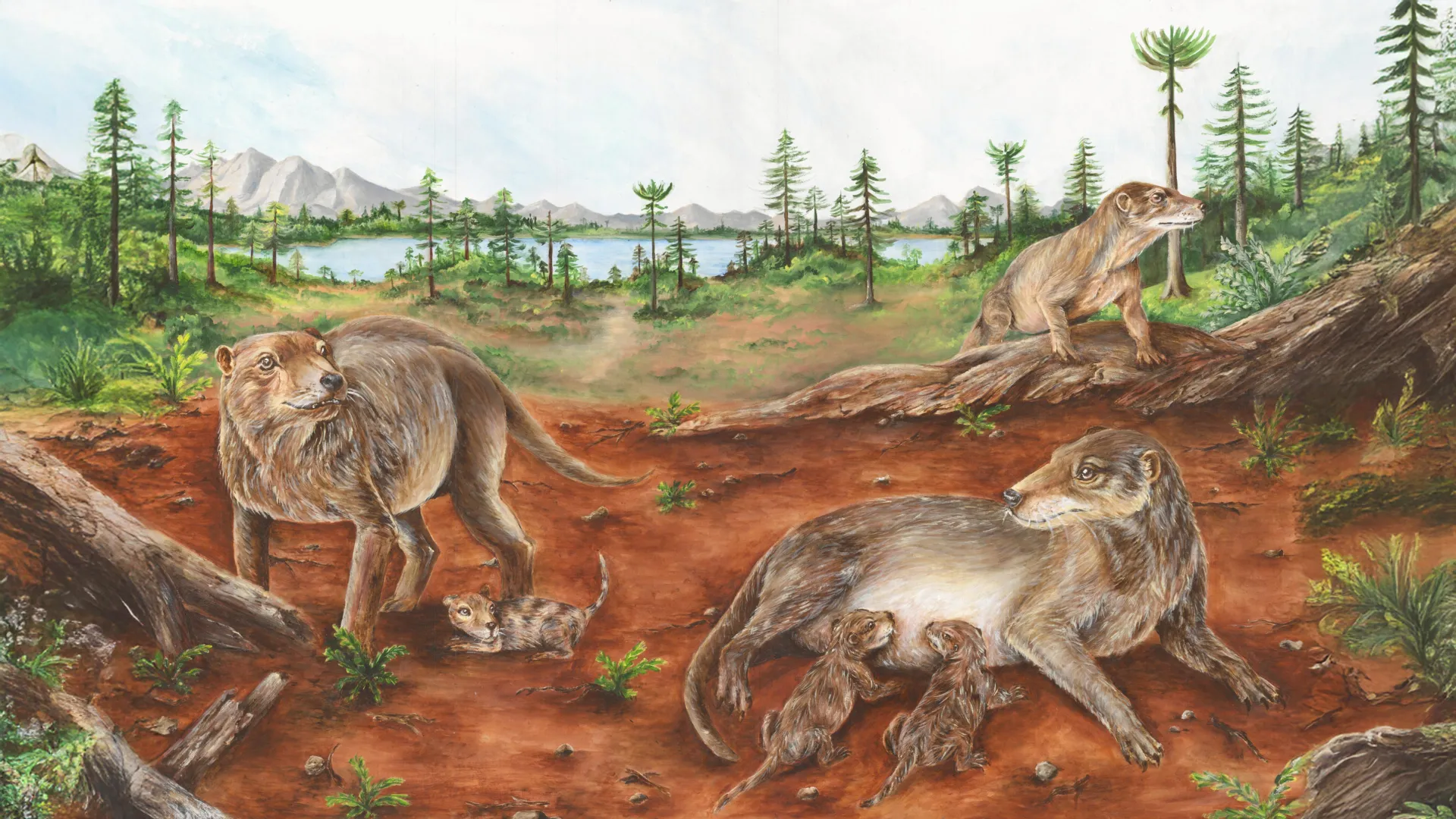
A fossilized cynodont skeleton discovered by researchers may overturn established timelines for the evolution of live birth in mammals, suggesting that this reproductive strategy emerged far earlier than previously believed.
The fossil, approximately 236 million years old, displays anatomical markers consistent with modern mammalian birth patterns. Scientists identified a neonatal growth line in the creature's bones, a distinctive feature that forms during the transition from fetal to independent life. The specimen also exhibited an unusually large birth size relative to its body proportions, matching patterns observed in living mammals that bear live young rather than laying eggs.
The research team examined bone microstructure and growth patterns, finding compelling parallels to modern taxa. The combination of these features suggests the ancient cynodont gave birth to relatively mature offspring, a hallmark of live-bearing reproduction.
Cynodonts occupied a critical position in evolutionary history as non-mammalian synapsids that bridged the gap between reptilian ancestors and true mammals. They thrived during the Triassic period before most lineages went extinct. This discovery places live birth firmly within the cynodont era, potentially pushing the origin of this trait back by up to 95 million years compared to earlier estimates based on the fossil record.
The implications extend beyond reproduction alone. If live birth evolved this early, other traits long considered uniquely modern may also have deep evolutionary roots. Researchers point to lactation, complex parental care, and metabolic adaptations as candidates for earlier-than-expected origins. These developments would suggest that the blueprint for modern mammalian biology assembled gradually across tens of millions of years rather than crystallizing after the dinosaur extinction event 66 million years ago.
The finding challenges the traditional narrative that most mammalian novelties remained dormant until dinosaurs vanished, allowing mammals to diversify and develop their characteristic features. Instead, the data point toward pre-dinosaurian origins for reproductive innovations that survived in descendant lineages through the Mesozoic extinction and into the present day.
Paleontologists emphasize that fossil evidence for soft tissue features like live birth requires indirect inference. No preserved placental tissue or embryonic remains exist for the studied specimen. The argument rests on bone growth patterns and size relationships, which provide strong but not definitive proof of viviparity. Additional fossils with comparable anatomical markers would strengthen the case.
The research opens new avenues for investigating cynodont biology through bone histology and biomechanical analysis. Future work may reveal whether live birth was widespread among cynodonts or restricted to specific lineages. Comparative studies with other Triassic synapsids could illuminate when and how often reproductive strategies shifted.
This discovery repositions cynodonts from minor transitional forms into key players in mammalian evolutionary history, suggesting that these ancient animals possessed greater complexity than skeletal remains alone typically reveal.