# Neptune's Tiny Moons May Be Fragments of Destroyed Ancient Worlds
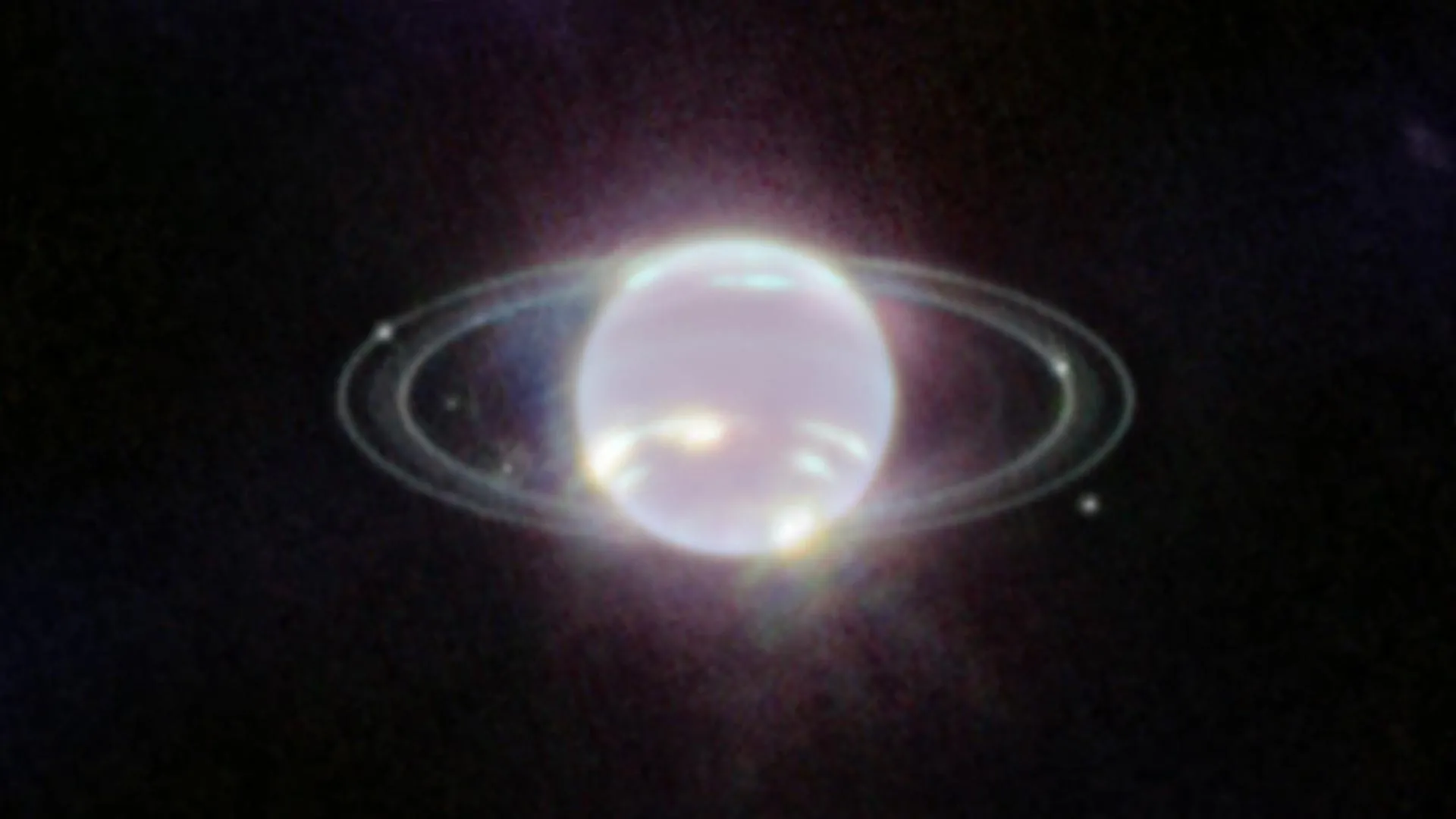
The James Webb Space Telescope has revealed an unexpected story written into the surfaces of Neptune's inner moons. Scientists detected clay-like minerals on Larissa and Galatea that form only in the presence of liquid water, yet these moons themselves lack the ice deposits you would expect to find on frozen bodies orbiting so far from the sun.
This contradiction points to a violent history. The minerals likely originated from material deep inside much larger icy moons that once orbited Neptune. Those ancient parent bodies were shattered billions of years ago when Triton, a massive moon, crashed into the Neptunian system from the outer solar system and was gravitationally captured into orbit around the planet. The collision was catastrophic enough to destroy most of Neptune's original moon system, scattering debris across the region.
The research team analyzed spectroscopic data collected by JWST to identify the clay-rich material. These phyllosilicates form specifically when liquid water interacts with rock at moderate temperatures over extended periods. Finding them on airless, frozen moons raised an immediate puzzle. The moons themselves show no evidence of substantial water ice reserves where such minerals could have formed in place.
The solution emerged from considering Neptune's turbulent past. The parent moons must have been large enough and differentiated enough to possess liquid water in their interiors, along with rocky components. When Triton's capture event unfolded, the gravitational violence pulverized these worlds. Material from their interiors, already rich with clay minerals formed by ancient aqueous chemistry, was dispersed throughout Neptune's system. Fragments eventually settled into stable orbits, becoming Larissa, Galatea, and other surviving inner moons. The clay-bearing material persisted on their surfaces across billions of years.
This discovery transforms how scientists understand Neptune's moon system architecture. Triton itself is a captured object from the Kuiper Belt, pulled in by gravitational encounter. Its arrival restructured the entire local environment. Models of early solar system dynamics predict such catastrophic encounters were not uncommon as massive bodies migrated through dense primordial disk structures. Neptune's system preserves direct physical evidence of this violent reorganization.
The clay-like minerals also appear in material associated with Neptune's rings, further supporting the idea that debris from shattered moons contributes to the ring structure. Studying this material offers a window into chemical processes that occurred inside ancient moons when they were intact and possibly habitable environments.
The findings carry implications beyond Neptune alone. They demonstrate that major collision events reshape planetary systems in ways that leave geological fingerprints readable billions of years later. JWST's unprecedented infrared sensitivity makes such discoveries possible by detecting subtle spectral signatures in distant material. As the telescope continues mapping outer solar system bodies, more evidence may emerge of similar catastrophic events in other planetary systems, revealing how common such restructuring truly is in cosmic history.