# Ancient Sauropod Footprints Reveal Possible Limp in 150-Million-Year-Old Dinosaur
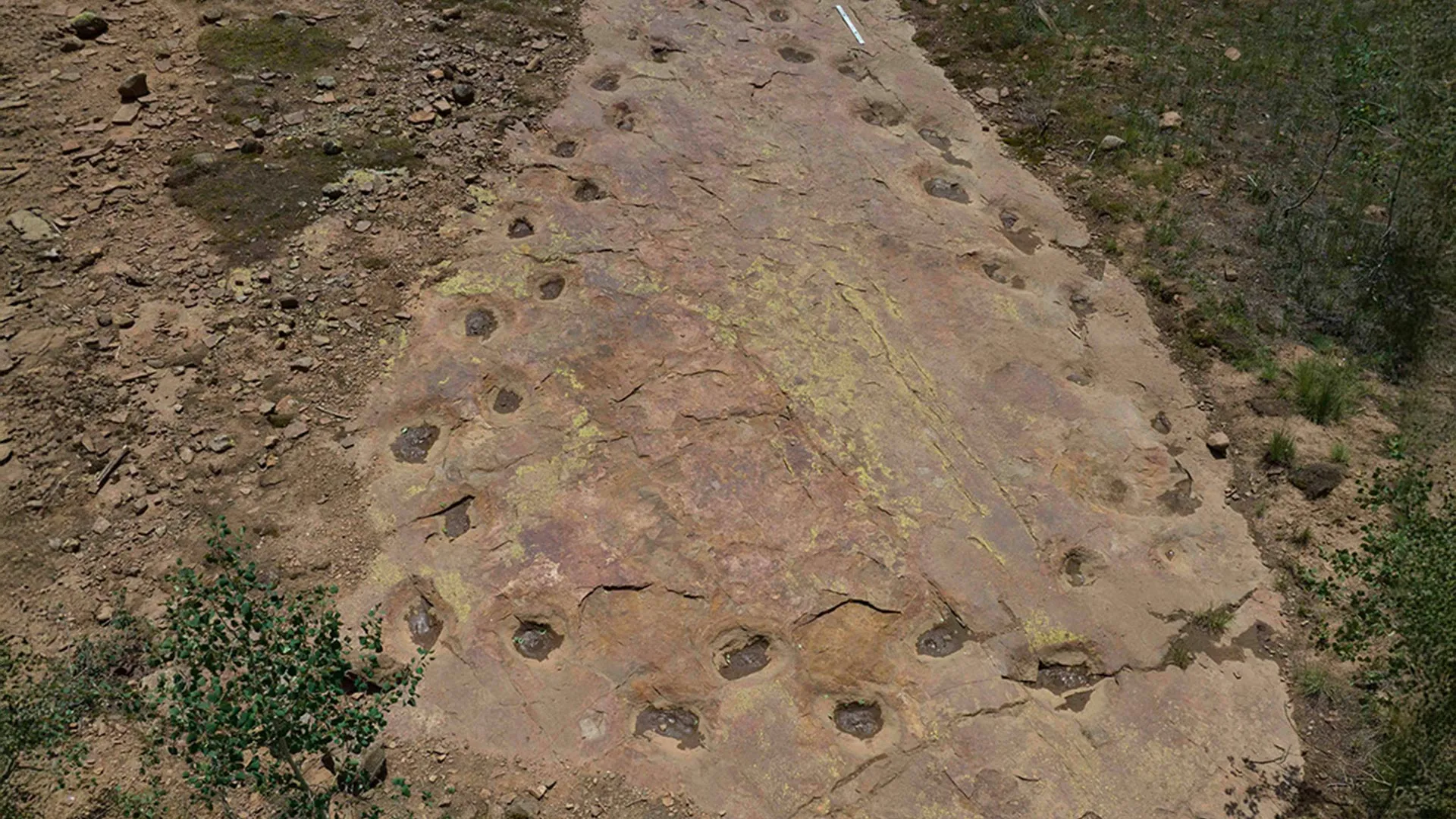
Paleontologists have discovered an unusual trackway from a giant sauropod that lived 150 million years ago, preserved in what is now northern Spain. The trail contains more than 130 consecutive footprints, offering an extraordinary window into the walking behavior of a creature that dwarfed modern elephants.
The most striking feature of the trackway is a complete loop. The sauropod changed direction sharply and traced an almost circular path before resuming its original course. This dramatic maneuver suggests the animal was not simply moving from point A to point B, but rather navigating its environment with deliberate, purposeful movement.
Beyond the loop itself, researchers noticed something more revealing about the dinosaur's gait. The spacing between footprints on one side of the body differs from the other, indicating an uneven stride. Paleontologists interpret this asymmetry as potential evidence that the sauropod walked with a limp, possibly due to an injury or chronic condition affecting one of its rear legs.
The discovery comes from the Lower Cretaceous Period deposits, though the exact research team and publishing journal were not specified in the available details. Sauropods represent one of the largest terrestrial animals ever to exist. Some species, like Brachiosaurus, weighed up to 100 tons. Their massive size required enormous limbs and specialized skeletal structures to support their weight. Understanding how these animals moved across ancient landscapes remains challenging since direct observation is impossible.
Trackways like this one offer advantages over skeletal remains alone. Bones reveal anatomy and structure, but footprints capture behavior. They show how an animal actually positioned its feet and distributed its weight. Multiple prints in sequence reveal gait patterns, speed, and any irregularities in locomotion.
The looping behavior recorded in this 150-million-year-old trail raises intriguing questions. Scientists debate whether sauropods were fully aquatic, semi-aquatic, or terrestrial. A complete circular path might suggest the animal was investigating something in its environment, or it could indicate turning to navigate terrain. The limp-like asymmetry, if confirmed through further analysis, would demonstrate that injured dinosaurs could survive and remain mobile despite their conditions.
Modern animals with injuries frequently alter their gait, shifting weight away from the affected limb. Ancient sauropods would have faced similar biomechanical constraints. If this individual survived with a compromised leg, it implies adequate food resources and perhaps a relatively safe environment where a partially disabled giant could still forage and move.
The trackway's preservation in sediment allowed fine details to emerge after millions of years. Each footprint captures the depression left by the massive foot pressing into ancient mud or sand. The pattern that emerges tells a story of an individual animal navigating its world, complete with apparent physical challenges.
This discovery joins a growing body of evidence showing that individual variation and injury affected dinosaur populations just as it does modern wildlife. Paleontologists continue searching for similar trackways that might provide additional data on sauropod biomechanics and behavior in the fossil record.