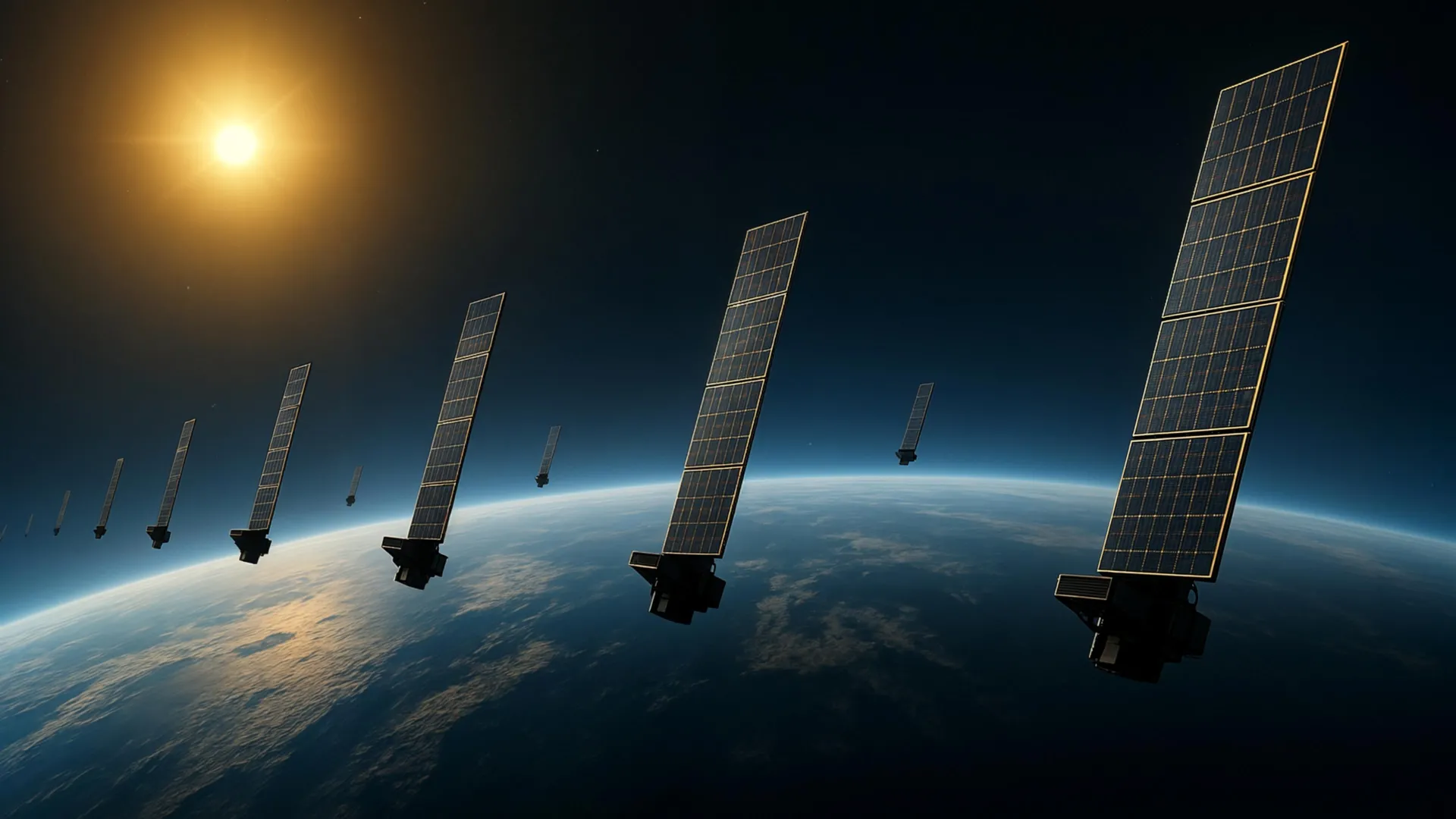
Researchers have repurposed Starlink's sprawling satellite constellation into an unexpected tool for atmospheric science. By analyzing orbital data from approximately 1,200 Starlink satellites, scientists reconstructed density variations in Earth's thermosphere, the atmospheric layer located roughly 500 kilometers above the surface.
The thermosphere remains notoriously difficult to measure directly. Traditional methods rely on sparse ground-based sensors and dedicated scientific satellites, which provide limited coverage. The Starlink approach leverages a massive, distributed observation network already in orbit. As these satellites travel through the thermosphere, atmospheric drag subtly alters their trajectories. By tracking these orbital changes, researchers reverse-engineered atmospheric density patterns across large regions and time periods.
This technique offers practical benefits for orbital mechanics. Precise thermospheric density maps improve satellite tracking accuracy and help predict debris collisions. Space traffic is intensifying as companies launch thousands of satellites for global internet coverage, making orbital safety increasingly urgent. Better atmospheric models feed directly into collision avoidance algorithms and launch planning systems.
The method also reveals how solar activity, geomagnetic storms, and other space weather events influence upper atmosphere density. These variations occur unpredictably and impact all satellites above 400 kilometers. Enhanced real-time monitoring through this approach could enable operators to adjust satellite positions preemptively and reduce conjunction risk.
The research demonstrates how large constellations designed for communications can simultaneously serve the scientific community. However, limitations exist. Starlink data provides observations only along orbital paths, creating geographic and temporal gaps. The approach relies on publicly available orbital elements, which have inherent uncertainties. Ground stations track Starlink positions continuously, but measurement errors propagate through density calculations.
Scientists have not disclosed which institutions led this work or where results appear in peer-reviewed literature, limiting independent verification of specific findings. The practical impact depends on how often this technique can update atmospheric models and whether