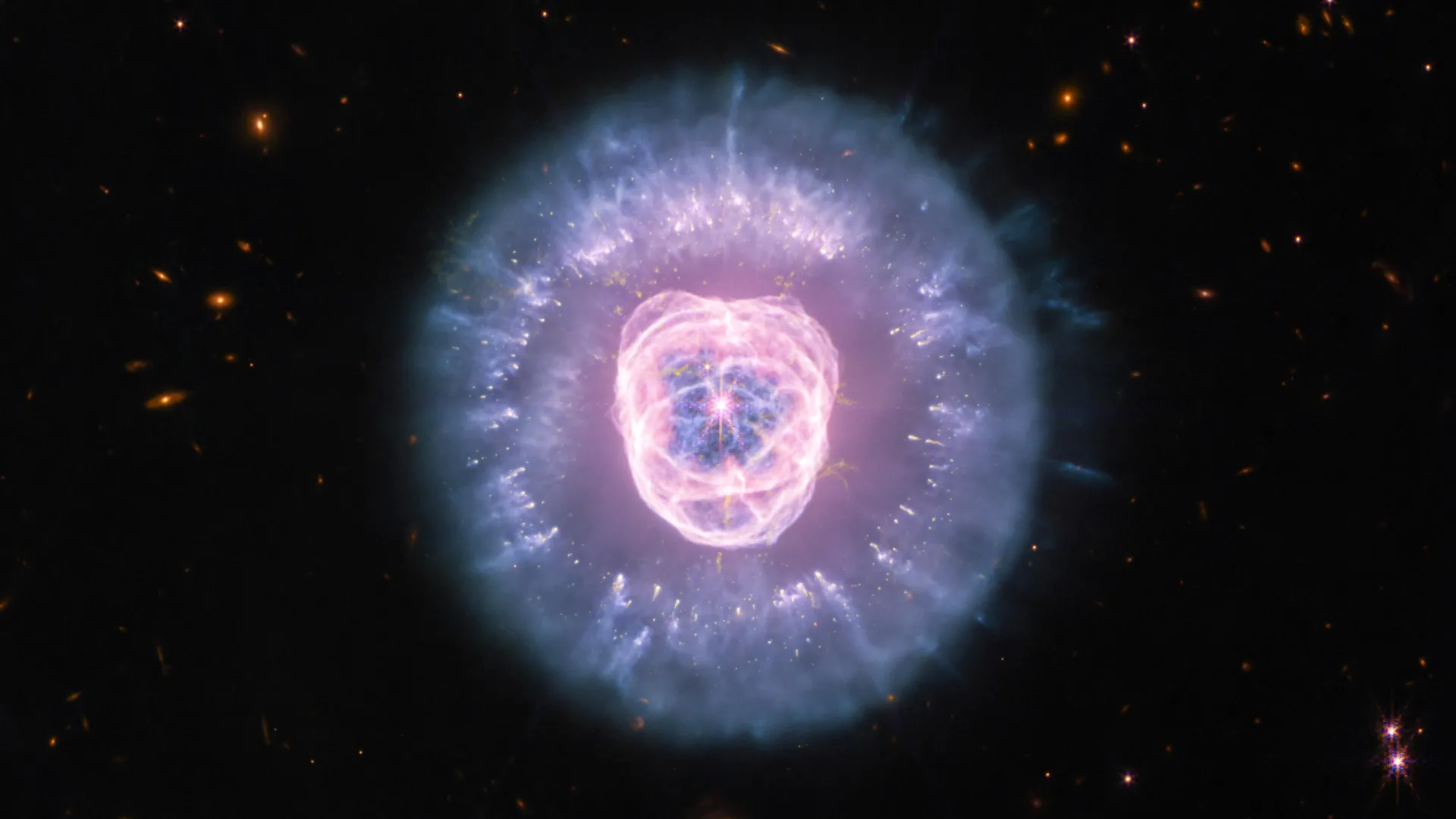
The James Webb Space Telescope has captured a vivid infrared portrait of NGC 2392, a planetary nebula located thousands of light-years away that resembles a roaring lion's face. At the nebula's core sits a white dwarf, the dense stellar remnant left behind after a Sun-like star exhausted its nuclear fuel and shed its outer layers.
The white dwarf radiates intense ultraviolet and X-ray energy that ionizes the surrounding gas, creating the nebula's distinctive features. This radiation carves intricate patterns into clouds of hydrogen, helium, and other elements, forming the appearance of a lion's nose, mouth, and eyes. Dust clumps scattered throughout the structure create the effect of a shaggy mane framing the central face.
NGC 2392 represents one phase in the life cycle of stars similar to our Sun. When such stars reach the end of their hydrogen-burning phase, they swell into red giants and eventually shed their outer atmospheres. What remains is an extremely hot white dwarf surrounded by expanding shells of ejected material, creating a planetary nebula. Despite their name, these structures have no connection to planets.
Webb's infrared capabilities proved essential for studying NGC 2392. The telescope's advanced sensors penetrate dust that obscures visible light observations, revealing both the hot gas illuminated by the white dwarf and cooler dust structures embedded within it. This multi-wavelength view provides astronomers with a clearer understanding of the nebula's three-dimensional structure and composition.
The observations contribute to broader research into stellar death and the chemical elements dispersed into space. These nebulae gradually expand and fade over thousands of years, eventually mixing ejected material back into the interstellar medium where it becomes part of new star and planet formation.
NGC 2392 was first catalogued by German-born astronomer Friedrich Wilhelm