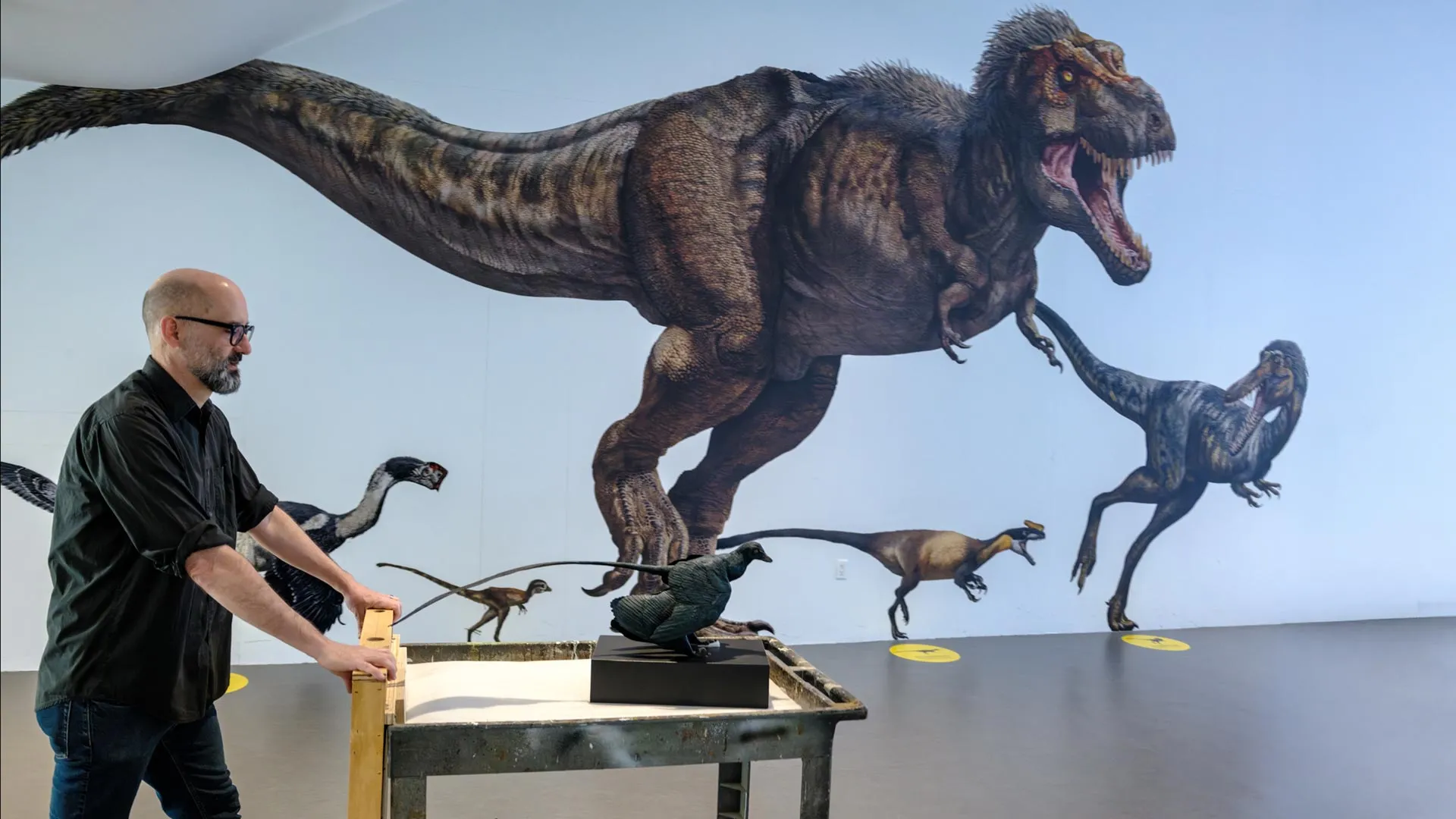
Dinosaurs evolved into giants that dominated terrestrial ecosystems for 165 million years, yet they almost never produced truly miniature species. New research challenges the assumption that physiology alone explains this evolutionary gap, pointing instead to early mammals as key competitors.
A team of scientists investigated why the smallest dinosaurs stopped shrinking around chicken size, despite their success at larger scales. They examined fossil records and compared dinosaur body-size distributions with modern animals. The findings suggest that ecological competition, not biological constraints, prevented the evolution of mouse-sized dinosaurs.
Early mammals, though small by dinosaur standards, occupied the ecological niches that could have sustained miniature dinosaurs. These primitive mammals filled roles as insectivores and small carnivores during the Mesozoic Era. The researchers propose that mammals essentially blocked dinosaurs from evolving into tiny forms, while dinosaurs simultaneously prevented mammals from growing large until after the mass extinction event 66 million years ago.
This represents a form of mutual ecological exclusion. Dinosaurs dominated larger body sizes, leaving no room for mammalian gigantism. Simultaneously, mammals held the small-animal ecological space, preventing dinosaurs from downsizing further. The relationship created complementary size distributions rather than overlapping ones.
The research has implications for understanding how competition shapes evolutionary trajectories. It suggests that the absence of a trait in a successful group doesn't necessarily reflect biological impossibility but rather ecological opportunity. Dinosaurs possessed the physiological capacity to become smaller, yet environmental pressures—specifically competition from mammals—discouraged this evolutionary pathway.
After the dinosaurs' extinction, mammals rapidly diversified into the vacated niches, eventually producing species ranging from shrews to whales. This explosion of mammalian diversity only became possible once dinosaurs disappeared, removing both the size ceiling and the ecological pressure that had confined early mammals to small body sizes.
The study underscores