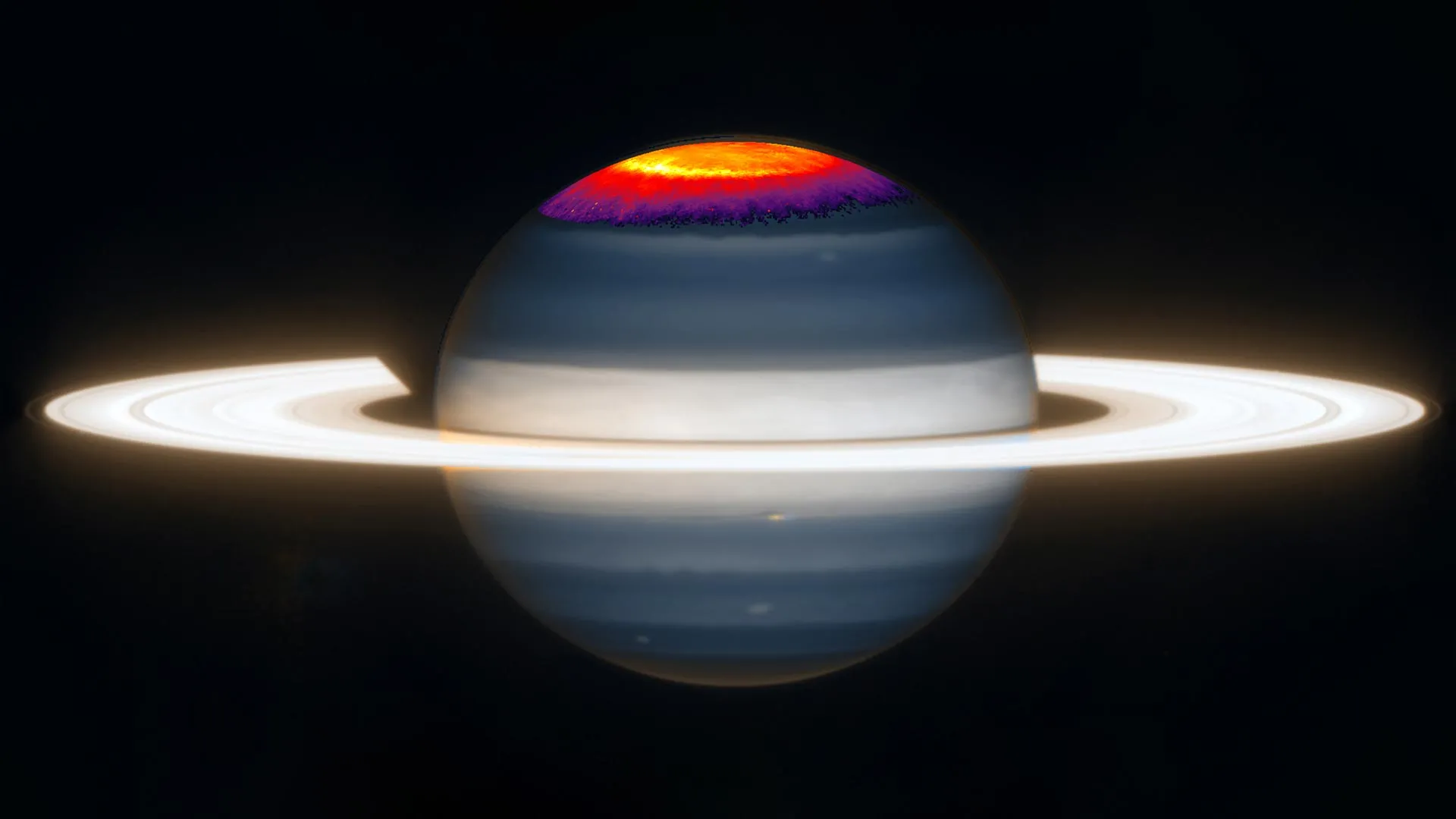
Saturn's magnetic shield operates under fundamentally different rules than Earth's, according to analysis of data from NASA's Cassini spacecraft. The planet's rapid rotation drags a critical opening in its magnetosphere—called the subsolar point—far toward the afternoon side rather than keeping it positioned near noon as occurs on Earth.
On Earth, the magnetosphere's subsolar point, where solar wind directly compresses the magnetic field, remains anchored near the noon position. Saturn's fast spin and abundant charged particles from its moon Enceladus overwhelm the Sun's influence, displacing this opening dramatically. The finding reveals that giant planets operate in a distinct magnetic regime governed by internal dynamics rather than external solar pressure.
Cassini collected this data during its 13-year mission orbiting Saturn, ending in 2017. The spacecraft's instruments detected how the planet's rapid 10-hour rotation period generates a corotating magnetosphere saturated with material ejected from Enceladus's geysers. This internal plasma dominates the magnetic environment, creating conditions unlike any terrestrial planet.
The research has implications for understanding exoplanet magnetospheres. Fast-rotating planets orbiting distant stars may exhibit similar displacement patterns, affecting how their atmospheres interact with stellar radiation. The finding also advances knowledge of how planetary rotation and internal plasma sources shape magnetic protection around giant worlds.
The Cassini mission, a joint effort of NASA, the European Space Agency, and the Italian Space Agency, provided unprecedented close-range observations of Saturn's magnetosphere over more than a decade. The spacecraft's final mission phase involved dives between Saturn and its rings, collecting detailed magnetic field measurements impossible to obtain from distance.
This discovery underscores how rotation speed and moon-generated plasma fundamentally alter magnetospheric structure on giant planets, distinguishing them from slower-rotating terrestrial worlds.