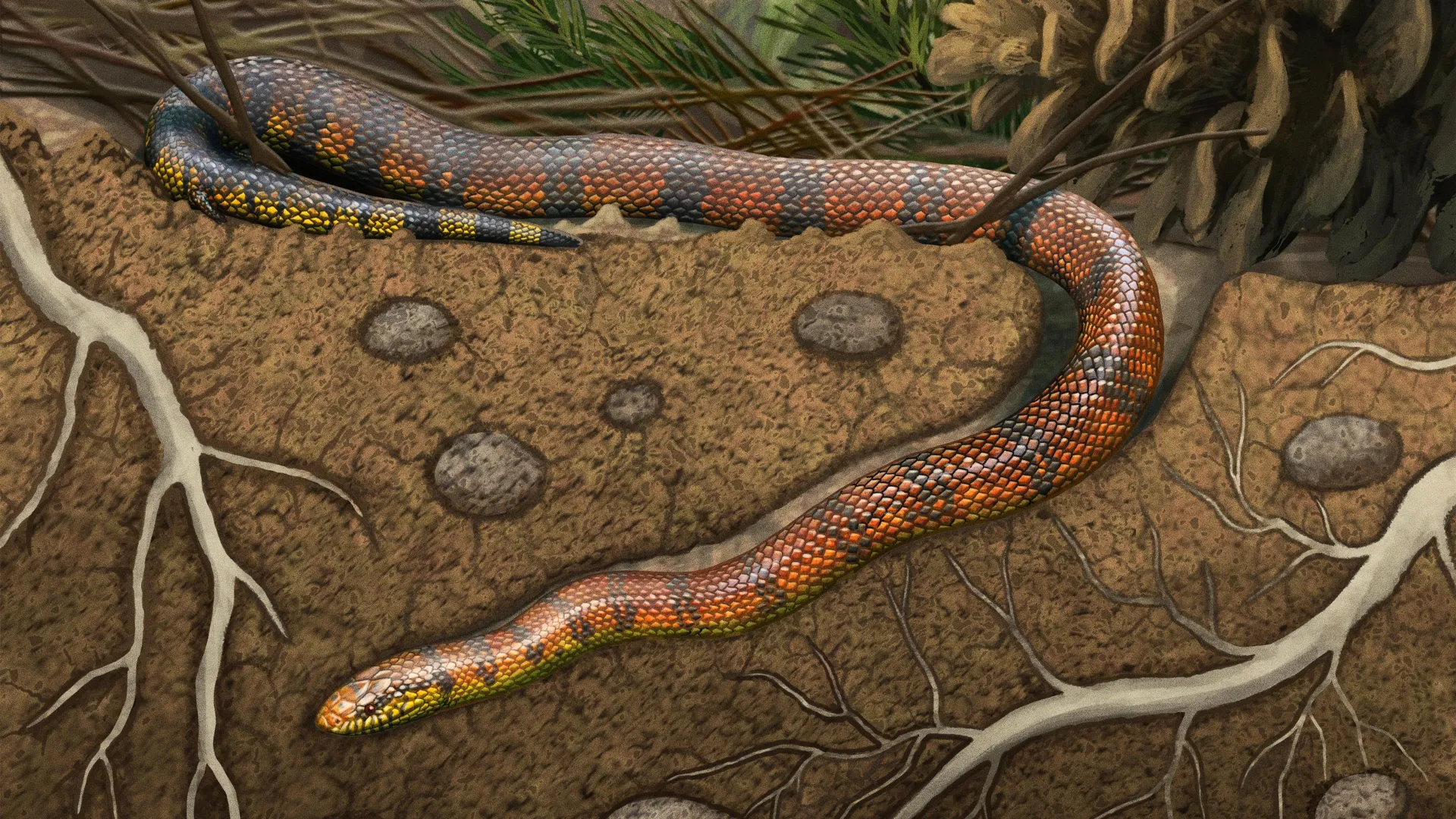
A fossil snake brain from Brazil dated to 80 million years ago reshapes understanding of early snake evolution. The specimen, identified as Tametara mirim, offers the first detailed neural anatomy of an ancient snake and reveals that snakes colonized diverse ecological niches far earlier than previously recognized.
Researchers reconstructed the brain using high-resolution computed tomography scanning. The fossil shows that Tametara mirim possessed neurological adaptations for burrowing, including a relatively small brain with reduced visual processing regions. This contrasts sharply with concurrent snake fossils that display adaptations for terrestrial hunting and marine environments.
The findings demonstrate that by the Cretaceous period, snakes had already diversified extensively across multiple habitats. Early snakes did not occupy a single ecological role but instead radiated into burrowing, surface-dwelling, and aquatic forms. This diversity emerged millions of years before scientists previously documented.
Brain morphology provides insight into sensory priorities. Burrowing species like Tametara mirim likely relied heavily on chemical sensing through their vomeronasal system, which detects prey odors and pheromones. Ground-dwelling snakes show larger optic lobes, indicating greater visual dependence. Marine forms developed distinct neural features suited to underwater hunting.
The research builds on recent paleontological work expanding knowledge of snake origins. Previous studies focused on skeletal anatomy and timing of major innovations like fangs. This work extends that understanding into nervous system evolution, revealing how brain architecture reflects ecological specialization.
The specimen's exceptional preservation in Brazilian sediments allowed detailed neural reconstruction impossible with most fossils. Sediment infiltrated the braincase before decomposition, creating a natural cast. Researchers then virtually removed the surrounding rock digitally.
These findings suggest the Cretaceous represented a period of rapid snake diversification and niche partitioning. Rather than evol