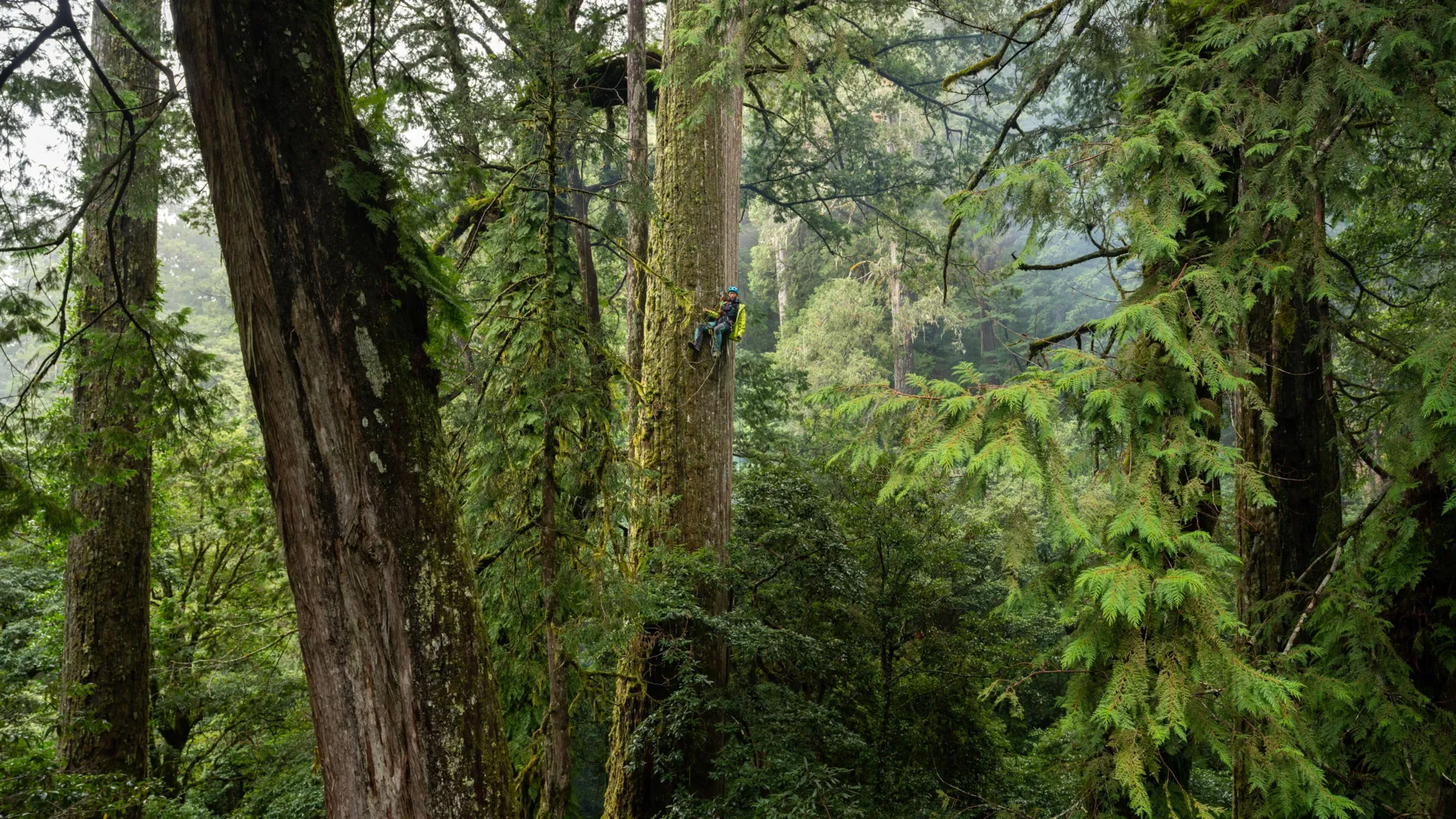
Researchers exploring Taiwan's remote mountain forests have discovered one of East Asia's most pristine old-growth ecosystems, hidden within steep terrain that has protected it from logging. An international team combined traditional expeditions, LiDAR scanning, and citizen reports to map the previously undocumented forests, which contain hundreds of giant Taiwania firs.
The team's most striking find: an 84.1-meter Taiwania fir, now confirmed as the tallest tree in East Asia. This single specimen towers at 276 feet. Beyond this record holder, scientists identified dense clusters they describe as "temples of giants," where dozens of colossal trees grow in proximity, creating a landscape unlike any other in the region.
These ancient Taiwania forests represent an exceptional carbon reservoir. The ecosystem's dense canopy and massive wood biomass rank it among the world's most carbon-rich environments per unit area. Taiwan's Taiwania trees can live for centuries, accumulating carbon in their trunks and maintaining it indefinitely.
The discovery required persistent fieldwork. Researchers conducted multiple expeditions into Taiwan's mountainous interior, where steep slopes and difficult terrain limited access. LiDAR technology, which uses laser pulses to measure tree heights through forest canopy, proved essential for identifying the tallest specimens. The team also leveraged citizen science, incorporating reports from local observers familiar with the region.
The research highlights how even well-studied regions harbor significant ecological surprises. East Asia has experienced intensive deforestation over centuries, making intact old-growth forests increasingly rare. Taiwan's remote mountains preserved these Taiwania stands largely by accident, their inaccessibility serving as inadvertent protection.
Scientists now face the challenge of balancing conservation with research access. These forests warrant protection status given their carbon storage capacity and biological uniqueness, yet increased human presence for study or tourism could threaten their integrity. The