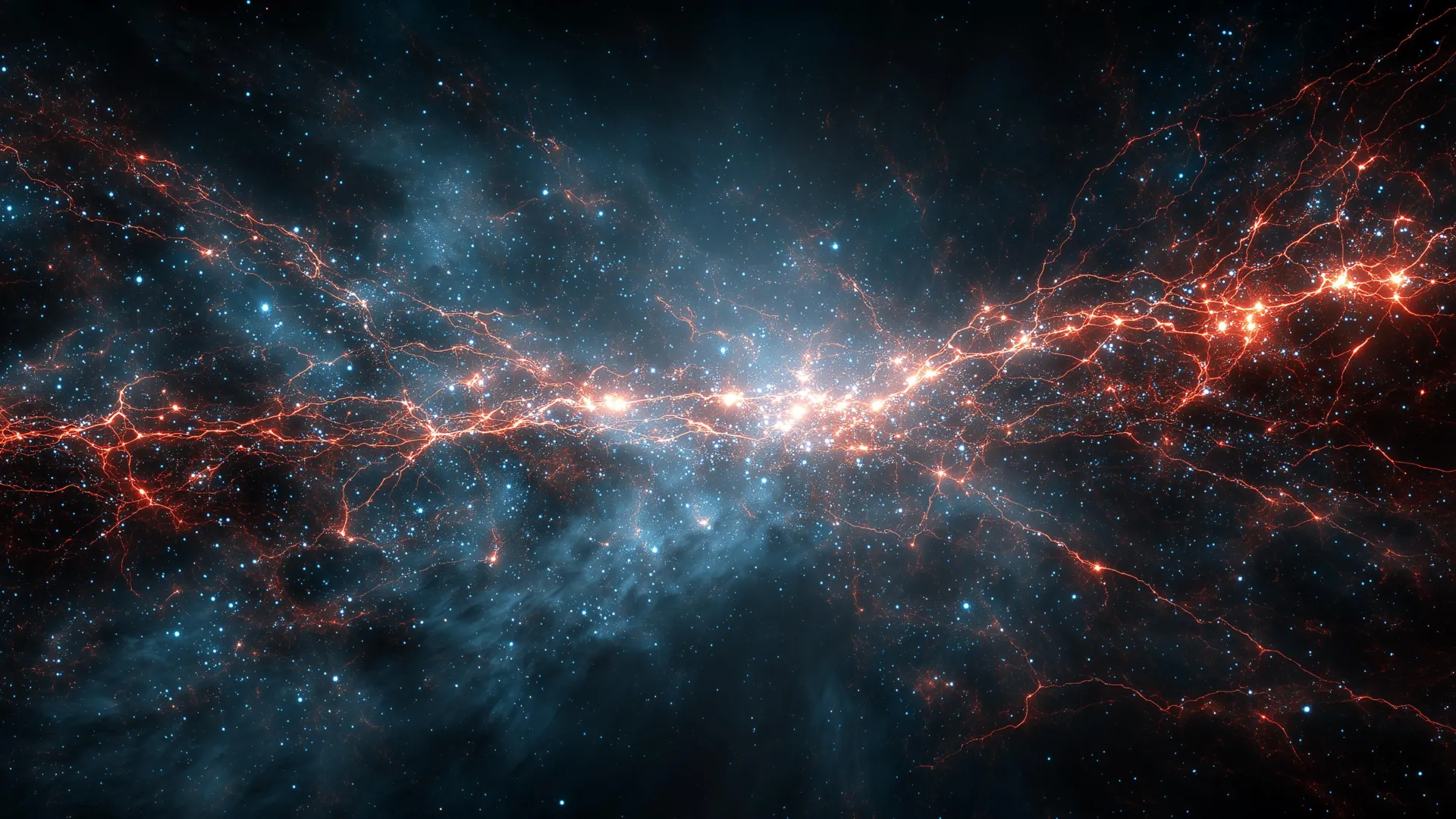
Physicists have discovered that dark matter particles may interact through a hidden force with counterintuitive behavior, according to research highlighted in ScienceDaily. The force simultaneously strengthens clustering among dark matter particles while making them effectively lighter as the universe expands, reducing their gravitational pull over cosmic time.
This hidden interaction produces effects opposite to what scientists anticipated. Researchers expected such a force to amplify dark matter's gravitational influence and accelerate the formation of cosmic structures like galaxy clusters. Instead, the weakened gravitational impact slows structure growth, presenting a puzzle for cosmological models.
Dark matter comprises roughly 85 percent of the matter in the universe, yet remains invisible to direct observation. Understanding its behavior shapes how physicists explain galaxy formation, cosmic expansion, and the universe's large-scale architecture. Most current models treat dark matter as inert, interacting only through gravity.
The research suggests dark matter particles possess an additional interaction mechanism beyond pure gravity. This hidden force causes particles to attract one another more strongly, allowing denser concentrations to form. However, the mechanism simultaneously reduces the effective gravitational mass of dark matter as cosmic expansion proceeds, dampening the force's net impact on universal structure.
The findings challenge conventional expectations about how new particle interactions should influence cosmic evolution. Theorists anticipated that extra attractive forces would amplify gravitational clustering and speed up the formation of cosmic web structures. The opposite outcome indicates more complex physics governing dark matter behavior than standard models capture.
These results carry implications for reconciling observations with theory. Discrepancies between predicted and observed cosmic structure growth rates have prompted physicists to explore alternative dark matter properties. This hidden force represents one avenue for resolving those tensions, though the mechanism's details require further investigation.
The research underscores how little remains understood about dark matter's fundamental nature. Continued observations of galaxy distributions and cosmic microwave background patterns will test whether this hidden force scenario accurately describes