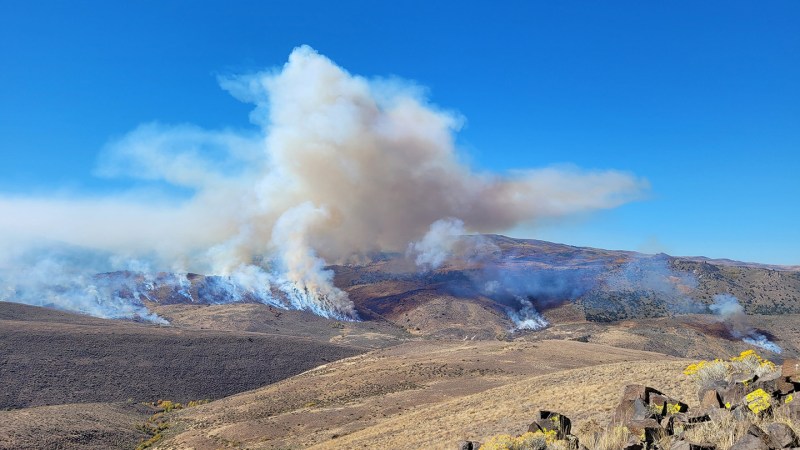
Researchers used infrasound, acoustic waves below human hearing range, to track the location and spread of a prescribed grassland fire in real time. The study demonstrates a novel monitoring method that could improve wildfire detection and safety protocols for firefighters and communities.
The team deployed infrasound sensors around a controlled burn and recorded the low-frequency acoustic signals generated by the flames and combustion processes. These subsonic vibrations, typically 0.5 to 20 hertz, travel long distances through the atmosphere with minimal interference from wind or terrain. By analyzing arrival times at multiple sensor stations, researchers triangulated the fire's position and tracked how it moved across the landscape.
This approach offers advantages over traditional infrared or satellite monitoring. Infrasound works in dense smoke and poor visibility, conditions that often obscure optical sensors. The method also operates continuously without relying on cloud-free skies or scheduled satellite passes. Detection occurs in real time, allowing incident commanders to adjust firefighter positions and evacuation zones immediately.
The research builds on decades of infrasound science, primarily used to monitor volcanic eruptions, meteorite impacts, and atmospheric phenomena. Adapting it for fire monitoring extends applications to a growing environmental challenge. With climate change intensifying fire seasons across western North America, Australia, and Mediterranean regions, faster detection translates to lives and property saved.
Limitations remain. The setup requires a network of specialized sensors, adding deployment costs compared to existing monitoring infrastructure. The technique works best for large fires; small fires may produce infrasound signatures too weak to detect reliably. The team did not specify the precise spacing needed for optimal accuracy across different terrain types.
The research, conducted at a controlled burn facility, represents early-stage validation. Scaling to operational wildfire scenarios requires testing under natural conditions with varying wind patterns, smoke intensity, and complex topography. Researchers must also develop standardized protocols for sensor placement and real