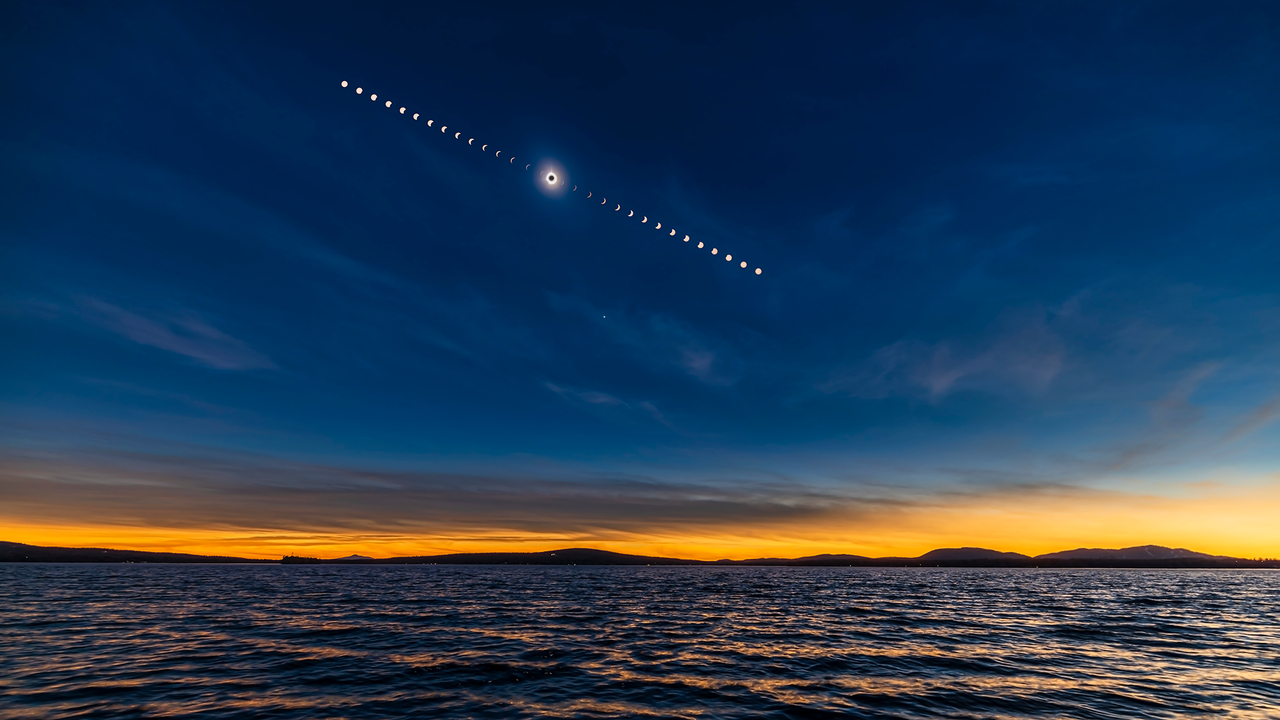
August 12, 2026 will deliver a rare convergence of astronomical events that skywatchers won't see again for years, according to Live Science.
A total solar eclipse will occur on that date, blocking the sun and revealing the sun's corona to observers along the eclipse path. Simultaneously, the Perseid meteor shower reaches its annual peak, delivering dozens of shooting stars per hour across dark skies. The timing allows viewers to witness both phenomena during a single night and day cycle.
Venus will also reach dichotomy on August 12, a phase when exactly half of the planet's disk appears illuminated from Earth. This occurs only twice per Venusian cycle and offers amateur astronomers a striking telescopic view of the planet's geometry.
Adding to the event, the Milky Way reaches its highest position in the night sky during its annual arc across the heavens. This positioning maximizes visibility of the galaxy's core and star-dense regions from Earth, making it an ideal window for astrophotography and naked-eye observation.
The combination of these four events creates what experts describe as exceptional skywatching conditions. A total eclipse paired with an active meteor shower is already uncommon. When paired with Venus's dichotomy phase and peak galactic visibility, the opportunity becomes exceptionally rare.
Observers planning to witness these events should position themselves along the eclipse path for optimal viewing of the solar phenomenon. Those outside the eclipse zone can still observe the meteors, Venus, and Milky Way from their locations. Clear skies and minimal light pollution significantly improve viewing conditions for all components of the astronomical display.
The convergence underscores how celestial mechanics occasionally aligns multiple notable events. Such alignments remain predictable decades in advance through astronomical calculation, allowing skywatchers to prepare observations and travel plans accordingly. This 2026 event represents a particular rarity in the frequency of simult