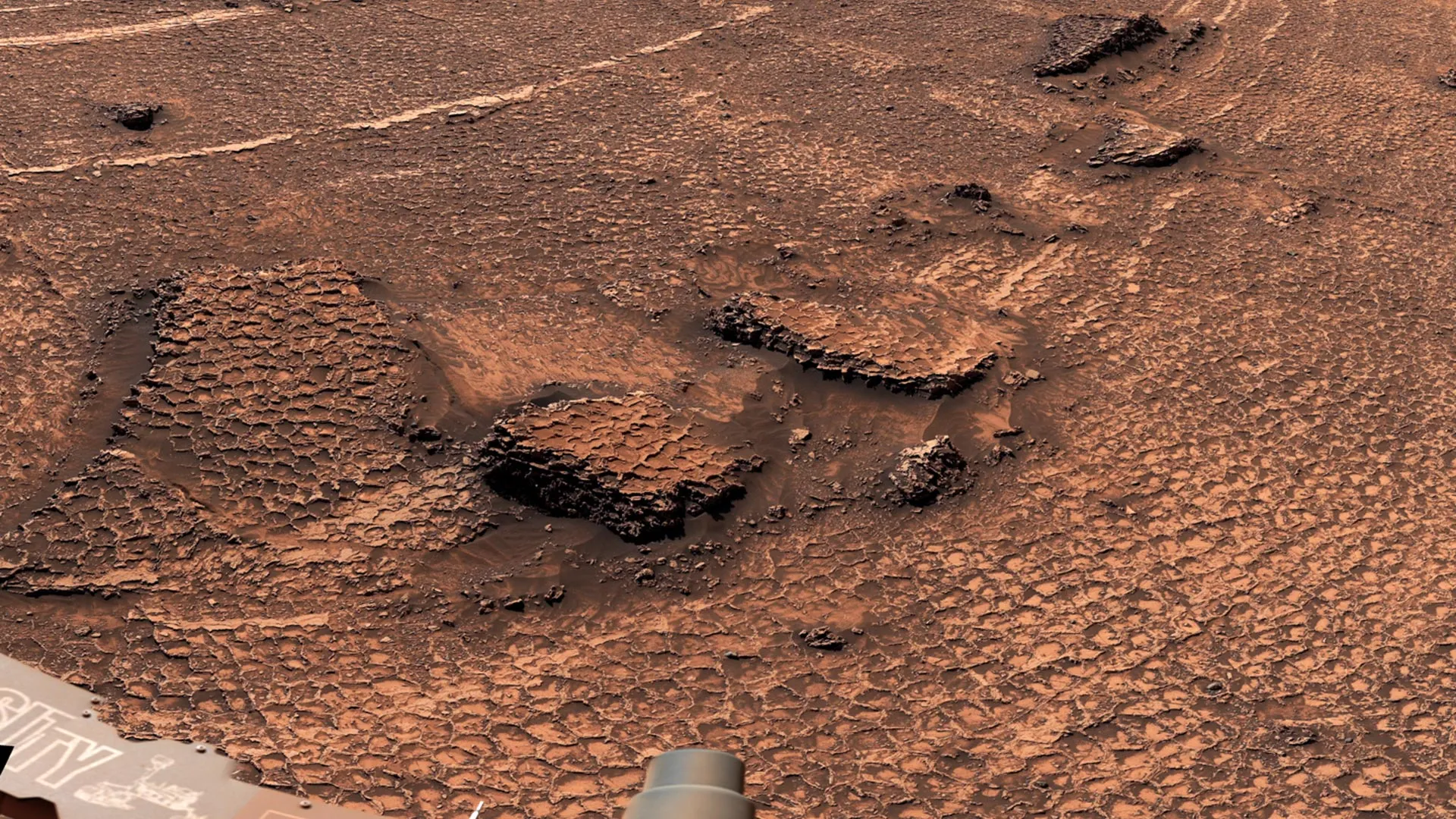
NASA's Curiosity rover has discovered an extensive honeycomb-patterned landscape in a Martian valley, revealing tiny polygon-shaped fractures that blanket the terrain. Each fracture measures only a few inches wide, yet collectively they span a vast area and even wrap around a nearby 20-foot-tall butte, creating what scientists describe as a "sea" of geometric formations.
The honeycomb patterns likely formed through thermal contraction and expansion cycles in the Martian surface. On Mars, extreme temperature fluctuations between day and night, combined with seasonal variations, cause the ground to crack in predictable ways. As materials heat and cool repeatedly, stress builds along weaknesses in the rock and soil. The ground fractures in a pattern that minimizes energy, naturally producing the hexagonal and polygonal shapes observed throughout the valley.
Similar polygon formations appear across Mars and other planetary bodies. On Earth, comparable honeycomb patterns form in dried mud, salt flats, and volcanic basalt fields. Scientists study these formations to understand subsurface composition and the planet's geological history.
The Curiosity rover, which has been exploring Mars since 2012, continues to map Gale Crater and document landscape features that provide clues about the planet's climate and habitability. The rover's cameras and instruments allow researchers to examine rock formations, analyze soil composition, and track seasonal changes across the Martian surface.
This discovery adds to the growing catalog of unusual Martian terrain features. The honeycomb landscape demonstrates how planetary-scale processes shape Mars differently than Earth, despite similar underlying physics. Understanding these patterns helps scientists interpret rover data and plan future exploration missions. The formations themselves pose no hazard to Curiosity's continued operations in the valley.