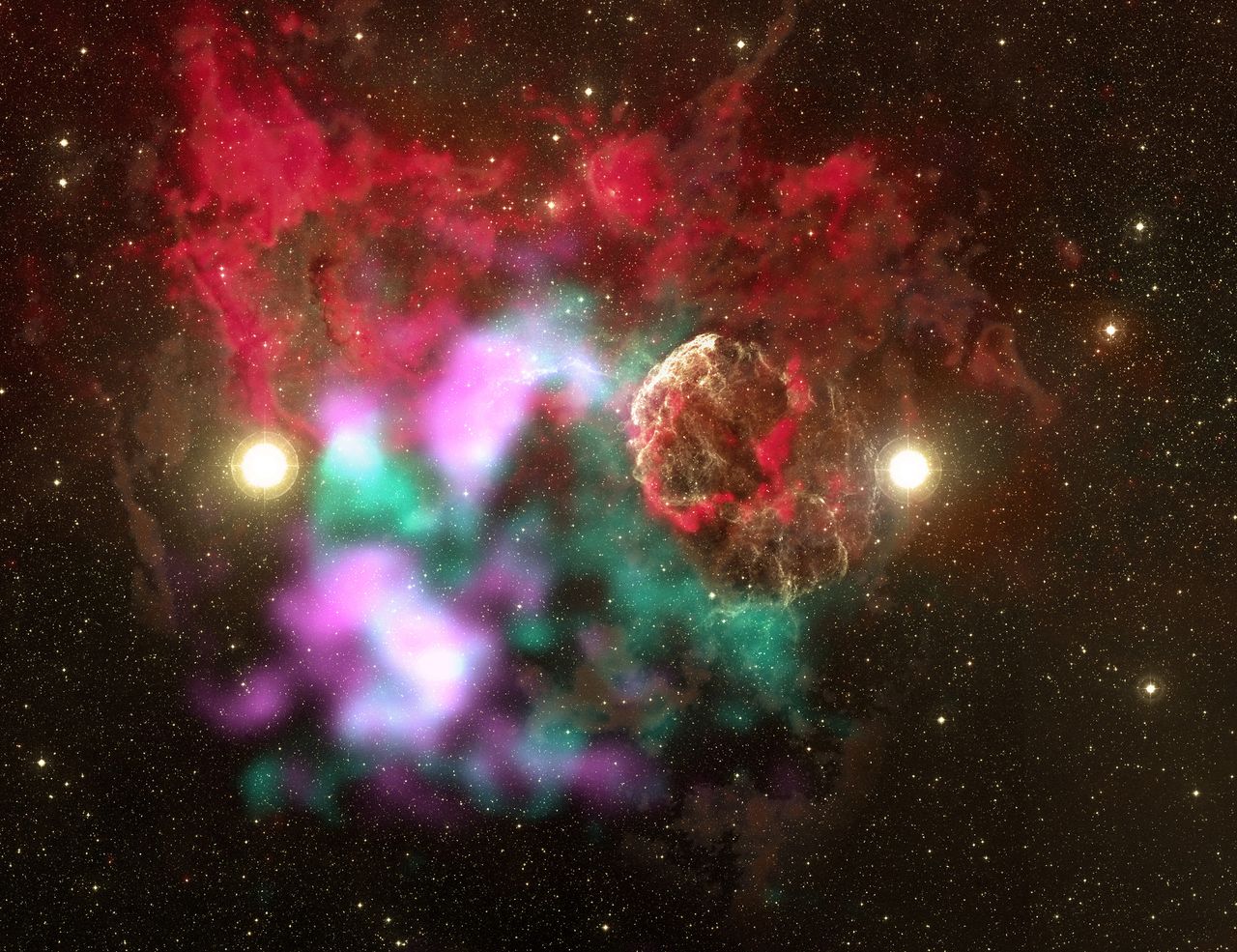
Astronomers have detected two supernova remnants originating from a binary star system, marking the first confirmed observation of sibling supernovas from orbiting stars. One remnant sits adjacent to the Jellyfish Nebula (IC 443), a well-known supernova remnant located roughly 5,000 light-years from Earth in the constellation Gemini.
The discovery reveals that both explosions came from stars gravitationally bound in a binary pair. Before detonating as supernovas, these stars orbited their common center of mass. This finding provides direct evidence for a theoretical scenario astronomers predicted but had never conclusively documented.
The research team identified the second supernova remnant through careful analysis of its proximity and physical characteristics relative to IC 443. The positioning and expansion rates of both remnants align with models predicting how companion stars would explode in succession or nearly simultaneously after their orbital dynamics shifted during the aging process.
Binary star systems can produce sequential supernovas through multiple pathways. In some cases, mass transfer between stars destabilizes their evolution. A white dwarf companion might accumulate material from an expanding red giant partner, eventually triggering thermonuclear explosion. Later, the companion star exhausts its fuel and explodes independently as a core-collapse supernova. The remnants in this system appear to follow this evolutionary sequence.
Understanding binary supernova systems expands astronomers' knowledge of stellar endpoints and the dynamics of close binary star pairs. These observations refine models for predicting how massive stars evolve and explode, information applicable to distant galaxies where individual binary systems remain unresolved.
The Jellyfish Nebula itself originated roughly 35,000 years ago, placing both explosions within the same cosmic epoch. Studying the second remnant allows researchers to measure the ejected material composition, expansion velocity, and energy release