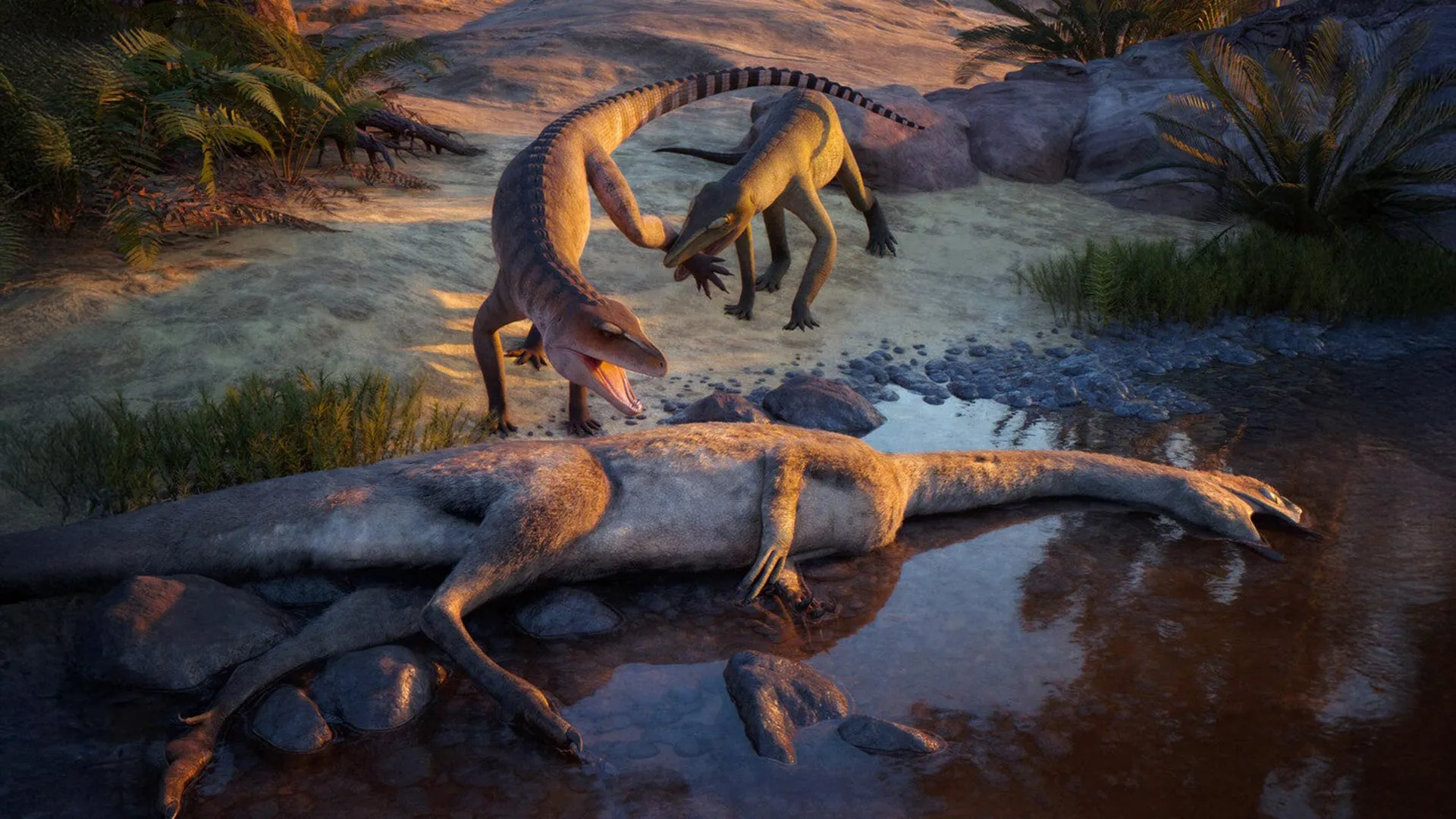
Researchers have identified a previously unknown predator from the early Triassic using a fossil that sat unstudied in museum collections for nearly 80 years. The creature, named Eosphorosuchus lacrimosa, lived 210 million years ago in present-day New Mexico and represents a distinct lineage of crocodile relatives adapted for hunting larger animals.
The fossil specimen reveals a jackal-sized predator with anatomical features suited to tackling prey much bigger than itself. The animal possessed a reinforced skull capable of withstanding tremendous forces, powerful jaw muscles concentrated at the back of its mouth, and a shortened snout optimized for powerful bite delivery rather than speed. This architecture differs markedly from modern crocodilians, which rely on long snouts and crushing force from jaw closure.
Eosphorosuchus lacrimosa inhabited the Triassic landscape alongside massive predatory reptiles and early dinosaurs. Its specialized hunting adaptations suggest it occupied a distinct ecological niche, targeting large prey through ambush and powerful bite force rather than the pursuit strategies employed by many modern predators. The discovery expands understanding of predatory diversity during a critical period of reptilian evolution.
The fossil's long neglect in museum collections highlights gaps in paleontological research. Many specimens collected during earlier field seasons remained undescribed and unstudied, buried in institutional archives. Modern scanning technology and renewed examination of legacy specimens continue yielding discoveries that reshape understanding of ancient ecosystems.
The identification of Eosphorosuchus lacrimosa demonstrates that the early Triassic contained greater predatory diversity than previously recognized. This period followed the devastating Permian extinction event and preceded the rise of dinosaurs. Understanding how different predatory lineages exploited available ecological opportunities during this transitional era clarifies how modern ecosystems assembled over millions of years.