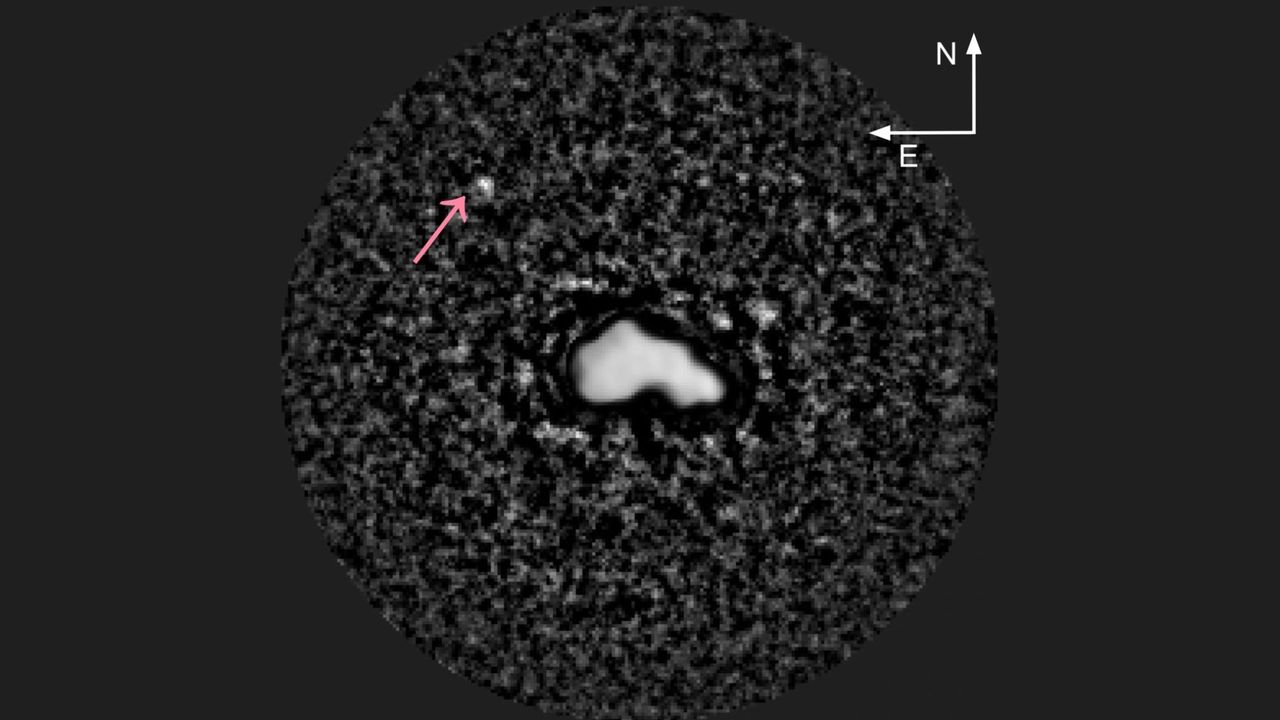
Astronomers using high-contrast imaging have discovered that asteroid 44 Nysa possesses an unexpected architecture: three distinct lobes and a small moon orbiting nearby. This marks the first known three-lobed asteroid in our solar system.
The discovery relies on advanced imaging techniques that suppress overwhelming starlight to reveal faint details of distant objects. Researchers observed the asteroid's complex shape with unprecedented clarity, revealing it is not a simple spherical body but rather an irregular, triple-lobed structure. The companion moon, previously undetected, orbits the asteroid system.
44 Nysa, located in the asteroid belt between Mars and Jupiter, ranks among the larger main-belt asteroids. The three-lobed morphology suggests the asteroid may have formed through collisions and gravitational interactions, or represents the merger of multiple smaller bodies. Such contact binary asteroids, formed when two objects orbit closely and eventually touch, are known. A three-lobed system is far rarer.
The moon's presence complicates the picture further. Binary and multiple asteroid systems are common in the belt, but the combination of three major lobes plus a satellite adds complexity to understanding how such systems assemble and evolve. The discovery provides astronomers fresh data about asteroid formation and dynamical processes in the inner solar system.
High-contrast imaging, similar to techniques used for directly imaging exoplanets, blocks the star's light to reveal dim nearby objects. This method requires sophisticated optics and often ground-based telescopes equipped with coronagraphs or comparable instruments.
The finding opens new questions about whether other large asteroids hide similar multi-lobed structures waiting for detection. Future observations using advanced telescopes like the James Webb Space Telescope may reveal additional hidden asteroid architectures. The discovery reminds researchers that asteroids, often treated as simple spheres in older models, display remarkable diversity and complexity that reshapes our understanding of