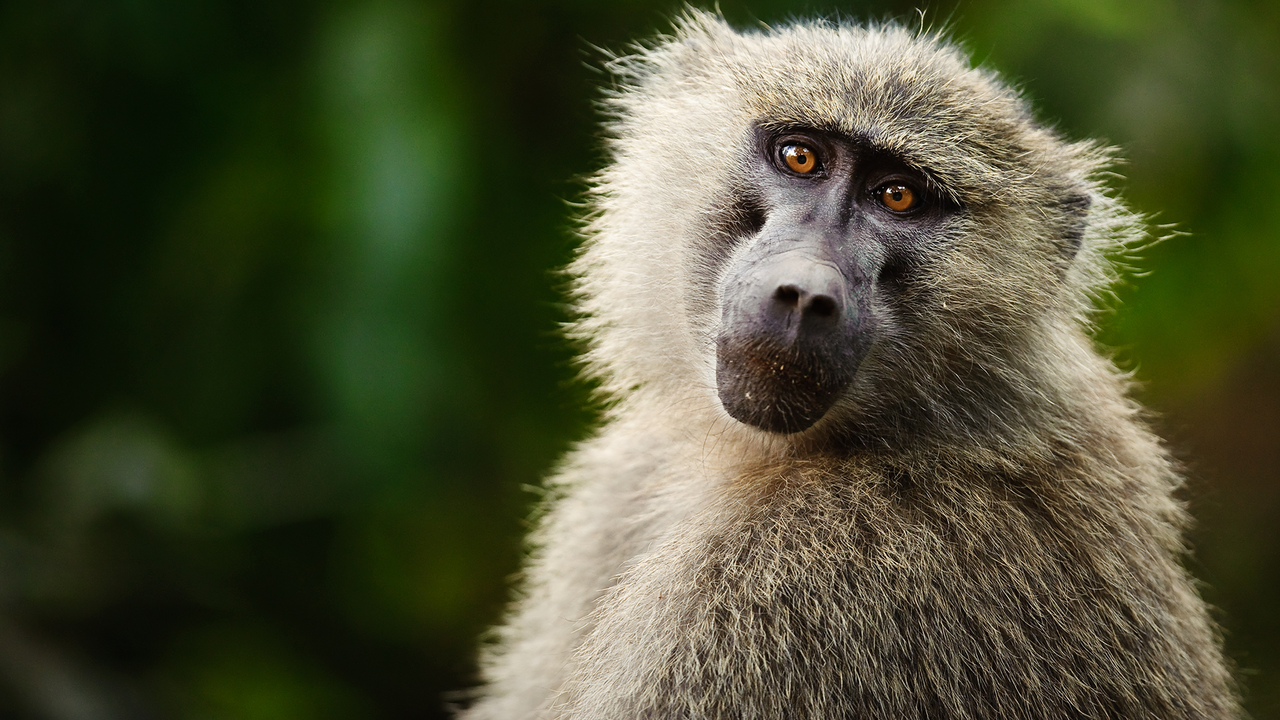
Researchers have discovered that baboons and macaques employ geometric reasoning strategies similar to humans when matching shapes, pointing to an evolutionary origin for basic geometric intuition in our primate ancestors.
Scientists tested baboons and macaques on shape-matching tasks where the animals had to identify which geometric forms corresponded to one another. The results revealed that both species used mental approaches that paralleled human geometric thinking, including strategies for recognizing angles, proportions, and spatial relationships.
The study suggests these geometric abilities did not emerge exclusively in humans but instead trace back to a common primate ancestor that possessed foundational spatial reasoning. This shared capacity likely provided evolutionary advantages for navigating complex environments, identifying threats, and locating food sources.
The research builds on growing evidence that various cognitive skills humans often consider uniquely our own actually have deep evolutionary roots. Previous work has shown non-human primates possess numerical abilities, tool-use reasoning, and social intelligence. Geometric intuition appears to represent another domain where primates share overlapping neural machinery.
The findings carry implications for understanding how the human brain developed its mathematical capacities. Rather than geometry being a recent cultural invention, the study indicates humans inherited basic geometric principles from our evolutionary past. Children's early geometric understanding may reflect these ancient primate competencies surfacing during development.
The work also illuminates how different primate species solve practical problems in nature. Spatial reasoning helps baboons and macaques navigate three-dimensional forest environments, judge distances for leaping between branches, and assess social positioning within groups.
However, researchers note important limitations. The tasks tested basic shape matching, not the abstract geometric theorems humans develop through formal education. The gap between intuitive geometric sense and sophisticated mathematical reasoning remains vast. Human geometry relies on symbolic representation, logical proof systems, and accumulated cultural knowledge that non-human primates do not possess.
The study underscores that evolution builds new capacities upon existing foundations